
Hire a Drone Light Show in Tampa
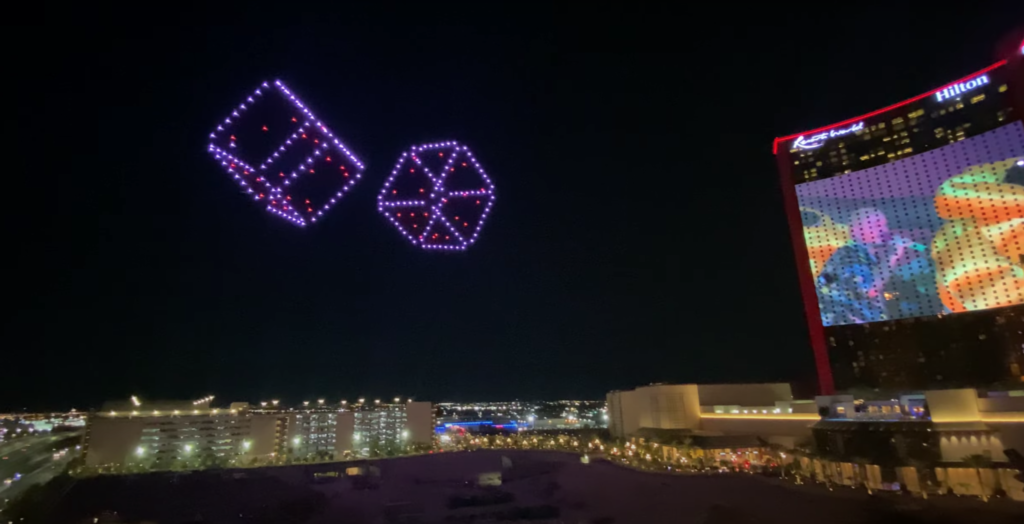
Tampa Bay gives a drone show water on three sides, a walkable downtown waterfront and a stadium district that fills for major events. Hire UAV Pro brings 50 to 5,000 drones to the bay area with FAA-certified pilots, $10 million in insurance and travel built into the quote.
1,000+
Shows flown
$10M
Insured
50–5,000
Drones per show
Flying Florida
We produce shows across Florida, including a 500-drone show in the Miami Design District for a Formula 1 race weekend and a 400-drone show in Sunrise on our Damoda V4 system. Tampa sits inside the same operating footprint, and our crews travel with the fleet.
Where Tampa drone shows fly
The Riverwalk and downtown waterfront give the best public sightlines, with the bay behind the fleet. Channelside and the port area handle larger crowds. Ybor City suits festival and nightlife events, the stadium and arena precinct works for seated audiences, and bayfront parks across St Petersburg and Clearwater open up the wider market.
Season and afternoon storms
Winter and spring are peak, when the weather is settled and the visitor season is strongest. Summer brings daily convective storms that typically clear by evening, and hurricane season from June to November means a backup window on every booking. Sea breeze can also shift wind direction quickly near the water, which we plan for.
Tampa airspace
Tampa International sits west of downtown and MacDill Air Force Base occupies the peninsula to the south, so airspace over parts of the bay is restricted. It is very workable, but venue choice matters more here than in most cities. Tell us the site first and we will confirm what can fly there.
Waterfront shows
Water is the single best thing that can happen to a drone show. The crowd stands on shore, the fleet flies over open water at a safe distance, reflections double the visual impact, and separation from spectators is straightforward. Tampa has more usable waterfront than almost any city we fly, which is why bayfront sites are usually our first recommendation here.
What every Tampa show includes
Custom show design previewed in 3D before approval, the drone fleet sized to your audience, FAA Part 107 certified pilots and ground crew, airspace authorization and FAA coordination, $10 million insurance with certificates issued to your venue, site survey and crowd separation planning, music synchronization, and full production and teardown. Travel is built into the quote — no surprise mobilization fees.
Drone Light Shows for Tampa Bay Sports and Stadium Events
Tampa Bay supports the Buccaneers, the Lightning and the Rays, three clubs with overlapping seasons and a shared regional audience reaching from Tampa across to St. Petersburg. If you are producing a season kickoff, a sponsor night, a fan fest or a championship rally, an aerial display gives you a centerpiece that works outdoors in Florida heat with no ground-level fire source at all. We staff shows at fleet counts from seventy drones up past three hundred, sized to the venue and to the imagery a client wants rendered overhead.
Florida’s dry season brings brush fire caution and local burn limits, and a show that produces no spark, no ember and no fallout sidesteps that whole discussion. Nothing lands on turf, on palms or on a parking deck. Afternoon storms are the real variable here, so launch windows get scheduled with that pattern in mind, often settling near nine o’clock. We staff with Part 107 certified operators, insure at ten million dollars for aviation liability, and have flown north of a thousand displays. Send details through the contact form.
Tampa’s Best Show Sites Need No Airspace Authorization — and Its Stadium Is Zero
Tampa has the sharpest airspace contrast of any city we have measured, and it works in your favour if you know about it and against you if you do not.
We queried the FAA’s UAS Facility Map feature service directly at the coordinates of each venue below.
Downtown’s premier waterfront sites return no grid cell at all
Curtis Hixon Waterfront Park: no grid cell. Amalie Arena and the Water Street district: no grid cell. Busch Gardens Tampa: no grid cell. The MIDFLORIDA Credit Union Amphitheatre at the Florida State Fairgrounds: no grid cell. Coachman Park and The Sound in Clearwater: no grid cell.
No UAS Facility Map cell means uncontrolled surface airspace — no FAA airspace authorization is required for a Part 107 operation at or below 400 feet AGL.
So the most prestigious civic event space in Tampa, the arena district, the city’s largest amphitheatre, the fairgrounds and Clearwater’s new waterfront park all have nothing on the critical path but the venue and the crew.
That is a better position than almost any comparable American city. For context, nearly a quarter of the mapped grid over New York City is zero-ceiling, almost half of Newark’s is, San Diego’s entire grid caps at 200 feet, and 899 of LAX’s 969 cells are zero.
And four miles away, Raymond James Stadium is zero
Raymond James Stadium sits at a zero-foot ceiling under Tampa International Class B. So does Steinbrenner Field.
A zero-foot grid ceiling means no automated LAANC authorization at all. The operation requires the FAA’s manual further-coordination process, which runs on roughly a 90-day timeline rather than a near-real-time one.
That is the contrast that should drive every Tampa venue conversation: Curtis Hixon needs no authorization whatsoever, and the Buccaneers’ stadium four miles away needs a ninety-day federal process. Anyone who quotes you a six-week turnaround on a Raymond James show has not queried the grid.
A zero-ceiling site is not impossible. It is a long-lead project, and the lead time is the thing to establish in the first conversation rather than in week eleven.
Across the bay
Tropicana Field in St. Petersburg: 300 feet under Albert Whitted Class D, LAANC-enabled. Vinoy Park, St. Petersburg: 300 feet, same facility.
Three hundred feet is three quarters of the vertical canvas — a real constraint but a workable one, and we would choreograph to it rather than pretend it is not there. Content that reads at 400 feet from a given audience distance needs rethinking at 300.
Stadium restrictions
A standing FAA restriction covers stadiums with a seating capacity of 30,000 or more during regular and postseason MLB, NFL and NCAA Division I football, plus major races — a three nautical mile radius, surface up to and including 3,000 feet AGL, from one hour before the scheduled start until one hour after the end. It restricts all aircraft operations, unmanned included.
In the Tampa Bay area that reaches Raymond James Stadium during the NFL season and its bowl-game slate, and Tropicana Field during the MLB season.
The restriction is event-triggered, not permanent — a show on a non-event date is unaffected, and a post-game show has to address the window explicitly rather than assume it has lapsed, which is the most common planning error at venues this size. We verify your date against the FAA’s own Sporting Event Automated Monitoring System feed rather than reading a published schedule.
At Raymond James, though, the zero-foot grid ceiling is the far larger constraint — it binds every day of the year, not just on game days.
Gasparilla Is the Best Unclaimed Drone Show Opportunity in Florida
We have looked at a lot of American event calendars for this work, and this is the single best-matched opportunity we have found anywhere.
The event
The Gasparilla Parade of Pirates runs on the last Saturday in January — most recently 31 January 2026, next on 30 January 2027. It draws roughly 300,000 people, with about 100,000 at the Children’s Parade a week earlier and a record near 750,000 in 2001.
The route runs about four and a half miles north along Bayshore Boulevard and has ended since 2011 at Curtis Hixon Waterfront Park on the Tampa Riverwalk, “where festivities continue into the evening.”
Why it fits so well
Four things line up, and they rarely all do.
The venue needs no airspace authorization. Curtis Hixon Waterfront Park returns no UAS Facility Map grid cell. The parade already terminates there, in the evening, with a crowd in place.
There is already a fireworks display to substitute for or build on. A fireworks show runs over Tampa Bay on Children’s Parade day. That is a direct, identified substitution target rather than a speculative pitch.
The date sits in Florida’s second-best weather window. Late January is dry, hurricane season is long closed, and wind is still below the March and April peak. Gasparilla season runs from roughly the start of the year to mid-March — comfortably ahead of the spring wind maximum.
And late January is entirely outside sea turtle nesting season. Which matters even here: Pinellas County’s nesting period runs 1 May to 31 October, so a Gulf-beach-visible show at Clearwater is closed for six months of the year. January is open.
The structure we would propose
Gasparilla is not one event, it is a season: the Children’s Parade, the Invasion, the Parade of Pirates, the Gasparilla Music Festival, the Gasparilla Film Festival, the Sant’ Yago Illuminated Knight Parade in Ybor City two weeks later, and the Outbound Voyage in March.
A multi-night programme across that season amortises fleet, crew, content and travel in a way a single evening never can, and the content can change between events — a pirate-themed show for the Invasion reads differently from one for the Music Festival. That is a fundamentally stronger proposition than a holiday one-off, and it is the structure the biggest Florida drone shows already use.
And a note on the rest of the Tampa calendar
Two other things worth knowing. The Florida State Fairgrounds and the MIDFLORIDA Amphitheatre sit in uncontrolled airspace with no grid cell, which makes a multi-night fair run straightforward. And the Hillsborough County Fairgrounds has already run a 100-drone 4 July show at 9:00 p.m. with free admission and paid parking — so the county has already bought this once, at a modest fleet size, and that is a useful reference point for any local committee weighing the budget.
The Questions Tampa Producers Actually Ask
Do we need FAA authorization for a show at Curtis Hixon?
No. Curtis Hixon Waterfront Park returns no UAS Facility Map grid cell — uncontrolled surface airspace, so no FAA airspace authorization is required for a Part 107 operation at or below 400 feet AGL. The same is true of Amalie Arena and the Water Street district, Busch Gardens, the MIDFLORIDA Amphitheatre at the Florida State Fairgrounds, and Coachman Park in Clearwater.
That is a better airspace position than almost any comparable American city. For scale: nearly a quarter of the mapped grid over New York City is zero-ceiling, almost half of Newark’s is, San Diego’s whole grid caps at 200 feet, and 899 of LAX’s 969 cells are zero.
So can we do a show at Raymond James Stadium?
Yes, with ninety days. Raymond James Stadium sits at a zero-foot ceiling under Tampa International Class B, as does Steinbrenner Field. A zero-foot grid ceiling means no automated LAANC authorization at all — the operation needs the FAA’s manual further-coordination process on roughly a 90-day timeline.
That contrast is the thing to take away: Curtis Hixon needs no authorization whatsoever and the Buccaneers’ stadium four miles away needs a ninety-day federal process. It is a long-lead project rather than an impossible one, and anyone quoting you a six-week turnaround there has not checked the grid.
What about Tropicana Field or St. Pete?
Tropicana Field and Vinoy Park both sit at 300 feet under Albert Whitted Class D, LAANC-enabled. Three hundred feet is three quarters of the vertical canvas — a genuine constraint but a workable one. Content that reads at 400 feet from a given audience distance needs rethinking at 300, and we would choreograph to it rather than pretend otherwise.
Can we do a post-game show at Raymond James or the Trop?
Outside the restriction window, yes. The standing restriction covers stadiums seating 30,000 or more during NFL, MLB and NCAA Division I football — three nautical miles, surface to 3,000 feet AGL, from an hour before the scheduled start to an hour after the end. It is event-triggered, not permanent, and we verify your date against the FAA’s own Sporting Event Automated Monitoring System feed rather than a published schedule.
At Raymond James, though, the zero-foot grid ceiling is the larger constraint — it binds every day of the year, not just on game days.
When should we schedule?
Late October through early December is the strongest window in Florida — rainfall has collapsed to about 2.34 inches in Tampa in October, hurricane season closes 30 November, and wind sits at 6.7 to 7.0 mph, still below the spring peak. February is a reasonable second window, dry but with wind already climbing.
Here is the counterintuitive part. Tampa’s calmest months are July and August, at 5.8 and 5.6 mph mean wind. The windiest are March at 7.9 mph and April at 7.8. That pattern holds at every Florida station without exception.
But July and August are the worst months of the year for convection, lightning and rainfall, and they sit inside hurricane season. So the calmest-wind months are the least reliable show months. Wind is not what cancels a Tampa show in July — a thunderstorm cell is.
March and April are the single worst wind period of the year, which is awkward commercially because that is when spring break and spring training demand arrives.
Is lightning a real risk for our date?
It is the Florida risk, and Tampa specifically shows up in the data. Florida leads the United States in lightning density statewide and at county level — in the 2025 Vaisala annual report, Polk County, just east of Tampa, recorded the most total lightning events of any US county at over 1.05 million, and Seminole County near Orlando was the highest-density county in the entire country.
The datapoint most useful for planning: in 2025, football stadiums in Miami, Tampa and Tallahassee logged some of the highest numbers of hours in the country meeting NFL game-suspension criteria. That is a third-party measure of exactly the risk your show window faces, at the exact venues you might be pitching.
Tampa Bay convection is driven by the East Coast and West Coast sea breezes converging, concentrated June through September in the afternoon and evening. We build weather holds into the run of show rather than treating them as a failure mode, and we would rather talk you toward November or late January than take a July date and hope.
Do the sea turtle rules affect us?
They depend entirely on whether your show is visible from an ocean or Gulf beach, and the distinction matters a great deal in this market.
The State Model Sea Turtle Lighting Ordinance provides that “lighting associated with a special event that may directly, indirectly, or cumulatively be visible from any portion of the beach shall not be authorized at nighttime during sea turtle nesting season.” A drone light show is lighting associated with a special event. Pinellas County’s nesting period runs 1 May to 31 October, and local ordinances can be stricter than the county floor.
So a Clearwater Beach or Gulf-beach-visible show is closed for six months of the year, including 4 July.
Curtis Hixon, Amalie Arena and Water Street are bay-facing rather than ocean beach, and the fairgrounds and Busch Gardens are inland — so the constraint does not reach them in the same way. We verify the specific position with the municipality rather than asserting it, because the ordinance language turns on visibility from the beach and that is a local judgement.
One honest caveat: we could not confirm whether any Florida municipality has authorised a beach-visible drone show during nesting season, or whether inspectors treat an elevated, upward-facing LED array differently from fixed beachfront lighting. There is a plausible technical argument, and it has to be won with the local Beach Lighting Inspector rather than asserted on a web page. For a beach-visible date inside nesting season we would make that call on your behalf before quoting.
Will the heat and humidity hurt the show?
Measurably, and here is the arithmetic. Running the National Weather Service density altitude formula at Florida sea-level pressure:
A January or February evening at 70°F computes to 975 feet density altitude — about 2.8% thrust loss at constant RPM. A July evening around 8 p.m. at 88°F with a 77°F dewpoint computes to 2,265 feet — about 6.5% thrust loss and 6.9% more hover current. A July mid-afternoon reaches 2,705 feet, and an extreme heat event 3,034.
So Florida at sea level routinely flies at a 2,300 to 3,000-foot density altitude on a summer evening, which is a real constraint on payload headroom, hover endurance, climb rate and the reserve available for gust rejection.
Isn’t the humidity the main culprit?
No, and we would rather give you the numbers than the slogan. Of the roughly 2,700 feet of density altitude at a 95°F Florida afternoon with a 78°F dewpoint, about 410 feet — some 15% — is humidity. The other 85% is temperature.
Holding temperature at 85°F and sweeping dewpoint across the full realistic Florida range, 55°F to 82°F, moves density altitude from 1,866 to 2,152 feet — a span of just 286 feet. Humidity sits in a stable 270-to-440-foot band in all realistic conditions. It is a consistent offset, not a wildcard.
The fix is the calendar. A February Tampa evening and a July afternoon are roughly 1,700 feet of density altitude apart, which is about four percentage points of thrust margin — and that difference shows up in gust tolerance on the night, which is the number that actually decides whether a show launches.
How does that compare with your Colorado shows?
Honestly, in Tampa’s favour. We are based in Arvada at roughly 5,300 feet. A Florida summer evening at around 2,300 feet density altitude is still materially denser air than a Colorado winter morning. The accurate statement is “Florida summer flies at about 2,300 to 2,700 feet density altitude,” not “Florida is as hard as Colorado.” It is not, and we would rather say so than inflate our own difficulty.
What should we look at besides 4 July?
Gasparilla — and we think it is the best unclaimed drone show opportunity in Florida.
The Parade of Pirates runs the last Saturday in January, drawing roughly 300,000 people, with about 100,000 at the Children’s Parade a week earlier. Since 2011 it has ended at Curtis Hixon Waterfront Park, in the evening, with the crowd already in place — and Curtis Hixon needs no airspace authorization at all. There is already a fireworks display over Tampa Bay on Children’s Parade day, so there is a direct substitution or augmentation target rather than a speculative pitch. Late January is dry, outside hurricane season, ahead of the spring wind peak, and entirely outside sea turtle nesting season.
Gasparilla is also a season rather than a date — the Children’s Parade, the Invasion, the Parade of Pirates, the Music Festival, the Film Festival, the Sant’ Yago Illuminated Knight Parade and the Outbound Voyage in March. A multi-night programme across that season amortises fleet, crew, content and travel in a way one evening never can, and the content can change between events.
How many drones do we need?
It depends on viewing distance, the ceiling at your site, and what you want the audience to read. Florida reference points: Disney Springs flew 800, Universal 600, Legoland 500, Ocala 300-plus — and the Hillsborough County Fairgrounds carried a 4 July show on 100.
So your own county has already bought this once at a modest fleet size, which is a useful anchor for a budget conversation. More drones means more resolution in the imagery rather than simply more lights, and we size to the geometry rather than to a package tier.
Should we replace our fireworks or add drones to them?
All three models are working within an hour’s drive, so we will build whichever fits. Universal put 600 drones inside an existing show alongside fountains, pyrotechnics and projection mapping. Legoland’s 500-drone show includes fireworks. Disney Springs ran 800 drones with no fireworks at all. Ocala and Hillsborough County replaced outright.
One honest counterpoint worth knowing: a drone show proposal was rejected in Fort Lauderdale for 4 July. Municipal politics is a real gate, and the technology winning on the merits does not mean it wins a council vote. We would rather help you build the case than pretend that part is easy.
Why hire a Colorado company for a Tampa show?
Because what you are buying is the analysis on this page plus the aircraft and crew to execute it. That Curtis Hixon, Water Street, Busch Gardens and the fairgrounds all sit outside any grid while Raymond James Stadium is zero-ceiling four miles away; that Tropicana Field is 300 feet; that your calmest wind months are your least reliable show months; that Polk County next door logs more lightning events than any county in America; that a Gulf-beach-visible show is closed from 1 May to 31 October while Curtis Hixon is not; that Gasparilla ends at an unrestricted waterfront park in the evening with an existing fireworks display to replace — that is work done because it decides whether a show flies and on which date. We fly nationally, we carry $10 million in drone aviation liability, and we would rather tell you a venue or a date is wrong in the first conversation than in week eleven.
Tampa drone show FAQ
Can you fly over Tampa Bay?
Yes, with the right authorizations, and it usually produces the best result for a large crowd.
How much does a Tampa drone show cost?
Fleet size drives the price, then animation, travel and duration. Exact pricing within 24 hours — see the cost guide.
When is the best time of year?
Winter and spring are easiest. Summer works with a backup window for storms.
Do you cover St Petersburg and Clearwater?
Yes, and the wider bay area.
Drone shows near Tampa
We fly across the region. Nearby: Orlando · Miami · Jacksonville. See Florida drone light shows for everything we have flown statewide, or explore drone show rental and corporate drone shows and events.
Book a Tampa drone show
Tell us your date, venue and audience and we will send a custom concept and exact pricing within 24 hours.
More Drone Light Shows in Florida
We fly across Florida. See all Florida drone light shows, or a nearby city or venue:
Tampa · Florida Gators · University Of Miami · Amelia Island · Bayfront Park · Clearwater Beach · Clearwater · Daytona Beach · Fort Lauderdale · Jacksonville · Jacksonville · Key West
Book a Tampa drone show
Tell us your date, venue and audience and we will send a custom concept and exact pricing within 24 hours.
Read more about our company and the two drone fleets we fly in Tampa.