
Miami Drone Light Shows
Picture the moment when night falls over Biscayne Bay and 500 glowing drones rise in perfect formation above the Miami skyline. Art Deco architecture frames the scene—pastel buildings and neon-lit streets creating a stage for something genuinely modern. Drone light shows in Miami aren’t just visual spectacles; they’re conversations between technology and culture, unfolding above water that’s caught the attention of everyone from Fortune 500 companies to cultural institutions. Whether your event sits on a rooftop in Wynwood, along the bay in Bayside, or out at a resort beachfront, synchronized drone formations deliver impact that stays with people long after the music stops.
For a full breakdown of everything drone light shows, visit our comprehensive drone light show guide page
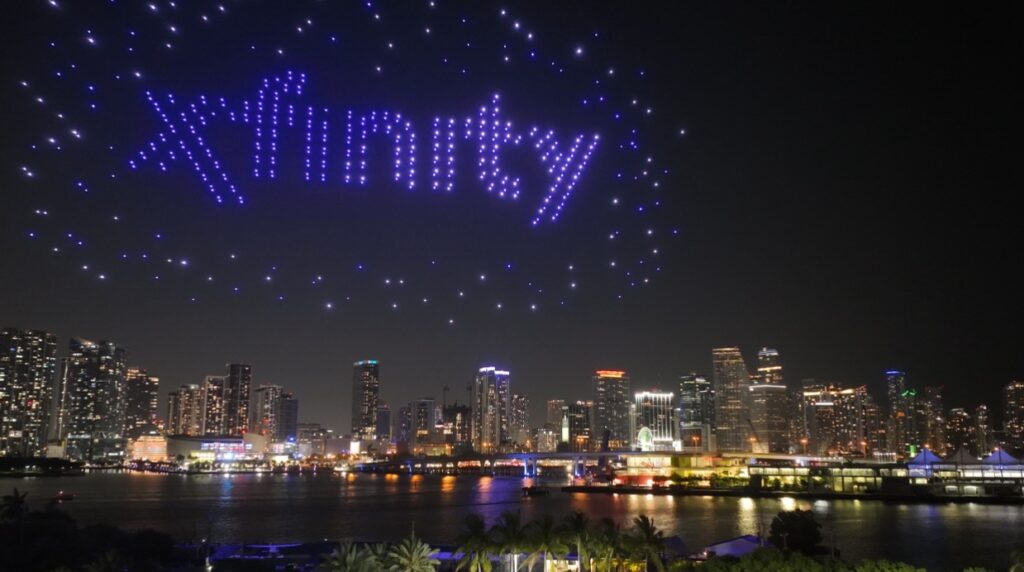
Drone Shows for Miami Game Days and Waterfront Stadium Events
South Florida gives a producer four leagues and a backdrop most markets cannot match. The Dolphins play north of the city in Miami Gardens, the Heat hold the basketball calendar on Biscayne Bay, the Marlins run baseball in Little Havana, the Florida Panthers skate up in Sunrise, and Inter Miami carries soccer in Fort Lauderdale. Formations read cleanly against open water and a flat skyline, which is why sponsor activations, international friendlies, season launches and championship celebrations here keep moving toward aerial programming rather than away from it.
Along the coast, a spark free show removes the debris conversation entirely. Nothing drops into a marina, nothing scorches a freshly resodded pitch, and nothing has to be swept out of a parking structure afterward. Certification under FAA Part 107 covers our pilots, ten million dollars in aviation liability covers the work, more than one thousand shows sit in the log, and fleets range between seventy and three hundred or more drones. Tell us what you are planning by way of the contact form.
More Drone Light Shows in Florida
We fly across Florida. See all Florida drone light shows, or a nearby city or venue:
Naples · Orlando · Orlando · The Pier District · St. Augustine · Tampa · Tampa · Florida Gators · University Of Miami · Amelia Island · Bayfront Park · Clearwater Beach
Miami Airspace, Measured Site by Site
Miami’s airspace is better than its reputation, and the surprises in it are specific. We queried the FAA’s UAS Facility Map feature service directly at the coordinates of each venue below.
Downtown flies at the full 400 feet — inside Class B
Bayfront Park: 400 feet. Museum Park and the Kaseya Center: 400 feet. Pitbull Stadium at FIU: 400 feet. All under Miami International Class B, all LAANC-enabled — so the authorization processes in near real time rather than through a federal queue.
That is a genuinely good position for a major Class B metro, and it means the two best civic waterfront sites in the city have full show altitude available through an app.
For context on how unusual that is: 899 of LAX’s 969 cells are zero-foot, with only two cells anywhere in the Los Angeles grid reaching 200 feet. San Diego’s entire grid caps at 200. Raymond James Stadium in Tampa is zero. Miami’s downtown is better placed than any of them.
Miami Beach returns no grid cell at all
Lummus Park and the Ocean Drive corridor on Miami Beach return no UAS Facility Map grid cell — uncontrolled surface airspace, so no FAA airspace authorization is required for a Part 107 operation at or below 400 feet AGL.
On airspace alone that is one of the easiest marquee venues in Florida. The constraint there is not the FAA. It is sea turtle lighting, and it is severe — see below.
Hard Rock Stadium is not in Miami Class B
This one is commonly gotten wrong. Hard Rock Stadium in Miami Gardens sits at a 300-foot ceiling under North Perry Class D — not under Miami International Class B.
Three hundred feet is three quarters of the vertical canvas, LAANC-available, and workable. But an operator quoting you an MIA authorization for Hard Rock has not checked the coordinates, and that matters because Hard Rock carries the densest event calendar in the state: the Orange Bowl, the Miami Open, Rolling Loud, Dolphins home games and 2026 FIFA World Cup matches.
The rest of the market
loanDepot Park: 200 feet under Miami Class B, LAANC-enabled — half the canvas, a real constraint on content that has to read at distance.
Fort Lauderdale Beach Park: 400 feet under Fort Lauderdale Class C, LAANC-enabled.
Homestead-Miami Speedway: 100 feet under Homestead Class D. A hundred-foot cap is severe and it is the kind of thing that only shows up if someone queries the actual point.
Grid cells are roughly one nautical mile across, so ceilings change block to block. Everything above is a retrieved value at a specific coordinate, not a neighbourhood average — and we check your actual launch point and full flight envelope rather than the venue centroid.
Stadium restrictions
A standing FAA restriction covers stadiums with a seating capacity of 30,000 or more during regular and postseason MLB, NFL and NCAA Division I football, plus NASCAR Cup, IndyCar and Champ Series races — a three nautical mile radius, surface up to and including 3,000 feet AGL, from one hour before the scheduled start until one hour after the end. It restricts all aircraft operations, unmanned included.
In South Florida that reaches Hard Rock Stadium during Dolphins games and the Orange Bowl, loanDepot Park during the MLB season, and the Miami International Autodrome during the Grand Prix under the motorsport clause.
The restriction is event-triggered, not permanent. A show at Hard Rock on a non-event date is unaffected. A show timed to an actual game has to address the window explicitly, and a post-game show needs the window addressed rather than assumed to have lapsed — the most common planning error at venues this size. We verify your date against the FAA’s own Sporting Event Automated Monitoring System feed rather than reading a published schedule.
Sea Turtle Lighting Is the Real Constraint in South Florida
This is the most important thing on this page, it is the least well understood rule in the Florida events business, and in Miami it is stricter than the state baseline.
What the rule actually says
Florida Statute §161.163 directs the Department of Environmental Protection to adopt guidelines for local beachfront lighting regulation to protect hatching sea turtles. The rule adopted under it is Rule 62B-55.004, F.A.C. — the State of Florida Model Sea Turtle Lighting Ordinance, effective 17 December 2020.
The clause that governs your event reads, verbatim:
“Lighting associated with a special event that may directly, indirectly, or cumulatively be visible from any portion of the beach shall not be authorized at nighttime during sea turtle nesting season.“
Read plainly, a drone light show is lighting associated with a special event. Where a municipality has adopted the state model, a nighttime show visible from any portion of the beach — directly, indirectly, or cumulatively — is not authorizable during nesting season.
The ordinance defines “indirectly visible” as light reflected from glowing elements that can be seen by an observer standing anywhere on the beach, which is a broad test. It also prohibits motorised vehicles on the beach at nighttime during nesting season, which hits ground transport of equipment to a beach launch site, and restricts handheld and temporary lighting.
The dates, and why Miami is worse than the state floor
Under the state model, Miami-Dade County’s nesting period runs 1 May to 31 October.
But Miami Beach’s own Turtle Nesting Protection ordinance uses 1 April to 31 October — a full month longer than the state guidance for its county. Adopted in 2006 and amended in October 2024, it covers artificial lights visible from the beach, sets interior lighting standards for hotels and commercial properties, limits fireworks to barges, and expressly “codifies special event requirements to protect sea turtles.”
That last phrase is the one to notice. Miami Beach has specifically written special events into its turtle protection framework.
And north of the county line it is stricter still. Broward, Palm Beach, Martin, St. Lucie, Indian River and Brevard run 1 March to 31 October — eight months — because leatherbacks nest earlier on that stretch of the Atlantic coast. So a Fort Lauderdale beach show faces a longer closed season than a Miami Beach one, and both are longer than the state default.
Hollywood has its own Chapter 108 lighting requirements for marine turtle protection. Always check the specific municipality: the county date is the floor, not the answer.
What that removes
Six to eight months of the year at any beach-visible venue in South Florida — and the excluded window includes 4 July, the single largest demand date in this business.
So a beach-visible show in Miami Beach is effectively a November-to-March product, and on the Broward and Palm Beach coast a November-to-February product.
Which Miami venues this changes, and which it does not
This is where the airspace analysis and the wildlife analysis have to be read together, because they point in opposite directions.
Miami Beach has the best airspace in the market — no grid cell at all — and the worst seasonal constraint: 1 April to 31 October closed.
Bayfront Park and Museum Park are at the full 400 feet and are not ocean-beach-facing. Whether a given show there is “visible from any portion of the beach” is a local judgement rather than a line on a map, and we verify it with the municipality rather than asserting it — but a downtown bayfront site is a fundamentally different proposition from Ocean Drive.
Hard Rock Stadium, loanDepot Park, Pitbull Stadium and Homestead-Miami Speedway are all inland. The turtle constraint does not reach them.
So the honest planning answer for South Florida is: the inland and downtown venues are the year-round business, and the beach is a winter product. Anyone who pitches you a 4 July show on Miami Beach has not read the ordinance.
The open question, stated honestly
We could not confirm whether any Florida municipality has issued a special-event authorization for a beach-visible drone show during nesting season, or whether local inspectors treat an elevated, upward-facing LED array differently from fixed beachfront lighting.
There is a plausible technical argument. The model ordinance defines “long wavelength” as light at or above 560 nanometres with no shorter wavelengths — amber, orange and red — and a show whose emitters sit above the audience and point upward is arguably a different thing from a floodlit beachfront. A palette restricted to the long-wavelength band is a real design option.
But that argument has to be won with the local Beach Lighting Inspector, not asserted on a web page, and we will not tell you it is settled when it is not. For a beach-visible South Florida show inside nesting season, we would make that call to the municipality on your behalf before quoting a date — and we would tell you honestly what the answer was.
The Questions Miami Producers Actually Ask
Can we fly at 400 feet in downtown Miami? It’s Class B.
Yes. Bayfront Park, Museum Park and the Kaseya Center all sit at a 400-foot ceiling under Miami International Class B, LAANC-enabled — so the authorization processes in near real time. Pitbull Stadium at FIU is also 400 feet.
That is better than most big Class B metros. 899 of LAX’s 969 cells are zero-foot, San Diego’s entire grid caps at 200, and Raymond James Stadium in Tampa is zero. Downtown Miami is well placed.
What about Miami Beach?
The best airspace and the worst calendar in the market, which is an awkward combination.
Lummus Park and the Ocean Drive corridor return no UAS Facility Map grid cell at all — uncontrolled surface airspace, no FAA authorization required at or below 400 feet AGL.
But Miami Beach’s Turtle Nesting Protection ordinance runs 1 April to 31 October, a month longer than the state guidance for Miami-Dade, and it expressly “codifies special event requirements to protect sea turtles.” The State Model Ordinance provides that “lighting associated with a special event that may directly, indirectly, or cumulatively be visible from any portion of the beach shall not be authorized at nighttime during sea turtle nesting season.”
A drone show is lighting associated with a special event. So Miami Beach is effectively a November-to-March product. Anyone pitching you a 4 July show on Ocean Drive has not read the ordinance.
Is Hard Rock Stadium in Miami Class B?
No, and this is the most commonly gotten-wrong fact in the market. Hard Rock Stadium sits at a 300-foot ceiling under North Perry Class D, not under Miami International. Three hundred feet is three quarters of the canvas, LAANC-available and workable — but an operator quoting you an MIA authorization there has not checked the coordinates.
That matters because Hard Rock carries the densest event calendar in the state: the Orange Bowl, the Miami Open, Rolling Loud, Dolphins home games and 2026 FIFA World Cup matches.
Which other venues should we know about?
loanDepot Park: 200 feet under Miami Class B — half the canvas, a real constraint on content that has to read at distance. Fort Lauderdale Beach Park: 400 feet under Fort Lauderdale Class C. Homestead-Miami Speedway: 100 feet under Homestead Class D, which is severe and is exactly the kind of thing that only shows up if someone queries the point.
Grid cells are roughly one nautical mile across, so ceilings change block to block. We check your actual launch point and full flight envelope, not the venue centroid.
Can we do a post-game show at Hard Rock?
Yes, outside the restriction window. The standing restriction covers stadiums seating 30,000 or more during NFL, MLB, NCAA Division I football and major races — three nautical miles, surface to 3,000 feet AGL, from an hour before the scheduled start to an hour after the end.
It is event-triggered, not permanent. A show on a non-event date is unaffected. A post-game show must address the window explicitly rather than assume it has lapsed. We verify your date against the FAA’s own Sporting Event Automated Monitoring System feed rather than a published schedule. Regionally the restriction also reaches loanDepot Park in the MLB season and the Miami International Autodrome during the Grand Prix.
How bad is the sea turtle constraint, exactly?
In South Florida it is the binding constraint on any beach-visible show, and the dates vary by jurisdiction in a way that catches people out.
Miami-Dade under the state model: 1 May to 31 October. Miami Beach’s own ordinance: 1 April to 31 October. Broward, Palm Beach, Martin, St. Lucie, Indian River and Brevard: 1 March to 31 October — eight months, because leatherbacks nest earlier on that coast. Hollywood has its own Chapter 108 lighting requirements.
So a Fort Lauderdale beach show faces a longer closed season than a Miami Beach one, and both are longer than the state default. The county date is the floor, not the answer — always check the specific municipality.
The ordinance also prohibits motorised vehicles on the beach at nighttime during nesting season, which hits ground transport of equipment to a beach launch site.
Could we get an exception?
Possibly, and we will not pretend to know. We could not confirm whether any Florida municipality has authorised a beach-visible drone show during nesting season, or whether inspectors treat an elevated, upward-facing LED array differently from fixed beachfront lighting.
There is a real technical argument to make. The ordinance defines “long wavelength” as light at or above 560 nanometres with no shorter wavelengths — amber, orange and red — and a palette restricted to that band, with emitters above the audience pointing upward, is arguably a different thing from a floodlit beachfront.
But that argument has to be won with the local Beach Lighting Inspector, not asserted on a web page. For a beach-visible date inside nesting season we would make the call to the municipality on your behalf before quoting, and tell you honestly what the answer was.
So where should we actually put the show?
If your date is in the April-to-October window, inland or downtown: Bayfront Park or Museum Park at 400 feet, Hard Rock at 300, Pitbull Stadium at 400, loanDepot at 200. Whether a downtown bayfront show counts as “visible from the beach” is a local judgement rather than a line on a map, and we verify it rather than assume it — but a bayfront site is a fundamentally different proposition from Ocean Drive.
If your date is November to March, Miami Beach is open and it has the best airspace in the market.
When should we schedule?
Late October through early December is the strongest window in Florida — rainfall has collapsed, hurricane season closes 30 November, wind sits below the spring peak, and on the coast the turtle season has just ended. The weather window and the wildlife window align, which is a rare and useful coincidence.
February is a reasonable second window.
Two Miami-specific cautions. Miami is the windiest of Florida’s major metros — 8.4 mph annual mean against Tampa’s 6.8, Orlando’s 7.7 and Jacksonville’s 6.7 — with March and April at 9.7 mph, the windiest months of the year. And while Miami’s calmest months are July and August at 7.1 and 7.2 mph, those are the worst months for convection, lightning and rainfall and sit inside hurricane season. The calmest-wind months are the least reliable show months.
Is lightning a real risk?
It is the Florida risk. Florida leads the United States in lightning density statewide and at county level, and the most useful planning datapoint is this: in 2025, football stadiums in Miami, Tampa and Tallahassee logged some of the highest numbers of hours in the country meeting NFL game-suspension criteria.
That is a third-party measure of exactly the risk your show window faces, at the exact venue you might be pitching. We build weather holds into the run of show rather than treating them as a failure mode.
Will the heat and humidity hurt the show?
Measurably, and Miami has the hardest numbers of the Florida cities because its nights stay warm. Miami’s July and August minimum temperatures average 77.5 to 77.7°F, which means overnight dewpoints stay in the mid-to-high seventies — so the evening cooling that helps Orlando and Jacksonville arrives less here.
Running the National Weather Service density altitude formula at Florida sea-level pressure: a January or February evening at 70°F computes to 975 feet density altitude, about 2.8% thrust loss. A July evening around 8 p.m. at 88°F with a 77°F dewpoint computes to 2,265 feet — about 6.5% thrust loss and 6.9% more hover current. A July mid-afternoon reaches 2,705 feet and an extreme heat event 3,034.
So Miami at sea level routinely flies at a 2,300 to 3,000-foot density altitude on a summer evening, which is a real constraint on payload, endurance, climb rate and gust-rejection reserve.
Isn’t the humidity the main culprit?
No, and we would rather give you the arithmetic than the slogan. Of the roughly 2,700 feet of density altitude at a 95°F afternoon with a 78°F dewpoint, about 410 feet — some 15% — is humidity. The other 85% is temperature.
Holding temperature at 85°F and sweeping dewpoint across the full realistic Florida range, 55°F to 82°F, moves density altitude from 1,866 to 2,152 feet — a span of just 286 feet. Humidity sits in a stable 270-to-440-foot band in every realistic condition. It is a consistent offset, not a wildcard.
The fix is the calendar, not the dehumidifier. A February Miami evening and a July afternoon are roughly 1,700 feet apart — about four percentage points of thrust margin, which shows up directly in gust tolerance on the night.
How does that compare with your Colorado shows?
Honestly, in Miami’s favour. We are based in Arvada at roughly 5,300 feet. A Florida summer evening at around 2,300 feet density altitude is still materially denser air than a Colorado winter morning. The accurate statement is “Florida summer flies at about 2,300 to 2,700 feet density altitude,” not “Florida is as hard as Colorado.” It is not, and we would rather say so than inflate our own difficulty.
How many drones do we need?
It depends on viewing distance, the ceiling at your site, and what you want the audience to read. Florida reference points: Disney Springs flew 800, Universal 600, Legoland 500, Ocala 300-plus, and the Hillsborough County Fairgrounds carried a 4 July show on 100.
More drones means more resolution in the imagery rather than simply more lights — and at Homestead’s 100-foot ceiling or loanDepot’s 200 the right number is different from a 400-foot venue. We size to the geometry and the ceiling.
Should we replace our fireworks or add drones to them?
All three models are working in Florida and we will build whichever fits. Universal Orlando put 600 drones inside an existing show alongside fountains, pyrotechnics and projection mapping. Legoland’s 500-drone show includes fireworks. Disney Springs ran 800 drones with no fireworks at all. Ocala and Hillsborough County replaced outright.
One honest counterpoint specific to your market: a drone show proposal was rejected in Fort Lauderdale for 4 July. Municipal politics is a real gate in South Florida, and the technology winning on the merits does not mean it wins a council vote. We would rather help you build the case than pretend that part is easy — and the sea turtle argument is a strong one to build it on, since a drone show is the option that does not put debris in the water or barges on the beach.
Why hire a Colorado company for a Miami show?
Because what you are buying is the analysis on this page plus the aircraft and crew to execute it. That Bayfront and Museum Park are at the full 400 feet inside Class B while Homestead is 100; that Hard Rock is governed by North Perry and not Miami International; that Miami Beach has no grid cell and an April-to-October closed season while Broward’s runs from March; that Miami is the windiest major metro in Florida and its calmest months are its least reliable; that the humidity term is 15% of the density altitude and temperature is the other 85% — that is work done because it decides whether a show flies and on which date. We fly nationally, we carry $10 million in drone aviation liability, and we would rather tell you a venue or a date is wrong in the first conversation than in week eleven.
Why Miami is Perfect for Drone Shows
Miami’s geography is built for aerial entertainment. You have clear sightlines across Biscayne Bay, controlled airspace around downtown, and venues ranging from intimate rooftop events to sprawling beachfront properties. The year-round warm weather means outdoor events are always on the calendar—corporate galas, product launches, luxury resort celebrations, and festival activations all happen in Miami. The city’s skyline, water backdrop, and diverse event venues create natural stages. We’ve flown shows for Miami’s hospitality sector and corporate events where the water became part of the show design itself—drones reflecting off bay surfaces, patterns that play against the downtown grid.
Wind conditions here are generally favorable for drone operations, especially during the cooler fall and winter months when events tend to concentrate. Permits and coordination with Miami’s regulatory framework are straightforward when you work with operators who understand the airspace. The city’s international character means events often have elevated production standards—choreography needs to be sharp, timing exact, coordination seamless. That’s exactly what we deliver.
Event Types That Work in Miami
Corporate Launches & Product Reveals: Tech companies, hospitality brands, and luxury retailers use drone shows to create memorable moments at product launches. Synchronized light patterns build anticipation, reveal product colors or logos, and generate social media content that spreads far beyond the live audience. A 300-500 drone show runs 12-16 minutes and can integrate seamlessly with live music, emcees, or broadcast.
Resort & Hotel Celebrations: Miami’s resort market is substantial. New Year’s Eve galas, milestone anniversaries, and celebrity events often include aerial elements. The water backdrop—whether bay, pool, or beachfront—creates natural composition for drone choreography. We’ve worked with resort properties where the drone show became the centerpiece of evening entertainment.
Cultural & Festival Events: Music festivals, cultural celebrations, and public events in Miami benefit from drone visibility. A show can be custom choreographed to music genres or cultural themes—Latin music animations, contemporary music syncs, or geometric patterns that complement stage design.
Real Estate & Development: Property developers and luxury real estate firms use drone shows to mark significant moments—groundbreakings, grand openings, or significant milestones. The aerial perspective highlights development scale and location benefits.
Pricing for Miami Drone Shows
We offer shows ranging from 100 to 5,000 drones, with pricing starting as low as $8,500. The final cost depends on drone count, animation complexity, location, and timing. Our team will put together a transparent, all-inclusive quote based on your event’s specific needs.
800+ Drones: Custom quote (large-scale productions, multiple launches, extended show runtime)
Pricing includes design, choreography, crew logistics, and technical coordination. For events in venues near Biscayne Bay or waterfront areas, we factor in maritime coordination and safety protocols. Timeline matters—shows designed with 4-6 weeks lead time run efficiently; expedited shows carry additional design fees.
How We Work With You
Step 1: Discovery & Planning — We start by understanding your event: What’s the occasion? Who’s your audience? What message do you want the drones to convey? Are there brand colors, logos, or themes to work with? What’s your venue, expected guest count, and preferred timing? This conversation shapes everything that follows.
Step 2: Choreography & Design — Our team builds custom animations from scratch. We work in-house using proprietary software that lets us test formations, timing, and transitions in real time. You’ll see previews before any drones launch. Revisions are built into the process—if you want adjustments to timing, patterns, or complexity, we make them.
Step 3: Technical Coordination — We handle airspace coordination, FAA compliance (we hold Part 107 certifications and multi-UAS waivers), permitting, and safety logistics. Our team scouts venues to understand wind conditions, sight lines, and operational constraints. We coordinate with your event production team on timing, music syncing, and go-live procedures.
Step 4: Rehearsal & Execution — We conduct full technical rehearsals before show day. Our pilots, visual observers, and technical crew coordinate with your event team on timing, audio systems, and contingency plans. On the day of your event, we execute the show with precision—from launch through flight to safe recovery.
Our Fleet: Two Systems Built for Every Event
We operate two professional drone platforms, giving you the flexibility to match your event’s scale and budget.
The Kaiken is our lightweight, durable, and cost-effective system — built for events that want professional quality at an accessible price point. It’s reliable, proven, and delivers clean formations and vivid color across the night sky.
The Damoda V4 is our premium platform — powerful, bright at 2,200+ lumens RGBW, and equipped with cutting-edge safety features including parachute recovery, GPS-fenced flight boundaries, automatic return-to-home, and fail-safe landing. The Damoda V4 also comes with a free second launch the same night, giving your audience up to 20 minutes of aerial entertainment across two performances.
Both systems are operated by FAA Part 107 certified pilots under multi-UAS and night operations waivers, backed by $10 million in aviation and umbrella insurance.
Let’s Build Your Miami Drone Show
Drone light shows in Miami work because they’re grounded in real event production—they’re not gimmicks, they’re choreographed performances that strengthen your event’s impact. Whether you’re planning a corporate milestone, resort celebration, or public-facing event, we bring the expertise to make it happen safely and memorably.
Ready to get started? Book a drone show and our team will put together a custom proposal within 48 hours.
Read more about our company and the two drone fleets we fly in Miami.