
Hire a Drone Light Show in Orlando
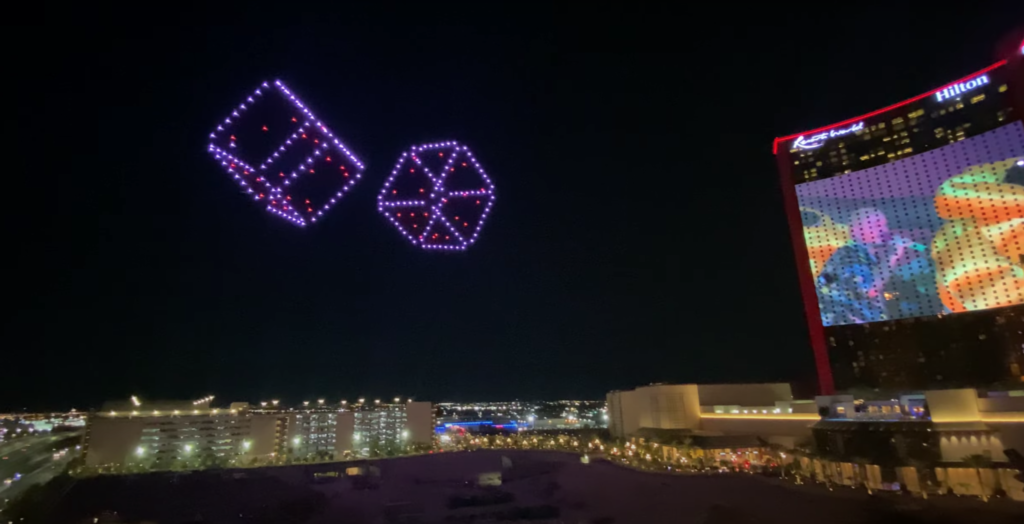
Orlando is the biggest convention market in the country, and it is one of the few cities where we are asked for indoor drone experiences as often as outdoor shows. Hire UAV Pro delivers both — drone light shows over resorts and parks, and drone cages inside exhibition halls and ballrooms.
1,000+
Shows flown
$10M
Insured
50–5,000
Drones per show
A show we have delivered in Orlando
We ran an indoor drone cage experience at a resort convention venue in Orlando — an enclosed flight area where attendees fly drones themselves, staffed by our crew. For conference organizers it solves the problem an outdoor show cannot: an attraction that runs all day on the exhibition floor rather than for ten minutes after dark.
Where Orlando drone shows fly
Resort properties and convention campuses dominate the market, and most have the open ground a launch zone needs. Lake Eola and the downtown parks work for civic and community events. Corporate campuses suit private company celebrations, and venues outside the tourist corridor give cleaner airspace and darker skies for larger public shows.
Year-round season and storms
Orlando works all year, with winter and spring busiest for conventions and corporate groups. Summer afternoons bring near-daily thunderstorms that usually clear before showtime, but every booking carries a backup window. Hurricane season runs June through November and we watch the forecast closely in the week before any show in that period.
Orlando airspace
Orlando International sits south-east of the city with Sanford to the north-east and Executive close to downtown, and there are permanent flight restrictions over the major theme parks that cannot be flown. That last point matters: some venues in this market are simply not available, and we will tell you that early rather than after you have planned around it.
Indoor drone experiences
For conferences and trade shows, a drone cage turns floor space into a queue. We design, test and build the enclosure to your hall dimensions, run it with our own staff, and can brand the cage for a sponsor. Formats range from professional demonstrations for industry audiences to games, races and prize competitions. Ask about adding virtual reality and robotics. See corporate drone shows and events.
What every Orlando show includes
Custom show design previewed in 3D before approval, the drone fleet sized to your audience, FAA Part 107 certified pilots and ground crew, airspace authorization and FAA coordination, $10 million insurance with certificates issued to your venue, site survey and crowd separation planning, music synchronization, and full production and teardown. Travel is built into the quote — no surprise mobilization fees.
Orlando Sports and Stadium Drone Show Production
Orlando’s professional anchors are the Magic and Orlando City SC, alongside the Orlando Pride, and the city’s stadiums also host bowl games, international friendlies and large touring events through much of the year. That mix suits activation agencies and venue marketers looking for something a crowd will photograph. HireUAVPro builds aerial light shows for season openers, supporters’ events, halftime and postmatch moments, and rally nights, with fleet counts starting at seventy and climbing past three hundred when a client wants full logo animation instead of a simple shape sequence.
Central Florida spends part of every year under dry conditions, and a display generating no spark, no shell fragments and no falling material avoids the risk calculus that pyro brings to landscaped grounds and an artificial pitch. Cleanup amounts to packing aircraft back into their cases. Part 107 certification for every pilot, ten million dollars of aviation liability behind the operation, and a record of more than a thousand shows. A ten thirty finish stays workable when a match runs long. Get in touch using the contact form.
The Disney TFR Does Not Cover Orlando
This is the most widely misunderstood fact in the Orlando events market, and getting it right opens up most of the city.
FDC NOTAM 4/3634 is a permanent standing restriction under 14 CFR §99.7, Special Security Instructions, with a statutory mandate behind it. Its operative language is unambiguous about drones:
“All aircraft flight operations, including unmanned and remote controlled aircraft, are prohibited within a 3 NMR of 282445N/0813420W… up to and including 3000FT AGL.”
So: a three nautical mile radius, surface to 3,000 feet AGL inclusive, permanent. The airspace inside is classified National Defense Airspace, and the NOTAM states that the United States government may use deadly force against an airborne aircraft determined to pose an imminent security threat.
That is real, and it is also small. We computed the distance from the NOTAM’s own centre coordinate to every landmark a producer is likely to name.
What is actually inside it
Magic Kingdom castle — 0.61 NM: inside. EPCOT — 2.57 NM: inside. Four Seasons Orlando at Golden Oak — 0.53 NM: inside. Plus the Seven Seas Lagoon resorts.
That is essentially the list.
What is outside it
Disney Springs — 3.80 NM. Universal Studios Orlando — 6.65 NM. SeaWorld Orlando — 5.84 NM. International Drive — 5.68 NM. The Orange County Convention Center — 5.51 NM. ESPN Wide World of Sports — 4.74 NM. Gaylord Palms in Kissimmee — 5.87 NM. Celebration — 5.61 NM. Camping World Stadium — 11.70 NM. Downtown Orlando and Lake Eola — 13.17 NM.
Every one of those sits outside the restriction.
Two venues need care: Animal Kingdom at 3.37 NM and Hollywood Studios at 3.38 NM are outside by less than four tenths of a nautical mile. We would treat both as inside without a verified site survey, because a fleet with lateral spread at a marginal standoff is exactly how an operator ends up on the wrong side of a national-defence boundary.
The proof that this is right
Disney’s own 800-drone show, “Disney Dreams That Soar,” flew nightly at Disney Springs — twice nightly at 9:00 p.m. and 10:45 p.m., ten minutes, from Memorial Day weekend 2024 through 2 September 2024. Disney Springs sits at 3.80 NM, outside the TFR. The 300-drone Intel “Starbright Holidays” ran at the same site in winter 2016.
If the TFR covered Orlando, Disney could not have flown 800 drones twice a night on its own property for three months.
There is also a waiver path inside the restriction: the NOTAM states that flights conducted for operational purposes of any Disney World event and venue are authorised with an approved waiver, applied for through the FAA’s waiver portal with TSA security authorization. That is a real route for a show tied to a Disney event, on a long timeline.
Why this matters commercially
Because an event producer who believes “you can’t fly drones near Disney” will not even ask about Universal, SeaWorld, the Convention Center, I-Drive, Kissimmee, Celebration, Camping World Stadium or downtown — and all of them are available.
We would rather hand you the distances than the reputation.
Orlando Airspace, Measured Site by Site
We queried the FAA’s UAS Facility Map feature service directly at the coordinates of each venue below. Grid cells are roughly one nautical mile, so ceilings change block to block — these are the actual retrieved values, not estimates.
The theme-park corridor is among the easiest airspace in Florida
SeaWorld Orlando: no grid cell. Universal Orlando and the International Drive corridor: no grid cell. Legoland Florida in Winter Haven: no grid cell.
No UAS Facility Map cell means uncontrolled surface airspace — no FAA airspace authorization required for a Part 107 operation at or below 400 feet AGL.
Gaylord Palms in Kissimmee sits at a 400-foot ceiling under Kissimmee Gateway Class D, LAANC-enabled, so where authorization is needed it processes in near real time.
That is a remarkable position for a tourism corridor of this density, and it is a large part of why Orlando has quietly become one of the most active drone show markets in the country.
The stadiums
Camping World Stadium: 400 feet under Orlando Executive Class D, LAANC-enabled. Inter&Co Stadium: 400 feet, same facility, LAANC-enabled. FBC Mortgage Stadium at UCF: no grid cell at all.
Three major stadium venues, two at full show altitude with app-based authorization and one in uncontrolled airspace. Again, an unusually good set.
The one downtown surprise
Lake Eola Park sits at a 100-foot ceiling.
Downtown Orlando’s signature park, the obvious instinct for a civic show, is capped at a quarter of the altitude available at Camping World Stadium four miles away.
A 100-foot cap is a severe choreographic constraint — it fundamentally changes what content can read at any audience distance. It is a workable show designed very differently, or a long-lead project seeking a higher authorization through the FAA’s manual further-coordination process on roughly a 90-day timeline. Either way, it is the thing to know before a date is promised, and anyone quoting a 400-foot show at Lake Eola has not queried the coordinates.
Stadium restrictions
A standing FAA restriction covers stadiums with a seating capacity of 30,000 or more during regular and postseason MLB, NFL and NCAA Division I football, plus major races — a three nautical mile radius, surface up to and including 3,000 feet AGL, from one hour before the scheduled start until one hour after the end. It restricts all aircraft operations, unmanned included.
In Orlando that reaches Camping World Stadium during its bowl-game slate — the Citrus Bowl, the Pop-Tarts Bowl and the Cure Bowl — and FBC Mortgage Stadium at UCF during NCAA Division I football, including the Hula Bowl.
The key point is that the restriction is event-triggered, not permanent. A show at Camping World Stadium on a non-event date is unaffected, and at a 400-foot LAANC ceiling that is one of the most straightforward large-venue drone show prospects in Florida. A show timed to an actual game has to address the window explicitly, and a post-game show needs the window addressed rather than assumed to have lapsed — the most common planning error at venues this size. We verify your date against the FAA’s own Sporting Event Automated Monitoring System feed rather than reading a published schedule.
Orlando Is Inland — and That Is Worth Six Months of the Year
This is the single biggest structural advantage Orlando has over every coastal market in Florida, and almost nobody frames it this way.
The sea turtle lighting constraint, and what it actually says
Florida Statute §161.163 directs the Department of Environmental Protection to adopt guidelines for local beachfront lighting regulation to protect hatching sea turtles. The rule adopted under it is Rule 62B-55.004, F.A.C. — the State of Florida Model Sea Turtle Lighting Ordinance, effective 17 December 2020.
The clause that matters most reads, verbatim:
“Lighting associated with a special event that may directly, indirectly, or cumulatively be visible from any portion of the beach shall not be authorized at nighttime during sea turtle nesting season.“
Read plainly, a drone light show is lighting associated with a special event. Where a municipality has adopted the state model, a nighttime show visible from any portion of the beach — directly, indirectly or cumulatively — is not authorizable during nesting season.
Nesting season runs 1 May to 31 October across most of Florida, and 1 March to 31 October on the Atlantic coast from Brevard south through Broward, where leatherbacks nest earlier. Local ordinances can be and are stricter — Miami Beach uses 1 April to 31 October, a month longer than the state guidance for its county.
The model ordinance also prohibits motorised vehicles on the beach at nighttime during nesting season, which hits ground transport of equipment to a beach launch site, and restricts handheld and temporary lighting.
What that removes from the coastal market
Six to eight months of the year at any beach-visible venue — and the excluded window includes 4 July, the single largest demand date in this business, on every Atlantic and Gulf beach in the state.
So beach-visible shows in Florida are effectively a November-to-February product on the southern Atlantic coast, and November-to-April on the Gulf and north Atlantic coasts.
Orlando has none of this
Orlando is inland. Lake Eola, Camping World Stadium, Inter&Co Stadium, the theme parks, the I-Drive corridor, the Convention Center, Gaylord Palms and Kissimmee are not beach-visible, so the sea turtle lighting constraint does not reach them.
That makes Orlando the year-round Florida drone show market while the coastal cities operate on a seasonal window. For a producer planning a 4 July show, a summer resident programme, a multi-night convention activation or a theme-park season, inland Central Florida is not just convenient — it is the part of the state where the calendar is actually open.
One honest caveat we would rather state than skip
We could not confirm whether any Florida municipality has issued a special-event authorization for a beach-visible drone show during nesting season, or whether local inspectors treat an elevated, upward-facing LED array differently from fixed beachfront lighting.
There is a plausible technical argument — the model ordinance defines “long wavelength” as light at or above 560 nanometres with no shorter wavelengths, meaning amber, orange and red, and a show whose emitters are above the audience could be characterised differently from a floodlit beachfront. But that argument has to be won with the local Beach Lighting Inspector, not asserted on a web page, and we will not tell you it is settled when it is not.
For a coastal Florida show inside nesting season we would make the call to the municipality on your behalf before quoting a date. For an Orlando show, the question does not arise.
When To Fly in Orlando — the Counterintuitive Answer
We computed and cross-checked this, and it inverts the obvious instinct.
The calmest months are the worst months
Florida Climate Center wind normals for Orlando, from a 37-year period of record:
The calmest months are July and August, both at 6.3 mph mean wind. The windiest are March at 9.0 mph and April at 8.7.
That pattern holds at every single Florida station without exception — July and August calmest, March and April windiest.
But July and August are also the worst months of the year for convection, lightning and rainfall, and they sit inside hurricane season. So in Florida the calmest-wind months are the least reliable show months. Wind is not what cancels a Florida show in July; a thunderstorm cell is.
The lightning context, stated precisely
Florida leads the United States in lightning density, statewide and at county level. In the 2025 Vaisala annual data, Seminole County — immediately north of Orlando — was the top county in the entire United States at 258 lightning events per square kilometre, and Polk County, just south-west, had the most total events of any US county at over 1.05 million.
The most useful datapoint for an event producer is this: in 2025, football stadiums in Miami, Tampa and Tallahassee logged some of the highest numbers of hours in the country meeting NFL game-suspension criteria. That is a third-party measure of exactly the risk your show window faces.
Central Florida convection is driven by the convergence of the East Coast and West Coast sea breezes, and it is an afternoon and evening phenomenon concentrated from June through September. We will not quote you a specific clock hour for peak initiation, because we could not confirm one from a primary source — but the shape of the risk is well established and it is the reason we build weather holds into a Florida run of show rather than treating them as a failure mode.
The window that actually works
Late October through early December is the strongest window in Florida. Rainfall has collapsed — Orlando’s October normal is 3.46 inches against the summer peak — hurricane season closes on 30 November, and wind is moderate and still well below the March and April peak.
February is a reasonable second window — dry, though wind is already climbing toward the spring maximum.
March and April are the single worst wind period of the year, which matters commercially because that is exactly when spring break and spring training demand arrives.
And here is the part worth noticing: for coastal Florida, that late-October-to-early-December window is also the period when the sea turtle nesting constraint lifts. The weather and the wildlife constraints align rather than conflict. Orlando, being inland, gets the good weather window without needing the wildlife window at all.
What Florida Heat Actually Costs — Computed, Not Estimated
Static rotor thrust at constant RPM is proportional to air density, so what governs aircraft performance is density altitude. We ran the National Weather Service formula at Florida sea-level station pressure. These are computations from the published equation, reproducible from it.
The numbers
| Conditions | Density altitude | Thrust loss at constant RPM | Hover current increase |
|—|—|—|—|
| Jan/Feb evening, 70°F / 62°F dewpoint | 975 ft | 2.8% | +2.9% |
| Mar/Apr evening, 78°F / 70°F | 1,559 ft | 4.5% | +4.7% |
| July evening around 8 p.m., 88°F / 77°F | 2,265 ft | 6.5% | +6.9% |
| July mid-afternoon, 95°F / 78°F | 2,705 ft | 7.7% | +8.3% |
| Extreme heat event, 100°F / 80°F | 3,034 ft | 8.6% | +9.4% |
The headline is that Florida at sea level routinely flies at a 2,300 to 3,000-foot density altitude on a summer evening. A city at the waterline operates with the air density of a high-desert morning, purely from heat and moisture.
That is a real constraint on payload headroom, hover endurance, climb rate and — the one that governs show reliability — the reserve available for gust rejection, because the same control authority has to come out of more motor output.
The honest version of the humidity story
You will hear that Florida humidity is what makes the air thin. It contributes, and it is not the main term, and we would rather give you the arithmetic than the slogan.
Of the roughly 2,700 feet of density altitude at a Florida 95°F afternoon with a 78°F dewpoint, about 410 feet — some 15% — is the humidity contribution. The remaining 85% is temperature.
Holding temperature at 85°F and moving dewpoint across the entire realistic Florida range, from 55°F to 82°F, shifts density altitude from 1,866 feet to 2,152 feet — a span of just 286 feet. Humidity’s contribution sits in a stable 270-to-440-foot band across every realistic Florida condition. It is a consistent offset, not a wildcard.
Temperature dominates, and the fix is the schedule. A July evening show at 2,265 feet against a July mid-afternoon at 2,705 recovers roughly 440 feet simply by flying when the show is actually scheduled — and a January evening at 975 feet is a different aircraft performance regime altogether from a July afternoon.
And the comparison that puts it in perspective
We are based in Arvada, Colorado at roughly 5,300 feet, so we would rather be straight about this than overstate it in our own favour.
A Florida summer evening at around 2,300 feet density altitude is still materially denser air than a Colorado winter morning. The correct statement is “Florida summer flies at about 2,300 to 2,700 feet density altitude,” not “Florida is as hard as Colorado.” It is not.
What it does mean is that a fleet and flight plan built for a February Orlando evening has about 4 percentage points more thrust margin than the same show in July — and that difference shows up in gust tolerance on the night, which is the number that actually decides whether a show launches.
Orlando Is Already One of the Busiest Drone Show Markets in America
This is not a market that needs persuading. It is a market with more confirmed large-scale drone show programming than almost anywhere in the country.
What has already flown here
Disney Springs — “Disney Dreams That Soar,” 800 drones a night. Debuted Memorial Day weekend 2024 and ran nightly through 2 September, twice each evening at 9:00 p.m. and 10:45 p.m., ten minutes, with no fireworks. Led by Disney’s vice president of live entertainment for Walt Disney World.
Universal Orlando — “CineSational: A Symphonic Spectacular,” 600 drones. The drones enter about six minutes into the show, integrated with fountains, fireworks and projection mapping.
Legoland Florida, Winter Haven — “Monster Skytacular,” 500 drones, part of the Brick-or-Treat Halloween event, including fireworks.
Gaylord Palms, Kissimmee — “Sounds of America: A Nighttime Spectacular” on select evenings on the Coquina Lawn.
Hillsborough County Fairgrounds ran a 100-drone 4 July show at 9:00 p.m. with free admission. The City of Ocala ran “The Patriotic Skies,” its first drone show, with 300-plus drones over fifteen minutes.
What that tells you about the airspace, not just the market
Look at where those shows fly. Disney Springs, Universal, Legoland and Busch Gardens all sit outside any UAS Facility Map grid, and Gaylord Palms is a 400-foot cell.
The biggest drone show venues in Florida are also among the easiest airspace in the state — and every one of them is outside the Disney TFR. That is not a coincidence; it is what happens when operators with the aircraft and the analysis choose sites properly.
The patterns worth copying
Three observations that transfer to any Orlando event.
Twice-nightly works. Disney ran 800 drones at 9:00 p.m. and again at 10:45. For a resort, a convention or a multi-day festival, two shows a night from one fleet and one crew changes the economics entirely, and it is the single most under-used structure in this business.
Integration beats replacement at the top end. Universal did not swap fireworks for drones — it put 600 drones inside an existing show alongside fountains, pyrotechnics and projection mapping, entering six minutes in. For an event with an established format and an audience that expects it, that is the lower-risk and often better answer.
Seasonal programmes, not single nights. Legoland’s drone show is part of a Halloween season; Disney’s ran for three months. A season amortises fleet, crew, content and travel across dozens of performances, and the content can evolve across the run. For any Orlando venue with a seasonal event — and most of them have one — that is a far stronger proposition than a holiday one-off.
And the honest counterpoint
A drone show proposal was rejected in Fort Lauderdale for 4 July. Municipal politics is a real gate, and the technology winning on the merits does not mean it wins in a council vote.
We also note that none of the theme-park sources name the drone operator. There are capable operators flying in Florida, and we would rather you compared proposals on substance than on a client list.
What we would ask you to compare is whether the proposal in front of you tells you the grid ceiling at your exact coordinates, your distance from the Disney TFR centre, the stadium restriction windows against your exact date, the sea turtle position if you are anywhere beach-visible, and the liability limit standing behind it. Everything on this page is the output of that work.
The Questions Orlando Producers Actually Ask
Can we fly drones near Disney at all?
Not inside the restriction, and the restriction is much smaller than its reputation. FDC NOTAM 4/3634 prohibits all aircraft including unmanned aircraft within a three nautical mile radius, surface to 3,000 feet AGL, permanently.
We computed the distances from the NOTAM’s own centre. Inside: Magic Kingdom at 0.61 NM, EPCOT at 2.57 NM, Golden Oak at 0.53 NM and the Seven Seas Lagoon resorts. Outside: Disney Springs at 3.80 NM, Universal at 6.65, SeaWorld at 5.84, I-Drive at 5.68, the Convention Center at 5.51, ESPN Wide World of Sports at 4.74, Gaylord Palms at 5.87, Camping World Stadium at 11.70, and downtown Orlando at 13.17.
Animal Kingdom at 3.37 NM and Hollywood Studios at 3.38 NM are outside by under four tenths of a nautical mile, and we would treat both as inside without a verified site survey.
There is also a waiver route: the NOTAM authorises flights conducted for operational purposes of a Disney World event or venue with an approved FAA waiver plus TSA security authorization. That is real, and it is a long timeline.
How do you know the TFR doesn’t block Orlando generally?
Because Disney itself flew 800 drones twice a night for three months at Disney Springs — “Disney Dreams That Soar,” Memorial Day weekend 2024 through 2 September, at 9:00 p.m. and 10:45 p.m. Disney Springs is 3.80 NM from the TFR centre. If the restriction covered Orlando, that show could not have happened.
Which Orlando venues have the best airspace?
An unusually good list. SeaWorld Orlando, Universal Orlando and the I-Drive corridor, Legoland Florida, and FBC Mortgage Stadium at UCF all return no UAS Facility Map grid cell — uncontrolled surface airspace, no FAA authorization required at or below 400 feet AGL.
Camping World Stadium and Inter&Co Stadium are both 400 feet under Orlando Executive Class D, LAANC-enabled. Gaylord Palms is 400 feet under Kissimmee Gateway Class D.
What about Lake Eola?
This is the Orlando surprise. Lake Eola Park sits at a 100-foot ceiling — a quarter of the altitude available at Camping World Stadium four miles away.
A 100-foot cap fundamentally changes what content can read at any audience distance. It is a workable show designed very differently, or a long-lead project seeking a higher authorization through the FAA’s manual further-coordination process on roughly a 90-day timeline. Either way it needs saying before a date is promised, and anyone quoting a 400-foot show at Lake Eola has not queried the coordinates.
Do the sea turtle rules affect us?
No, and this is Orlando’s biggest structural advantage over every coastal market in Florida.
The State Model Sea Turtle Lighting Ordinance says that “lighting associated with a special event that may directly, indirectly, or cumulatively be visible from any portion of the beach shall not be authorized at nighttime during sea turtle nesting season.” A drone light show is lighting associated with a special event. Nesting season runs 1 May to 31 October across most of the state and 1 March to 31 October from Brevard south through Broward — and Miami Beach’s own ordinance uses 1 April to 31 October.
That removes six to eight months of the year from beach-visible venues, including 4 July, on every Atlantic and Gulf beach in Florida.
Orlando is inland. None of it reaches Lake Eola, the stadiums, the theme parks, I-Drive, the Convention Center or Kissimmee. Orlando is the year-round Florida drone show market while the coast operates on a seasonal window.
When should we schedule?
Late October through early December is the strongest window in Florida — rainfall has collapsed, hurricane season closes 30 November, and wind sits well below the spring peak. February is a reasonable second.
Here is the counterintuitive part. Orlando’s calmest months are July and August, both at 6.3 mph mean wind. The windiest are March at 9.0 and April at 8.7. That holds at every Florida station without exception. But July and August are the worst months for convection, lightning and rainfall and sit inside hurricane season — so the calmest-wind months are the least reliable show months. Wind is not what cancels a Florida show in July. A thunderstorm cell is.
March and April are the single worst wind period of the year, which is awkward because that is exactly when spring break demand arrives.
Is lightning a real problem for our date?
It is the Florida risk, and the numbers are stark. Florida leads the United States in lightning density. In the 2025 Vaisala data, Seminole County — immediately north of Orlando — was the top county in the entire country at 258 lightning events per square kilometre, and Polk County to the south-west had the most total events of any US county at over 1.05 million.
The datapoint we find most useful for planning: in 2025, football stadiums in Miami, Tampa and Tallahassee logged some of the highest numbers of hours in the country meeting NFL game-suspension criteria. That is a third-party measure of exactly your show-window risk.
Central Florida convection comes from East Coast and West Coast sea breezes converging, and it is an afternoon and evening phenomenon concentrated June through September. We build weather holds into the run of show rather than treating them as a failure mode, and we would rather talk you toward November than take a July date and hope.
Will the heat and humidity hurt the show?
Measurably, and the arithmetic is worth seeing. We ran the National Weather Service density altitude formula at Florida sea-level pressure:
A January or February evening at 70°F computes to 975 feet density altitude — about 2.8% thrust loss at constant RPM. A July evening around 8 p.m. at 88°F with a 77°F dewpoint computes to 2,265 feet — about 6.5% thrust loss and 6.9% more hover current. A July mid-afternoon reaches 2,705 feet, and an extreme heat event 3,034.
So Florida at sea level routinely flies at a 2,300 to 3,000-foot density altitude on a summer evening. That is a real constraint on payload, endurance, climb rate and gust-rejection reserve.
Isn’t the humidity the main problem?
No, and we would rather give you the arithmetic than the slogan. Of the roughly 2,700 feet of density altitude at a 95°F Florida afternoon, about 410 feet — some 15% — is humidity. The other 85% is temperature.
Holding temperature at 85°F and sweeping dewpoint across the entire realistic Florida range, 55°F to 82°F, moves density altitude from 1,866 to 2,152 feet — a span of only 286 feet. Humidity sits in a stable 270-to-440-foot band in all realistic conditions. It is a consistent offset, not a wildcard.
The fix is the calendar, not the dehumidifier. A February evening and a July afternoon are roughly 1,700 feet of density altitude apart.
How does that compare with your Colorado shows?
Honestly, and in Florida’s favour. We are based in Arvada at roughly 5,300 feet. A Florida summer evening at around 2,300 feet density altitude is still materially denser air than a Colorado winter morning. The accurate statement is “Florida summer flies at about 2,300 to 2,700 feet density altitude,” not “Florida is as hard as Colorado.” It is not, and we would rather say so than inflate our own difficulty.
How many drones do we need?
It depends on viewing distance, the ceiling at your site, and what you want the audience to read in the sky. Local reference points are unusually good here: Disney Springs flew 800, Universal 600, Legoland 500, Ocala 300-plus, and the Hillsborough County Fairgrounds carried a 4 July show on 100.
More drones means more resolution in the imagery rather than simply more lights — and at Lake Eola’s 100-foot ceiling the right number is different from a 400-foot venue. We size to the geometry and the ceiling, and we tell you where extra aircraft stop buying you anything.
Should we replace our fireworks, or add drones to them?
In Orlando the evidence points at integration, and at the top of the market it is unambiguous. Universal put 600 drones inside an existing show alongside fountains, pyrotechnics and projection mapping, entering six minutes in. Legoland’s 500-drone show includes fireworks. Disney Springs ran 800 drones with no fireworks at all. Ocala and Hillsborough County replaced outright.
So all three models are working within an hour’s drive. We will build whichever one fits your audience and your format, and be straight about what each costs.
One structure we would push you toward if it fits: twice-nightly, or a seasonal run. Disney flew 800 drones at 9:00 p.m. and again at 10:45; Legoland’s show is part of a Halloween season. Two shows a night, or thirty nights in a season, amortises fleet, crew, content and travel in a way a single holiday evening never can — and it is the most under-used structure in this business.
Why hire a Colorado company for an Orlando show?
Because what you are buying is the analysis on this page plus the aircraft and crew to execute it. That the Disney TFR is 3 NM and covers Magic Kingdom and EPCOT but not Universal, SeaWorld, I-Drive or downtown; that Animal Kingdom and Hollywood Studios clear it by under 0.4 NM; that Lake Eola is capped at 100 feet while Camping World Stadium is 400; that the theme-park corridor sits outside any grid at all; that being inland exempts you from a wildlife rule that closes the coast for six months including 4 July; that your calmest wind months are your least reliable show months — that is work done because it decides whether a show flies and on which date. We fly nationally, we carry $10 million in drone aviation liability, and we would rather tell you a venue or a date is wrong in the first conversation than in week eleven.
Orlando drone show FAQ
Can you fly near the theme parks?
No. There are permanent flight restrictions over the major parks. We will confirm your specific venue before anything is planned.
Do you do indoor drone experiences?
Yes — drone cages sized to convention halls and resort ballrooms, staffed and run by our crew.
How much does an Orlando drone show cost?
It depends on fleet size or cage configuration, plus travel and duration. Exact pricing within 24 hours — see the cost guide.
Can you fly during hurricane season?
Yes, with a planned backup window. We reschedule rather than risk a show.
Drone shows near Orlando
We fly across the region. Nearby: Tampa · Miami · Jacksonville. See Florida drone light shows for everything we have flown statewide, or explore drone show rental and corporate drone shows and events.
Book a Orlando drone show
Tell us your date, venue and audience and we will send a custom concept and exact pricing within 24 hours.
More Drone Light Shows in Florida
We fly across Florida. See all Florida drone light shows, or a nearby city or venue:
Orlando · The Pier District · St. Augustine · Tampa · Tampa · Florida Gators · University Of Miami · Amelia Island · Bayfront Park · Clearwater Beach · Clearwater · Daytona Beach
Book a Orlando drone show
Tell us your date, venue and audience and we will send a custom concept and exact pricing within 24 hours.
Read more about our company and the two drone fleets we fly in Orlando.