
Hire a Drone Light Show in Jacksonville
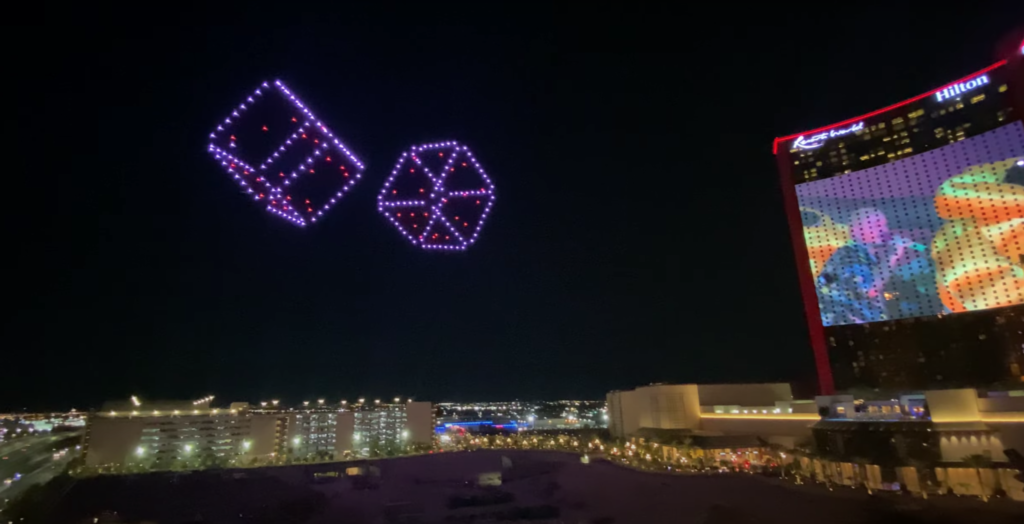
Jacksonville is the largest city by area in the continental United States, with the St Johns River through the middle of it and beaches to the east. That combination gives a drone show more usable open space than almost anywhere else in Florida. Hire UAV Pro brings the fleet, licensed pilots and full production.
1,000+
Shows flown
$10M
Insured
50–5,000
Drones per show
Florida is an active market for us
Our Florida work includes a 500-drone show for a Formula 1 race weekend in Miami, a 400-drone show in Sunrise, university shows in Boca Raton and Miami, and equestrian season shows in Wellington. Travel is built into every quote, so a Jacksonville show is priced the same way as one in our home state.
Where Jacksonville drone shows fly
The St Johns riverfront and the downtown landing give water and city backdrop together. The stadium and sports complex handles large seated crowds. Jacksonville Beach, Neptune Beach and Atlantic Beach suit summer community events, and the sheer amount of open parkland across Duval County makes site selection easier here than in denser Florida markets.
Season and hurricanes
Autumn through spring is the comfortable season, and it is when most civic events book. Summer shows fly after sunset once the heat drops, with afternoon storms usually clearing in time. Hurricane season from June through November means every booking in that window carries a planned backup date as standard.
Jacksonville airspace
Jacksonville International sits north of the city, with Naval Air Station Jacksonville to the south-west and Mayport to the east, so military airspace is a genuine consideration across the metro. Stadium events add temporary restrictions. Send us the venue first and we will confirm the airspace before you plan around it.
Beach and riverfront shows
Beach shows work particularly well in north Florida. The crowd spreads along the sand, the fleet flies over water, and separation is straightforward. Riverfront sites downtown give the skyline behind the show, which is the better option when the audience is a civic crowd rather than a summer beach crowd. We survey either before show night.
What every Jacksonville show includes
Custom show design previewed in 3D before approval, the drone fleet sized to your audience, FAA Part 107 certified pilots and ground crew, airspace authorization and FAA coordination, $10 million insurance with certificates issued to your venue, site survey and crowd separation planning, music synchronization, and full production and teardown. Travel is built into the quote — no surprise mobilization fees.
Drone Light Shows for Jacksonville Sports and Stadium Events
Jacksonville’s calendar is built around the Jaguars. NFL home dates anchor the fall and give sponsors the market’s biggest audiences, while the Jacksonville Jumbo Shrimp play a full Triple-A summer downtown and the city’s riverfront keeps a steady run of festivals and civic gatherings going between seasons. A drone display fits a season opener, a sellout celebration, a sponsor-presented night, a tailgate footprint outside the gates or a closing moment that holds the crowd in place after the whistle. Formations run from seventy aircraft to three hundred or more depending on sightlines and the size of the audience.
The no-pyro angle carries real weight on the First Coast. Natural grass is expensive to repair, dry spells raise brush fire concern across the surrounding marsh and pine, and river breezes make ember drift unpredictable. Our aircraft do not burn anything, so there is no fallout to manage over a field or a waterfront crowd. Pilots hold FAA Part 107 certification, the company maintains ten million dollars in aviation liability coverage, and over one thousand shows inform how we plan. Use the contact form to get a conversation started.
Jacksonville’s Downtown Riverfront Is Capped at 150 Feet — and Not by the Airport You’d Expect
This is the fact that will surprise anyone planning a Jacksonville show, and it governs the entire downtown core.
We queried the FAA’s UAS Facility Map feature service directly at the coordinates of each venue below.
The whole downtown riverfront sits at 150 feet
EverBank Stadium: 150 feet. Riverfront Plaza, the former Jacksonville Landing site: 150 feet. The Southbank Riverwalk: 150 feet.
All three under Naval Air Station Jacksonville Class D — not under Jacksonville International.
That is the part people get wrong. A producer checking “Jacksonville airspace” naturally looks at JAX, which sits well north of downtown. The facility that actually governs the riverfront is the naval air station to the south-west, and it caps the mapped grid at 150 feet across the whole downtown core.
A 150-foot ceiling is a serious choreographic constraint. It is under 40% of the vertical canvas available at a 400-foot venue, and it fundamentally changes what content can read at any audience distance. A formation that resolves cleanly at 400 feet seen from a quarter mile does not resolve the same way at 150.
It is a workable show designed very differently, or a long-lead project seeking a higher authorization through the FAA’s manual further-coordination process on roughly a 90-day timeline. Either way it needs saying before a date is promised. Anyone quoting you a 400-foot show on the Southbank Riverwalk has not queried the coordinates.
Two Jacksonville sites with no constraint at all
121 Financial Ballpark returns no UAS Facility Map grid cell. Neither does the Jacksonville Beach pier.
No grid cell means uncontrolled surface airspace — no FAA airspace authorization required for a Part 107 operation at or below 400 feet AGL.
So the Jumbo Shrimp ballpark, immediately adjacent to EverBank Stadium’s 150-foot cell, has the full 400 feet available with no authorization at all. Grid cells are roughly one nautical mile across, and this is as clean an illustration as exists anywhere in the country of why the launch point matters more than the city.
121 Financial Ballpark is, on airspace alone, the best show venue in Jacksonville. It also sits well below the 30,000-seat stadium restriction threshold, so it carries no event-triggered window either. Full altitude, no authorization, no TFR — and a baseball crowd already in place.
The beach pier is a different story once wildlife rules enter, covered below.
Stadium restrictions
A standing FAA restriction covers stadiums with a seating capacity of 30,000 or more during regular and postseason MLB, NFL and NCAA Division I football, plus major races — a three nautical mile radius, surface up to and including 3,000 feet AGL, from one hour before the scheduled start until one hour after the end. It restricts all aircraft operations, unmanned included.
In Jacksonville that reaches EverBank Stadium during Jaguars home games, the Florida–Georgia game and the Gator Bowl.
The restriction is event-triggered, not permanent — a show on a non-event date is unaffected, and a post-game show has to address the window explicitly rather than assume it has lapsed, which is the most common planning error at venues this size. We verify your date against the FAA’s own Sporting Event Automated Monitoring System feed rather than reading a published schedule.
At EverBank, though, the 150-foot grid ceiling binds every day of the year, not just on game days, and it is the larger constraint by a wide margin.
A note on the military airspace
Being governed by a naval air station rather than a civil airport is worth understanding. The grid is published and LAANC is available at the mapped ceilings, so it is not a closed door. But the ceiling is what it is because of military operations, and a further-coordination request there is a different conversation from the same request at a civil Class D field. We would set expectations accordingly rather than promise a 400-foot authorization we cannot be confident of.
Jacksonville Is the Calmest Major Market in Florida
This is a genuine competitive advantage for Jacksonville events and nobody uses it.
The wind numbers
Florida Climate Center wind normals, from a 37-year period of record:
Jacksonville’s annual mean wind is 6.7 mph. Compare Miami at 8.4, Orlando at 7.7, Tampa at 6.8, West Palm Beach at 9.5 and Key West at 10.0.
Jacksonville’s calmest months are July at 5.8 mph and August at 5.7. The windiest is March at 7.8, with April at 7.5.
So Jacksonville is the calmest of Florida’s four largest metros, and it is markedly calmer than the South Florida coast. For a city whose events market is far less saturated than Orlando’s or Miami’s, that is worth stating plainly.
But the calmest months are still the worst months
Here is the pattern that holds at every single Florida station without exception: July and August are the calmest, March and April the windiest.
And July and August are simultaneously the worst months of the year for convection, lightning and rainfall, and they sit inside hurricane season. So in Florida the calmest-wind months are the least reliable show months. Wind is not what cancels a Jacksonville show in July — a thunderstorm cell is.
Florida leads the United States in lightning density, statewide and at county level. The most useful planning datapoint: in 2025, football stadiums in Miami, Tampa and Tallahassee logged some of the highest numbers of hours in the country meeting NFL game-suspension criteria. That is a third-party measure of exactly the risk a summer show window faces.
The window that actually works
Late October through early December is the strongest window in Florida. Rainfall has collapsed, hurricane season closes on 30 November, and wind sits at 6.4 to 6.5 mph in Jacksonville — below the spring peak and close to the annual low.
And on the coast there is a second reason: that window is also when the sea turtle nesting constraint lifts. The weather and the wildlife constraints align rather than conflict, which is a rare and genuinely useful coincidence in this market.
February is a reasonable second window — dry, though wind is already climbing toward the spring maximum.
March and April are the single worst wind period of the year.
The one Jacksonville-specific winter issue
Jacksonville is far enough north that winter is a real variable, unlike in Miami. Jacksonville’s January mean minimum is 42.9°F — against Miami’s 61.0°F.
For a December or January show here, the operational concerns are condensation on airframes and optics, and battery temperature management — not density altitude, which is excellent in cold air. Cold shortens usable battery endurance and we size the fleet and segment lengths for it. Those are manageable, and they are different problems from the summer ones, so we plan for them specifically rather than treating a winter date as a summer date in a jacket.
The upside is substantial: a cold evening is the densest air of the year. A 70°F Florida evening computes to about 975 feet density altitude against a July evening’s 2,265, which is roughly four percentage points more thrust margin — and that difference shows up directly in gust tolerance on the night.
The Questions Jacksonville Producers Actually Ask
Can we do a 400-foot show on the Riverwalk?
Not under an automated authorization, and this is the fact that surprises everyone. EverBank Stadium, Riverfront Plaza and the Southbank Riverwalk all sit at a 150-foot ceiling — and the controlling facility is Naval Air Station Jacksonville Class D, not Jacksonville International.
A producer checking “Jacksonville airspace” naturally looks at JAX, which is well north of downtown. The facility that actually governs the riverfront is the naval air station to the south-west.
A 150-foot cap is under 40% of the canvas available at a 400-foot venue. It is a workable show designed very differently, or a long-lead project seeking a higher authorization through the FAA’s manual further-coordination process on roughly a 90-day timeline. Anyone quoting you a 400-foot show on the Southbank has not queried the coordinates.
So where should the show actually be?
121 Financial Ballpark. It returns no UAS Facility Map grid cell at all — uncontrolled surface airspace, the full 400 feet available with no FAA airspace authorization whatsoever — and at its capacity it sits well below the 30,000-seat stadium restriction threshold, so there is no event-triggered window either.
Full altitude, no authorization, no TFR, and a baseball crowd already in place. On airspace alone it is the best show venue in the city, and it is immediately adjacent to EverBank Stadium’s 150-foot cell. Grid cells are roughly one nautical mile across, and that pairing is as clean an illustration as exists anywhere of why the launch point matters more than the city.
Why is a navy base setting our ceiling?
Because the UAS Facility Map is organised by controlling facility rather than by the airport you would name, and NAS Jacksonville’s Class D reaches the downtown core.
It is worth understanding what that means practically. The grid is published and LAANC is available at the mapped ceilings, so it is not a closed door — but the ceiling is what it is because of military operations, and a further-coordination request there is a different conversation from the same request at a civil Class D field. We set expectations accordingly rather than promising a 400-foot authorization we cannot be confident of.
Can we do a post-game show at EverBank?
Outside the restriction window, yes. The standing restriction covers stadiums seating 30,000 or more during NFL and NCAA Division I football — three nautical miles, surface to 3,000 feet AGL, from an hour before the scheduled start to an hour after the end. In Jacksonville that reaches Jaguars home games, the Florida–Georgia game and the Gator Bowl.
It is event-triggered, not permanent, and we verify your date against the FAA’s own Sporting Event Automated Monitoring System feed rather than a published schedule.
But at EverBank the 150-foot grid ceiling binds every day of the year, not just on game days, and it is the larger constraint by a wide margin. A post-game show there is a 150-foot show unless you have secured a higher authorization ninety days out.
What about a show at the beach?
The airspace is clean and the wildlife rules are not. The Jacksonville Beach pier returns no UAS Facility Map grid cell — no FAA authorization required at or below 400 feet AGL.
But the State Model Sea Turtle Lighting Ordinance provides that “lighting associated with a special event that may directly, indirectly, or cumulatively be visible from any portion of the beach shall not be authorized at nighttime during sea turtle nesting season.”
A drone light show is lighting associated with a special event. Duval County’s nesting period runs 1 May to 31 October, and local ordinances can be stricter than the county floor — always check the specific municipality, because the county date is the floor, not the answer.
So a beach-visible Jacksonville show is effectively a November-to-April product, and the excluded window includes 4 July. The ordinance also prohibits motorised vehicles on the beach at nighttime during nesting season, which hits ground transport of equipment to a beach launch site.
Downtown and inland venues — 121 Financial Ballpark, the riverfront, EverBank — are the year-round business. The beach is a winter product.
Could we get an exception for a beach show in summer?
Possibly, and we will not pretend to know. We could not confirm whether any Florida municipality has authorised a beach-visible drone show during nesting season, or whether inspectors treat an elevated, upward-facing LED array differently from fixed beachfront lighting.
There is a real technical argument. The ordinance defines “long wavelength” as light at or above 560 nanometres with no shorter wavelengths — amber, orange and red — and a palette restricted to that band, with emitters above the audience pointing upward, is arguably a different thing from a floodlit beachfront. But that argument has to be won with the local Beach Lighting Inspector, not asserted on a web page. For a beach-visible date inside nesting season we would make that call on your behalf before quoting, and tell you honestly what the answer was.
When should we schedule?
Late October through early December is the strongest window in Florida — rainfall collapsed, hurricane season closed on 30 November, Jacksonville wind at 6.4 to 6.5 mph near its annual low, and on the coast the turtle season just ended. The weather and wildlife windows align, which is rare and useful.
February is a reasonable second window. March and April are the single worst wind period of the year.
And the counterintuitive part: Jacksonville’s calmest months are July at 5.8 mph and August at 5.7 — but those are the worst months for convection, lightning and rainfall and sit inside hurricane season. The calmest-wind months are the least reliable show months. Wind is not what cancels a Jacksonville show in July. A thunderstorm cell is.
Is Jacksonville better or worse than the rest of Florida for weather?
Better, and it is not close. Jacksonville’s annual mean wind is 6.7 mph against Miami’s 8.4, Orlando’s 7.7, West Palm Beach’s 9.5 and Key West’s 10.0. It is the calmest of Florida’s four largest metros and markedly calmer than the South Florida coast.
For a market far less saturated than Orlando’s or Miami’s, that is a real advantage and nobody uses it.
Can you fly in December or January here?
Yes, and the air is better then — but the issues are different from summer, so we plan for them specifically.
Jacksonville’s January mean minimum is 42.9°F, against Miami’s 61.0°F. For a winter show here the operational concerns are condensation on airframes and optics, and battery temperature management. Cold shortens usable battery endurance and we size the fleet and segment lengths for it.
The upside is substantial. A cold evening is the densest air of the year: a 70°F Florida evening computes to about 975 feet density altitude against a July evening’s 2,265 — roughly four percentage points more thrust margin, which shows up directly in gust tolerance on the night.
Will the heat and humidity hurt a summer show?
Measurably, and here is the arithmetic. Running the National Weather Service density altitude formula at Florida sea-level pressure: a January or February evening at 70°F computes to 975 feet — about 2.8% thrust loss at constant RPM. A July evening around 8 p.m. at 88°F with a 77°F dewpoint computes to 2,265 feet — about 6.5% thrust loss and 6.9% more hover current. A July mid-afternoon reaches 2,705 feet, and an extreme heat event 3,034.
So Florida at sea level routinely flies at a 2,300 to 3,000-foot density altitude on a summer evening, which is a real constraint on payload, endurance, climb rate and gust-rejection reserve.
Isn’t the humidity the main culprit?
No, and we would rather give you the numbers than the slogan. Of the roughly 2,700 feet of density altitude at a 95°F afternoon with a 78°F dewpoint, about 410 feet — some 15% — is humidity. The other 85% is temperature.
Holding temperature at 85°F and sweeping dewpoint across the full realistic Florida range, 55°F to 82°F, moves density altitude from 1,866 to 2,152 feet — a span of just 286 feet. Humidity sits in a stable 270-to-440-foot band in every realistic condition. It is a consistent offset, not a wildcard.
The fix is the calendar. A February Jacksonville evening and a July afternoon are roughly 1,700 feet apart.
How does that compare with your Colorado shows?
Honestly, in Jacksonville’s favour. We are based in Arvada at roughly 5,300 feet. A Florida summer evening at around 2,300 feet density altitude is still materially denser air than a Colorado winter morning. The accurate statement is “Florida summer flies at about 2,300 to 2,700 feet density altitude,” not “Florida is as hard as Colorado.” It is not, and we would rather say so than inflate our own difficulty.
How many drones do we need?
It depends on viewing distance, the ceiling at your site, and what you want the audience to read. Florida reference points: Disney Springs flew 800, Universal 600, Legoland 500, Ocala 300-plus, and the Hillsborough County Fairgrounds carried a 4 July show on 100.
The Jacksonville-specific point is that the ceiling changes the answer more here than almost anywhere. At the Southbank’s 150 feet the right number is different from 121 Financial Ballpark’s 400, because what sets drone count is the resolution your content needs at your audience’s distance — and a low ceiling compresses the canvas rather than shrinking the audience. We size to the geometry and the ceiling, and we tell you where extra aircraft stop buying you anything.
Should we replace our fireworks or add drones to them?
All three models are working in Florida and we will build whichever fits. Universal Orlando put 600 drones inside an existing show alongside fountains, pyrotechnics and projection mapping. Legoland’s 500-drone show includes fireworks. Disney Springs ran 800 drones with no fireworks at all. Ocala and Hillsborough County replaced outright — Ocala’s was the city’s first drone show, at 300-plus drones over fifteen minutes.
One honest counterpoint: a drone show proposal was rejected in Fort Lauderdale for 4 July. Municipal politics is a real gate, and the technology winning on the merits does not mean it wins a council vote. We would rather help you build the case than pretend that part is easy.
Why hire a Colorado company for a Jacksonville show?
Because what you are buying is the analysis on this page plus the aircraft and crew to execute it. That the whole downtown riverfront is capped at 150 feet by a naval air station rather than by Jacksonville International; that 121 Financial Ballpark next door has no grid cell at all and sits below the stadium threshold; that Jacksonville is the calmest major market in Florida at 6.7 mph annual mean; that your calmest wind months are your least reliable show months; that a beach-visible show is closed from 1 May to 31 October including 4 July; that a January show’s real issues are condensation and battery temperature rather than air density — that is work done because it decides whether a show flies and on which date. We fly nationally, we carry $10 million in drone aviation liability, and we would rather tell you a venue or a date is wrong in the first conversation than in week eleven.
Jacksonville drone show FAQ
Can you fly over the beach or the river?
Yes, with the right authorizations. Both give excellent sightlines for a crowd.
How much does a Jacksonville drone show cost?
Fleet size drives the price, then animation, travel and duration, with exact pricing within 24 hours. See our cost guide.
How many drones does a public event need?
Large public audiences want 300 or more. Corporate and private events work well at 100 to 200.
How far ahead should we book?
Sixty to ninety days is comfortable; July 4th books earliest.
Drone shows near Jacksonville
We fly across the region. Nearby: Orlando · Tampa · Savannah · Charleston. See Florida drone light shows for everything we have flown statewide, or explore drone show rental and corporate drone shows and events.
Book a Jacksonville drone show
Tell us your date, venue and audience and we will send a custom concept and exact pricing within 24 hours.
More Drone Light Shows in Florida
We fly across Florida. See all Florida drone light shows, or a nearby city or venue:
Jacksonville · Key West · Lake Eola Park · Miami · Naples · Orlando · Orlando · The Pier District · St. Augustine · Tampa · Tampa · Florida Gators
Book a Jacksonville drone show
Tell us your date, venue and audience and we will send a custom concept and exact pricing within 24 hours.