
Hire a Drone Light Show in Charlotte
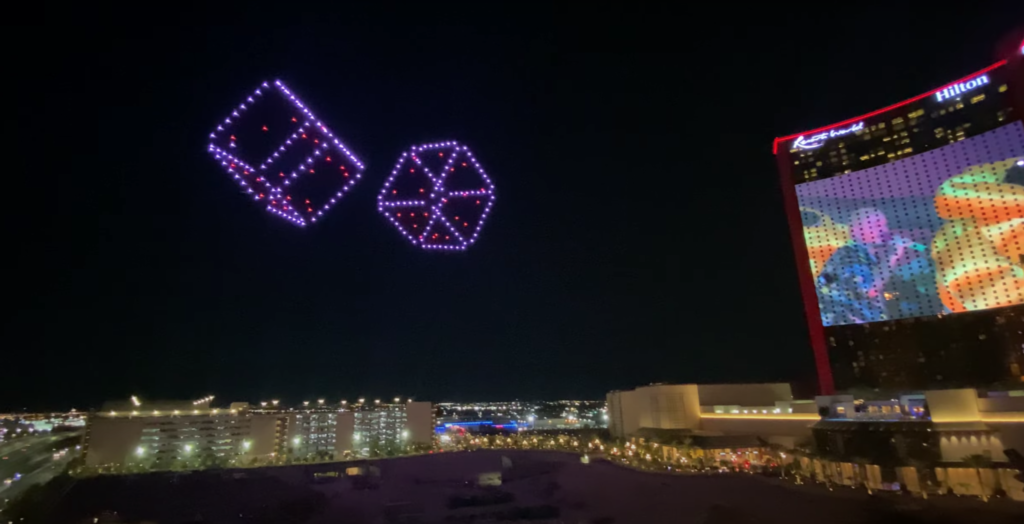
Charlotte is a banking and corporate headquarters city with a compact, walkable uptown, which shapes what a drone show looks like here. Most of our Charlotte enquiries are corporate — company milestones, client events and brand activations — rather than municipal fireworks replacements. Hire UAV Pro handles both.
1,000+
Shows flown
$10M
Insured
50–5,000
Drones per show
Where Charlotte drone shows fly
Romare Bearden Park and the uptown green spaces sit right beside the corporate towers, which is exactly what a company event wants. The stadium and arena precinct handles seated crowds. Corporate campuses in Ballantyne and the University City area give private, controlled ground, and the lakes and parks outside the city offer open airspace for larger public shows.
Season and Carolina weather
Spring and autumn are the easiest months here. Summer shows fly later in the evening once the heat and humidity drop, with afternoon thunderstorms usually clearing before showtime. Winter is reliable and suits corporate holiday events, with an earlier start time. Every booking carries go/no-go thresholds and a backup window.
Charlotte airspace
Charlotte Douglas International is one of the busiest airports in the world by aircraft movements, and it sits immediately west of uptown. That makes venue choice genuinely consequential here — some sites are straightforward and others are not. Send us the location first and we will tell you early and honestly whether it can be flown.
Corporate shows
For a company event, the sky is the largest brand surface available. We animate logos from your vector files, match brand colours, and can form a scannable QR code that puts your campaign in the audience’s hands during the show. Every formation is previewed in 3D before approval, which makes brand and legal sign-off straightforward. See corporate drone shows and events.
What every Charlotte show includes
Custom show design previewed in 3D before approval, the drone fleet sized to your audience, FAA Part 107 certified pilots and ground crew, airspace authorization and FAA coordination, $10 million insurance with certificates issued to your venue, site survey and crowd separation planning, music synchronization, and full production and teardown. Travel is built into the quote — no surprise mobilization fees.
Drone Light Shows for Charlotte Sports and Stadium Events
Charlotte fields the Panthers, the Hornets and Charlotte FC, all playing in or beside Uptown, which puts three professional audiences inside one compact footprint. The region draws a heavy motorsports and college football following on top of that. For a club marketing lead or a brand activation producer, the booking targets are obvious: home openers, derby matches, fan festivals, sponsor nights and postseason celebrations. Each operator carries FAA Part 107 certification, aviation liability is insured to ten million dollars, and the show count exceeds one thousand.
An aerial drone display puts no spark, no burning shell and nothing falling over a crowd or a playing surface. In Uptown, where towers rise immediately beside the venues and sidewalks fill long before kickoff, taking debris out of the equation simplifies the entire review. Pitch and turf go untouched, which grounds staff tend to appreciate even more than the marketing department does. Shows run from a seventy-ship package to a three-hundred-plus build, and a nine o’clock launch is the usual target for an evening fixture. Our contact form reaches the team directly.
Charlotte Airspace, Measured Site by Site
Charlotte is the easiest major metro airspace in the Southeast for a drone show, and almost nobody says so because the city has a Class B airport and people assume Class B means closed.
We queried the FAA’s UAS Facility Map feature service directly at the coordinates of each venue below.
Uptown flies at the full 400 feet — inside Class B
Bank of America Stadium: 400 feet. Truist Field: 400 feet. Romare Bearden Park: 400 feet. The U.S. National Whitewater Center: 400 feet.
All four under Charlotte Douglas Class B. All four LAANC-enabled, which means the authorization processes in near real time rather than sitting in a federal coordination queue for a quarter.
Across the whole Charlotte Douglas grid: 815 cells, of which 543 allow the complete 400 feet and 138 — about 17% — carry a zero-foot ceiling.
Put that against the other large markets. Nearly a quarter of the mapped grid over New York City is zero-ceiling. Almost half of Newark’s is. In Atlanta the two hardest venues — Truist Park and Chastain Park Amphitheatre — are constrained by Dobbins Air Reserve Base rather than by Hartsfield-Jackson, and Truist Park is zero-ceiling outright.
Charlotte has a major Class B hub and its downtown event core still flies at full show altitude with an app-based authorization. That is the single most useful fact on this page.
Romare Bearden Park is the city’s best civic site, and it is already proven
Romare Bearden Park sits at a 400-foot LAANC ceiling in the heart of uptown, and it is where “Salute to America 250” flew on 4 July 2026 — billed as the largest drone show in the Carolinas.
That event is worth describing properly because of how it was structured. Free entry from 4:30 p.m. A Charlotte Symphony concert at Truist Field, gates at 6 p.m., simulcast into the park. Drones and fireworks together. Co-hosted by the Charlotte Symphony, the Charlotte Knights and Charlotte Center City Partners.
A symphony, a minor league ballpark and a downtown partnership organisation on one bill, in a park at full show altitude. If you are trying to understand what a Charlotte drone show can be, that is the template — and the fact that it worked at that scale with that cast is more persuasive than any drone count.
The one constrained venue, and the reason is not what you would guess
Charlotte Motor Speedway sits at a 200-foot ceiling — because of Concord-Padgett Regional, not Charlotte Douglas. The speedway falls inside JQF’s Class D grid, which runs 282 cells with 48 at zero and 182 at the full 400.
A 200-foot cap halves the vertical canvas. That is a show designed differently rather than an impossible one, and the difference matters: content that reads at 400 feet from a given audience distance does not automatically read at 200. Anyone quoting you a 400-foot show at the speedway because “Charlotte is 400” has not queried the coordinates.
There is a specific commercial reason to care. Speedway Christmas runs from late November into early January — a 3.75-mile drive-through light course with more than three and a half million lights through the oval, infield and concourse. On the face of it that is the best-matched existing light-show property in the Carolinas for a drone addition, with an established audience and a season nobody else is competing for. The 200-foot ceiling is the design constraint, and knowing it before the pitch is worth more than discovering it after.
Stadium restrictions, and the error people make
A standing FAA restriction covers stadiums with a seating capacity of 30,000 or more during regular and postseason MLB, NFL and NCAA Division I football, plus NASCAR Cup, IndyCar and Champ Series races — a three nautical mile radius, surface up to and including 3,000 feet AGL, from one hour before the scheduled start until one hour after the end. It restricts all aircraft operations, unmanned included.
In Charlotte that covers Bank of America Stadium at roughly 74,900 seats and Charlotte Motor Speedway at roughly 95,000. Truist Field, at about 10,200, sits well below the threshold and is not covered by the standing restriction at all.
The critical point: the restriction is event-triggered, not permanent. A show at Bank of America Stadium or the speedway on a non-event date is entirely unaffected. A show timed to an actual game or race has to address the window explicitly — and a post-game or post-race show needs the window addressed rather than assumed away. That is the most common planning error at these venues, and we verify your date against the FAA’s own Sporting Event Automated Monitoring System feed rather than reading a published schedule and hoping.
When To Fly in Charlotte
We computed this rather than looked it up. Ten years of NOAA daily summaries, 2016 through 2025, at Charlotte Douglas — peak five-second gusts, plus thunder-day counts from the GHCN daily thunder flag and tornado climatology from the NOAA Storm Prediction Center database.
Charlotte is the calmest major city in the Southeast
Annual mean daily peak gust at Charlotte is 22.6 mph, with 117.4 days a year above 25 mph and 45.4 above 30.
Atlanta runs 24.8 mph mean, 158.2 days above 25 and 74.0 above 30. Nashville runs 24.1, 146.6 and 72.5.
So Charlotte sees roughly 40% fewer 30-mph gust days per year than Atlanta. For anyone planning a season of outdoor evening events, that is a materially better market than either of its nearest large neighbours, and it is not a reputation Charlotte currently has.
October is the single best month, by the widest margin we have measured anywhere
October at Charlotte: 20.2 mph mean daily peak gust, 7.5 days a year above 25 mph, and just 1.2 days a year above 30.
That 1.2 figure is the lowest for any month at any city in our entire Southeastern dataset.
September is close behind — 21.1 mph mean, 5.8 days above 25, 2.4 above 30 — and November is nearly as good at 20.4 and 2.0.
March and April are the worst. March runs 24.9 mph mean with 14.5 days above 25; April 24.8 with 13.8. The strongest single gust of the decade at Charlotte was 68 mph, in April, and April is also North Carolina’s primary tornado peak at 6.1 per year.
Thunderstorms agree. Charlotte averages 54.6 thunder days a year against Orlando’s 106.8 and Tampa’s 104.7 — roughly half of central Florida’s. July peaks at 13.7 thunder days; September falls to 3.5 and October to just 0.8. Measurable-precipitation days bottom out in October at 5.8.
Three independent measures — gusts, thunderstorms, rainfall frequency — all point at the same answer. October is the optimum month in Charlotte, with September close behind, and the spring shoulder is the one to price defensively or avoid.
The one honest caveat, and it argues for October over September
North Carolina has a risk its neighbours do not share. The state has a distinct second tornado peak in September — 4.9 per year — driven by tropical systems tracking inland. Georgia does not share it, and Tennessee’s September is the quietest month in the whole regional table at 0.3 per year.
Hurricane Helene in late September 2024 is the definitive case: landfall on the Florida Big Bend as a Category 4, then inland, with catastrophic damage in western North Carolina and record rainfall as far inland as Atlanta.
So the honest framing: September is excellent on wind, thunderstorms and rain, with a named tropical caveat. October is excellent on all of those and sits clear of the tropical peak. If your date has any flexibility in Charlotte, October is the strongest recommendation we can make.
One caveat about the numbers themselves
WSF5 is a daily peak gust, recorded at any hour. Drone shows fly at dusk, when the boundary layer typically decouples and surface winds slacken. These figures overstate the wind a show would actually see. They are valid for ranking months and cities against each other — which is what we use them for — and they are not a show-time forecast. Anyone presenting a daily-peak gust statistic as a 9 p.m. condition is either confused or hoping you are.
The Questions Charlotte Producers Actually Ask
Can we really fly at 400 feet in uptown? It’s Class B.
Yes. Bank of America Stadium, Truist Field, Romare Bearden Park and the U.S. National Whitewater Center all sit at a 400-foot ceiling, LAANC-enabled, inside Charlotte Douglas Class B. Across the full Charlotte grid, 543 of 815 cells allow the complete 400 feet and about 17% are zero-ceiling — against nearly a quarter over New York City and almost half around Newark. Charlotte is the easiest major metro airspace in the Southeast, and Class B is not the obstacle people assume.
What about Charlotte Motor Speedway?
200 feet — and the constraint is Concord-Padgett Regional, not Charlotte Douglas. The speedway sits inside JQF’s Class D grid. A 200-foot cap halves the vertical canvas, so it is a show designed differently rather than an impossible one. Content that reads at 400 feet from a given viewing distance does not automatically read at 200, and we would size and choreograph accordingly. Anyone quoting 400 feet there because “Charlotte is 400” has not checked the coordinates.
Which Charlotte venue would you actually recommend?
Romare Bearden Park, for most civic and public events. Full 400-foot LAANC ceiling, uptown setting, and already proven at scale — “Salute to America 250” flew there on 4 July 2026 billed as the largest drone show in the Carolinas, with a Charlotte Symphony concert at Truist Field simulcast into the park and fireworks on the same bill, co-hosted by the Charlotte Symphony, the Charlotte Knights and Charlotte Center City Partners.
For a corporate or private event, the U.S. National Whitewater Center at 400 feet is an unusually good site — controlled grounds, water, and room to put an audience at a proper viewing distance.
Can we do a post-game show at Bank of America Stadium?
Yes, and this is where planning usually goes wrong. The standing stadium restriction covers venues seating 30,000 or more during NFL, MLB, NCAA Division I football and major races — three nautical miles, surface to 3,000 feet AGL, from an hour before the scheduled start to an hour after the end.
It is event-triggered, not permanent. A show at the stadium on a non-event date is unaffected. A post-game show has to address the window explicitly rather than assume it has lapsed. We verify your date against the FAA’s own Sporting Event Automated Monitoring System feed rather than reading a published schedule.
Worth knowing: Truist Field, at about 10,200 seats, is below the threshold and not covered by the standing restriction at all — which makes a Knights game a genuinely straightforward drone show prospect.
When should we schedule?
October, then September. October is the best month in Charlotte on three measures simultaneously: 20.2 mph mean daily peak gust, only 1.2 days a year above 30 mph — the lowest figure in our whole Southeastern dataset — 0.8 thunder days, and the year’s lowest rainfall frequency. September is close on wind and thunderstorms but carries North Carolina’s tropical-season tornado peak at 4.9 per year, which Georgia and Tennessee do not share. March and April are the worst months, and the decade’s strongest Charlotte gust — 68 mph — was in April.
Are consumer fireworks legal in Charlotte?
Not if they leave the ground. North Carolina has no aerial exemption at all. The consumer exemptions cover toy caps, snakes and glow worms, smoke devices, party poppers and snappers, wire sparklers, and ground or hand-held sparkling devices that do not detonate, spin, or propel themselves through the air. Violation is a Class 2 misdemeanor.
One useful consequence for a drone show: unlike Michigan or Pennsylvania, there is no statutorily protected neighbourhood-fireworks window competing with your event for a dark sky.
What does a fireworks display have to do that we don’t?
A display needs a permit from the county board of commissioners (or a city the county has authorised), a display operator licensed under G.S. 58-82A-3 physically present and personally directing all aspects of the discharge, handlers trained and licensed under Article 82A, and at least $500,000 in operator insurance.
A drone show needs none of it — Article 54 does not mention drones or unmanned aircraft anywhere. What it does need is FAA authorization where the airspace requires it, the landowner’s permission, and the venue’s own event permit. We carry $10 million in drone aviation liability, twenty times the statutory floor for a display operator.
Can you fly during a burn ban?
Yes, and in North Carolina the argument is stronger than most people realise. The Forest Service states plainly that “an open burning permit is not a request for permission to burn but is instead a notification that a burn may occur” — and the Commissioner of Agriculture can enact a statewide ban that overrides permits already issued. If your event depends on combustion, a decision in Raleigh days before your date can end it, and a permit in hand is not protection. A drone show has nothing to burn.
Will heat and humidity hurt the show?
No, and we checked the humidity claim properly rather than repeating it. A Charlotte show at 9 p.m. in summer operates at roughly 2,236 feet density altitude; Phoenix at the same hour averages 3,996. The Southeastern water-vapour correction runs about +285 to +325 feet against Phoenix’s +130 to +170 — so humidity costs Charlotte roughly 150 feet more than it costs Phoenix. But the gap between the cities is around 1,760 feet, so humidity closes about 150 feet of it. Field elevation and temperature dominate by an order of magnitude.
The more operationally useful number: at 3 p.m. Charlotte averages about 2,865 feet density altitude, reaching roughly 3,719 on a hot afternoon, against 2,236 at show time. A crew test-flying in afternoon heat is working 600 to 800 feet higher than the show will see — so a marginal afternoon check is not necessarily a problem. Knowing that is the difference between an unnecessary scrub and a confident launch.
How many drones do we need?
It depends on viewing distance and what you want the audience to read, not on a package tier. For in-state reference, Chapel Hill carried a full Independence Day replacement on 300 drones, and Charlotte’s own “Salute to America 250” was billed as the largest in the Carolinas. More drones means more resolution in the imagery rather than simply more lights — and at the speedway’s 200-foot ceiling the right number is different from a 400-foot venue. We size to the geometry.
Should we replace our fireworks or add to them?
North Carolina gives you a worked precedent for both, which is unusual. Charlotte is the additive case — drones, a symphony and fireworks on one bill under a civic-partnership structure. Chapel Hill is the replacement case — 300 drones, published reasoning, a 2024 community survey behind it, with the mayor citing air pollution, chemical runoff, people who don’t enjoy explosions, and animals. We will build either and be straight with you about what each one costs.
What should we look at besides 4 July?
Two things, and they are the best unclaimed opportunities in the region. Speedway Christmas at Charlotte Motor Speedway runs late November into early January — already a light-show property with an established audience, a season with no competition, and a 200-foot ceiling to design around. And the North Carolina State Fair in Raleigh runs in October, inside the best weather window in the state, where a multi-night run amortises the same fleet and crew across several performances and lets content change nightly.
Independence Day clusters hard on 1, 3 and 4 July across the whole region — crews, aircraft and airspace all under pressure inside a single 96-hour window. These dates are not.
Why hire a Colorado company for a Charlotte show?
Because what you are buying is the analysis on this page plus the aircraft and crew to execute it. That uptown flies at 400 feet inside Class B while the speedway is capped at 200 because of Concord-Padgett; that Truist Field is below the stadium threshold entirely; that October beats September and both beat spring by a wide margin on three separate measures; that North Carolina’s September tornado peak is a tropical signal its neighbours don’t share; that the agriculture commissioner can void issued burn permits statewide; that setup-hour density altitude runs 600 feet above show-hour — that is work done because it decides whether a show flies and on which date. We fly nationally, we carry $10 million in drone aviation liability, and we would rather tell you a venue or a date is wrong in the first conversation than in week eleven.
Charlotte drone show FAQ
How much does a Charlotte drone show cost?
Fleet size drives the price, then custom animation, travel and duration, with exact pricing within 24 hours. See our cost guide.
Can you fly in uptown Charlotte?
It depends on the exact site, given how close the airport is. We confirm the airspace before anything else is planned.
Can you put our logo in the sky?
Yes — logos, brand colours, product shapes and scannable QR codes, all previewed in 3D first.
How many drones does a corporate event need?
Most corporate audiences are well served at 100 to 200. Large public crowds want 300 or more.
Drone shows near Charlotte
We fly across the region. Nearby: Raleigh · Charleston · Atlanta. See North Carolina drone light shows for everything we have flown statewide, or explore drone show rental and corporate drone shows and events.
Book a Charlotte drone show
Tell us your date, venue and audience and we will send a custom concept and exact pricing within 24 hours.
More Drone Light Shows in North Carolina
We fly across North Carolina. See all North Carolina drone light shows, or a nearby city or venue:
Charlotte Motor Speedway · Charlotte · Duke University · Durham · Greensboro · NC State · Outer Banks · Raleigh · Raleigh · University Of North Carolina · Wilmington · Winston-Salem
Book a Charlotte drone show
Tell us your date, venue and audience and we will send a custom concept and exact pricing within 24 hours.
More about our drone light show company — how a show gets planned, and what a booking includes.