
North Carolina Drone Light Shows
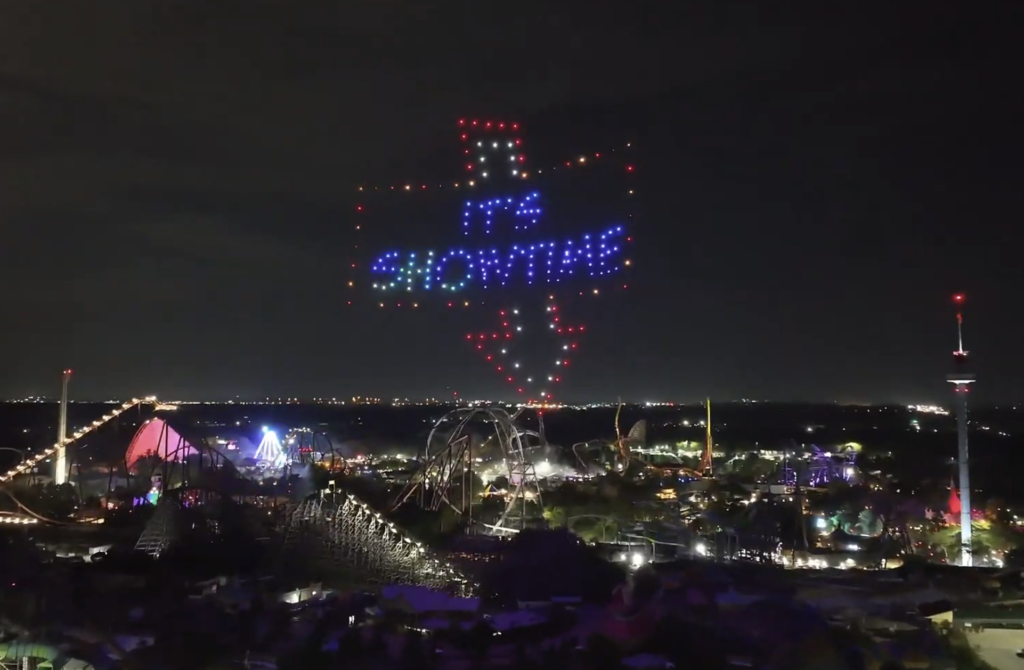
Picture hundreds of drones rising together above a North Carolina venue—a waterfront park in Wilmington, a corporate campus in Charlotte or Raleigh, a mountain clearing in Asheville, or a festival ground in Durham. Their LEDs create synchronized patterns choreographed to your music, visible for miles in the Carolina night. For North Carolina event planners, businesses, and communities, a professional drone light show is entertainment that people remember. It’s sophisticated, controlled, customizable, and genuinely impressive.
Why Drone Light Shows Work in North Carolina
North Carolina’s diverse landscape—from coast to mountains, from urban centers to rural communities—creates varied and interesting venues for drone shows. The state’s clear night skies and generally favorable weather conditions support outdoor evening entertainment. North Carolina audiences appreciate both tradition and innovation; a drone show bridges both worlds. Unlike fireworks, which create smoke, noise, and debris, drone shows are clean and silent—perfect for venues near homes, businesses, or sensitive environments. The bright LED arrays—each drone delivering 2,200+ lumens of RGBW light—are vivid and visible across North Carolina’s varied terrain. And because drone shows are repeatable and completely customizable, you can perform multiple shows in sequence or design animations that reflect your event’s specific theme, community, or brand message.
North Carolina Events Perfect for Drone Light Shows
Waterfront and coastal celebrations: Wilmington, Carolina Beach, and other coastal North Carolina communities host events where a drone show over the water creates a stunning visual. The contrast between water and lights is striking. Families and tourists photograph everything.
Corporate events and business launches: Charlotte and Raleigh are centers of finance, technology, and commerce. Companies use drone shows to celebrate milestones, launch products, and generate buzz. The spectacle positions your brand as innovative and forward-thinking.
Weddings and upscale celebrations: North Carolina’s diverse wedding venues—from Outer Banks beachfront properties to mountain lodges to Piedmont estates—are enhanced by a custom drone show choreographed to your song and colors. Guests photograph and share the moment. It becomes part of your celebration story.
Community and municipal celebrations: Fourth of July, Memorial Day, town anniversaries, and seasonal festivals. North Carolina communities embrace events that bring residents together and create shared memories.
Festivals and entertainment events: Music festivals, outdoor concerts, and seasonal celebrations benefit from a drone show finale. The spectacle extends your event’s energy and creates unique social media content.
Our Fleet: Kaiken vs. Damoda V4
We operate two professional drone systems, each designed for different event needs and budgets.
Kaiken: Our proven, cost-effective drone system. Kaiken units are lightweight, durable, and reliable. Perfect for events where you want professional choreography and quality effects at a more accessible price point. Ideal for community events, smaller venues, and organizations managing budgets carefully. Kaiken delivers professional-grade performance without premium cost.
Damoda V4: Our advanced, premium system featuring cutting-edge capabilities and engineered safety. Each Damoda V4 weighs just 2 lbs but delivers 2,200+ lumens of RGBW LED power—bright enough to be seen clearly even with ambient light. Damoda V4 includes parachute recovery, GPS-fenced flight boundaries, automatic return-to-home, and fail-safe landing systems. Every Damoda V4 show comes with a free second launch the same night, letting you extend your show or run a dusk pre-show plus your main performance. For high-profile corporate events, premium weddings, and situations where advanced safety and maximum visual impact matter most, Damoda V4 is the choice. It’s what we recommend for North Carolina’s most significant events.
Pricing for North Carolina Drone Light Shows
Drone light show pricing scales with drone count and animation complexity. We create shows ranging from 100 drones to 5,000 drones. Base pricing starts at $8,500, with all design, choreography, music synchronization, FAA coordination, and staffing included. Larger shows—500, 1,000, or more drones—are customized based on your specific venue, flight duration, animation complexity, and other event factors. Every proposal is detailed and transparent. We work with you to create a show that fits your budget and vision.
For a full breakdown of everything drone light shows, visit our comprehensive drone light show guide page
Drone Light Shows in North Carolina Cities
We bring professional drone light shows to cities across North Carolina. Explore our services in your area:
- Asheville Drone Light Shows
- Chapel Hill Drone Light Shows
- Charlotte Drone Light Shows
- Durham Drone Light Shows
- Greensboro Drone Light Shows
- Raleigh Drone Light Shows
- Wilmington Drone Light Shows
- Winston-Salem Drone Light Shows
Don’t see your city? We serve all of North Carolina. Book a drone show anywhere in the state.
Your North Carolina Drone Show Partner
Hire UAV Pro has been flying professional shows since 2017, completing over 1,000 events across diverse locations and conditions. Our pilots hold FAA Part 107 Remote Pilot Certificates, multi-UAS waivers, and night operations waivers. We carry $10 million in aviation and umbrella insurance. We understand North Carolina’s airspace, weather patterns, and the unique requirements of different venues—from coastal locations to mountain sites to urban centers. Our team is licensed, insured, and experienced. When you book with Hire UAV Pro, you’re working with proven professionals who deliver reliable, safe, and spectacular drone light shows.
Ready to bring a drone show to North Carolina? Book a drone show and our team will put together a custom proposal within 48 hours.
North Carolina Is the Easiest Major Airspace in the Southeast
We queried the FAA’s UAS Facility Map feature service directly at the coordinates of each venue below. Charlotte’s result is the best of any large Southeastern metro we have measured.
Uptown Charlotte sits at the full 400 feet — inside Class B
That sentence sounds wrong, and it is correct.
Bank of America Stadium: 400 feet. Truist Field: 400 feet. Romare Bearden Park: 400 feet. The U.S. National Whitewater Center: 400 feet. All of them under Charlotte Douglas Class B, and all of them LAANC-enabled — meaning the authorization processes in near real time rather than through a federal coordination queue.
Across the whole Charlotte Douglas grid: 815 cells, of which 543 allow the full 400 feet and 138 — about 17% — are zero-ceiling.
Set that against the other big markets. Nearly a quarter of the mapped grid over New York City is zero-ceiling. Almost half of Newark’s is. Atlanta’s two hardest venues, Truist Park and Chastain Park, are constrained by Dobbins Air Reserve Base rather than by Hartsfield-Jackson. Charlotte has a Class B airport and its downtown event core still flies at full show altitude through an app.
The one constrained Charlotte venue, and why
Charlotte Motor Speedway sits at a 200-foot ceiling — and the reason is Concord-Padgett Regional, not Charlotte Douglas. The speedway falls inside JQF’s Class D grid, which runs 282 cells with 48 at zero and 182 at the full 400.
That is a non-obvious fact and it matters, because a 200-foot cap halves the vertical canvas. It is a workable show designed differently, not an impossible one — and anyone who quotes you a 400-foot show at the speedway because “Charlotte is 400” has not queried the actual coordinates.
It is worth knowing in a specific commercial context. Speedway Christmas runs from late November into early January — a 3.75-mile drive-through light course with more than three and a half million lights through the oval, infield and concourse. On the face of it that is the single best-matched existing light-show property in the Carolinas for a drone addition. The 200-foot ceiling is the constraint to design around, and it is better to know that before the pitch than after.
Stadium restrictions
A standing FAA restriction covers stadiums with a seating capacity of 30,000 or more during regular and postseason MLB, NFL and NCAA Division I football, plus NASCAR Cup, IndyCar and Champ Series races — a three nautical mile radius, surface up to and including 3,000 feet AGL, from one hour before the scheduled start until one hour after the end. It restricts all aircraft operations, unmanned included.
In North Carolina that reaches Bank of America Stadium, Charlotte Motor Speedway, Carter-Finley Stadium in Raleigh and Kenan Memorial Stadium in Chapel Hill.
The crucial operational point is that this restriction is event-triggered, not permanent. A drone show at Bank of America Stadium or the speedway on a non-event date is entirely unaffected. A show timed to an actual game or race has to address the window explicitly — and a post-game show needs the restriction addressed, not assumed away. That is the single most common planning error at these venues, and we check your date against the FAA’s own Sporting Event Automated Monitoring System feed rather than reading a schedule and hoping.
Elsewhere in the state
Raleigh carries the venues with the best capacity-to-complexity ratio in the state: Dorothea Dix Park at 308 acres, Carter-Finley Stadium at roughly 57,600 seats, Coastal Credit Union Music Park at Walnut Creek at about 20,000, Red Hat Amphitheater at about 6,000, and the North Carolina State Fairgrounds, whose October run falls squarely inside the state’s best weather window.
Greensboro — First National Bank Field at roughly 7,500, the Greensboro Coliseum Complex, and LeBauer and Center City Parks downtown.
Chapel Hill — Kenan Memorial Stadium at about 50,500, and Chapel Hill High School on Seawell School Road, which is where the town’s own 300-drone Independence Day show flies.
Asheville — McCormick Field, Pack Square Park and the Salvage Station. One honest note: Asheville was severely damaged by Hurricane Helene in September 2024, and we would confirm current venue status with you directly rather than quoting from a venue list.
North Carolina Fireworks Law — and the Detail Most People Miss
Here is the fact that reframes the whole conversation in this state.
Consumer aerial fireworks are illegal in North Carolina. There is no aerial exemption at all.
Under N.C.G.S. § 14-410(a) it is unlawful to manufacture, buy, sell, possess, use or discharge any pyrotechnics except as Article 54 provides. And the consumer exemptions in § 14-414 are narrow and explicit: toy-pistol caps up to a quarter gram; snakes and glow worms; smoke devices; trick noisemakers such as party poppers, string poppers and snappers up to sixteen milligrams; wire sparklers up to a hundred grams; and other hand-held or ground-based sparkling devices that do not detonate, spin, or propel themselves through the air, capped at 75 grams per tube and 200 grams total.
Nothing that goes up is on that list. Violation is a Class 2 misdemeanor, or Class 1 if indoors.
So in North Carolina, anything in the sky at a public event is a professional display or it is a drone show. There is no third category, and there is no neighbourhood-fireworks tradition competing with your event for the sky the way there is in Michigan or Pennsylvania.
The professional display chain
Public display permits are issued by the county board of commissioners under § 14-413(a) — for fairs, carnivals, shows and public celebrations — and a county may by resolution authorise a city to issue them instead.
The operator requirements are specific. Under § 14-410(a1)(2) and (c)(2), a display operator licensed under G.S. 58-82A-3 must be present and personally direct all aspects of the discharge, and handlers must complete the training and licensing requirements of Article 82A of Chapter 58. Under § 14-413(d) the operator must carry at least $500,000 in insurance, or the State Building Code minimum, whichever is greater.
Article 54 does not mention drones or unmanned aircraft anywhere.
A drone show in North Carolina therefore needs no county commissioners’ display permit, no licensed pyrotechnic display operator personally directing a discharge, and no Article 82A handler licensing. It is governed by the FAA under Part 107, by whatever land manager controls the ground, and by the venue’s own event permitting. That is not a loophole — it is simply that fireworks law regulates combustion, and an aircraft is not combustion.
We carry $10 million in drone aviation liability — twenty times the $500,000 floor North Carolina sets for a display operator. Because that floor is written into statute, it is a comparison you can verify rather than a claim you have to accept.
Open burning, and the ban that overrides everything
North Carolina’s open burning regime is administered by the N.C. Forest Service under Chapter 106, Article 78. A permit is required from midnight to 4 p.m. for fires in or within 500 feet of Forest Service-protected woodland, and in most counties for any open burn more than 100 feet from an occupied dwelling in that window. High-hazard counties always require a permit for burns under five acres beyond 100 feet, with a special permit for land clearing over five acres.
Two details are worth quoting almost verbatim, because they describe a risk that lands on event organisers rather than on the Forest Service. First: “An open burning permit is not a request for permission to burn but is instead a notification that a burn may occur.” Second, and more consequentially: permits can be cancelled when fire danger is too high, and the Commissioner of Agriculture can enact a statewide ban that overrides permits already issued.
Statewide bans do happen. If your event depends on combustion, a decision taken in Raleigh days before your date can end it — and a permit in hand is not protection.
A drone show has nothing to burn. A burn ban, a drought restriction, a fire-weather advisory or a venue’s own no-open-flame policy prohibits combustion and leaves a drone show available. In a state where the agriculture commissioner can override issued permits statewide, that is not an abstract argument.
When To Fly in North Carolina
We computed this rather than looked it up. Ten years of NOAA daily summaries, 2016 through 2025, at Charlotte Douglas. The metric is WSF5 — the fastest five-second gust recorded each day — plus thunder-day counts from the GHCN daily thunder flag and tornado climatology from the NOAA Storm Prediction Center database.
Charlotte is the calmest major city in the Southeast
Annual mean daily peak gust at Charlotte is 22.6 mph, with 117.4 days a year above 25 mph and 45.4 above 30.
Compare Atlanta at 24.8 mph mean, 158.2 days above 25 and 74.0 above 30, and Nashville at 24.1 mph, 146.6 and 72.5. Charlotte sees roughly 40% fewer 30-mph gust days per year than Atlanta. For an operator planning a season, that is a materially better market.
October and September are the best months
October is the single best month in Charlotte: 20.2 mph mean peak gust, 7.5 days a year above 25, and just 1.2 days above 30 — the lowest figure in the entire dataset for any month at any of the three cities we measured.
September is close: 21.1 mph mean, 5.8 days above 25, 2.4 above 30.
March and April are the worst. March runs 24.9 mph mean with 14.5 days above 25; April 24.8 with 13.8. The strongest single gust of the decade at Charlotte was 68 mph, in April.
Thunderstorms point the same way. Charlotte averages 54.6 thunder days a year — against Orlando’s 106.8 and Tampa’s 104.7, so roughly half of central Florida’s. July is the peak at 13.7 thunder days; September drops to 3.5 and October to 0.8. Measurable-precipitation days bottom out in October at 5.8.
So three independent measures — gusts, thunderstorms and rainfall frequency — all agree that late September through October is the optimum window in North Carolina, and that the spring shoulder is the one to price defensively or avoid.
The honest caveat, and it is specific to this state
There is one risk that runs against the September recommendation, and North Carolina has it worse than its neighbours.
North Carolina has a distinct second tornado peak in September — 4.9 per year — driven by tropical systems. Georgia and Tennessee do not share it; Tennessee’s September is the quietest month in the entire regional table at 0.3 per year. North Carolina’s primary peak is April at 6.1 per year, but the September figure is not far behind it, and the cause is landfalling and inland-tracking tropical weather.
Hurricane Helene in late September 2024 is the definitive case. It made landfall in the Florida Big Bend as a Category 4 and then tracked inland, dropping 11.12 inches of rain on Atlanta in 48 hours — breaking a record set in 1886 — with 80 mph winds at Augusta and over a million customers without power in Georgia alone. Western North Carolina took catastrophic damage.
So the honest framing for North Carolina is this: October is the best month on the wind, thunderstorm and rainfall data, and it also sits clear of the September tropical peak. If your event can be in October, that is the strongest recommendation we can make in this state. If it has to be in September, the weather data still supports it and we build the tropical-system contingency into the plan rather than treating it as a surprise.
One caveat about the numbers themselves
WSF5 is a daily peak gust, recorded at any hour. Drone shows fly at dusk, when the boundary layer typically decouples and surface winds slacken. These figures overstate the wind a show would actually see. They are valid for ranking months and cities against each other — which is exactly what we use them for — and they are not a show-time forecast or a scrub predictor. Anyone quoting a daily-peak gust statistic as a 9 p.m. condition is either confused or hoping you are.
Density Altitude, and What Humidity Actually Does
This section argues against our own geography, and it also corrects a claim that gets made a lot in this industry.
We are based in Arvada, Colorado, at about 5,400 feet, so we fly a great deal of work at altitude and have the engineering discipline for it. In a North Carolina conversation the physics runs North Carolina’s way.
We computed the figures below from NCEI hourly observations, summers 2021 through 2025, using actual dry-bulb temperature, dewpoint and station pressure rather than altimeter estimates — with the water-vapour term calculated properly, because moist air is less dense than dry air and the correction is real.
A Charlotte show at 9 p.m. in summer operates at roughly 2,236 feet density altitude on average, rising to about 2,907 feet on a genuinely hot evening. Field elevation at Charlotte Douglas is 748 feet, so the elevation-to-density-altitude spread at show time is about 1,490 feet.
For comparison, Phoenix at 9 p.m. in summer averages 3,996 feet. Charlotte holds roughly a 1,760-foot advantage on an average summer evening.
The humidity claim, corrected
You will sometimes hear that Southeastern humidity cancels out the altitude advantage over the desert Southwest. We checked, and it does not.
The water-vapour correction in the Southeast runs about +285 to +325 feet of density altitude. In Phoenix it runs about +130 to +170 feet. So humidity does cost Charlotte something real — roughly 150 feet more than it costs Phoenix.
But the gap between the two cities at show time is around 1,760 feet. Humidity closes about 150 feet of it. Temperature and field elevation dominate, and they dominate by an order of magnitude. The honest version is: yes, the humidity correction is real and we compute it; no, it does not change the ranking.
The number that actually matters operationally
Here is the one most people miss, and it is about your crew rather than your show.
At 3 p.m. in summer, Charlotte’s density altitude averages about 2,865 feet and reaches roughly 3,719 feet on a hot afternoon. By 9 p.m. the show flies at about 2,236.
So a crew staging, test-flying and verifying a fleet in the afternoon heat is working at a density altitude roughly 600 to 800 feet higher than the show itself will see. A pre-flight check that passes comfortably at 3 p.m. has margin to spare by 9 p.m. — and a check that is marginal in the afternoon is not necessarily a problem. Knowing which is which is the difference between an unnecessary scrub and a confident launch.
What the margin buys
Static propeller thrust scales roughly with air density, so this translates directly into available thrust. More payload headroom per airframe. Longer hover endurance from the same battery. Higher climb rate. And the one that governs show reliability: a larger reserve for gust rejection, because the same control authority comes out of less motor output.
The thin-air derates that constrain fleet sizing, flight duration and wind limits in the Mountain West and Desert Southwest do not bind in North Carolina. Your fleet size here is set by what the choreography needs to read at your audience’s viewing distance, and by nothing else.
North Carolina Has Already Converted — and It Is the Cleanest Case in the South
Most states in this market are still at the “would this work?” stage. North Carolina is past it, and the evidence is unusually well documented.
Chapel Hill replaced its fireworks outright
For Independence Day 2026, the Town of Chapel Hill replaced its fireworks display with a 300-drone show, moving the event to Chapel Hill High School on Seawell School Road from Southern Village, where fireworks had run since 2019. The vendor was Skyworx.
What makes this the cleanest conversion case in the South is that the town published its reasoning, and it was not primarily about cost or novelty.
The decision followed a 2024 community survey and the town’s own sustainability and inclusivity goals. Mayor Jess Anderson cited air pollution and chemical runoff, people who simply do not enjoy explosions, and animals. Separately, the town noted that the previous site “presented some serious safety challenges, particularly around vehicle traffic.”
Every one of those is a transferable argument. If you are a North Carolina town council or parks department weighing this, Chapel Hill has already made your case in public, with a community survey behind it, and the answer at that scale was 300 drones.
Charlotte went big and additive
Uptown Charlotte’s “Salute to America 250” on 4 July 2026 was billed as the largest drone show in the Carolinas. It flew at Romare Bearden Park — free, from 4:30 p.m. — paired with a Charlotte Symphony concert at Truist Field simulcast into the park, plus fireworks. It was co-hosted by the Charlotte Symphony, the Charlotte Knights and Charlotte Center City Partners.
Note what that is: a drone show, an orchestra, a minor league ballpark and a downtown partnership organisation, all on one bill, in a park that sits at a 400-foot LAANC ceiling. The additive model — drones alongside fireworks rather than instead of them — at a major-city scale.
Between them, those two events give a North Carolina client both templates. Chapel Hill is the replacement case with published community reasoning. Charlotte is the additive case with a civic-partnership funding structure. Whichever conversation your committee is having, there is a North Carolina precedent for it.
The scheduling insight hiding in all of this
Independence Day events in this region cluster hard on 1, 3 and 4 July. Chapel Hill flew on the 4th; Charlotte on the 4th. That clustering is a real constraint on crews, aircraft and airspace across the whole region in a single 96-hour window.
Which is why the two best unclaimed opportunities in North Carolina are not in July at all.
The North Carolina State Fair in Raleigh runs in October — inside the single best weather window in the state on gusts, thunderstorms and rainfall simultaneously. A multi-night fair run amortises the same fleet and crew across several performances and lets the content change night to night, which is a fundamentally better proposition than one holiday evening.
Speedway Christmas at Charlotte Motor Speedway runs from late November into early January — a 3.75-mile drive-through course with over three and a half million lights. It is already a light-show property with an established audience and a season nobody else is competing for. The 200-foot ceiling there is the design constraint, and it comes from Concord-Padgett rather than Charlotte Douglas.
The Questions North Carolina Producers Actually Ask
Can we fly at 400 feet in uptown Charlotte? It’s Class B.
Yes — and this surprises people. Bank of America Stadium, Truist Field, Romare Bearden Park and the U.S. National Whitewater Center all sit at a 400-foot ceiling, LAANC-enabled, inside Charlotte Douglas Class B. Across the whole Charlotte grid, 543 of 815 cells allow the full 400 feet and about 17% are zero-ceiling. By comparison, nearly a quarter of the mapped grid over New York City is zero-ceiling and almost half of Newark’s is. Charlotte is the easiest major metro airspace in the Southeast.
What about Charlotte Motor Speedway?
200 feet — and the reason is Concord-Padgett Regional, not Charlotte Douglas. The speedway sits inside JQF’s Class D grid. A 200-foot cap halves the vertical canvas, so it is a show designed differently rather than an impossible one. Anyone quoting you 400 feet there because “Charlotte is 400” has not queried the coordinates.
Are consumer fireworks legal in North Carolina?
Not if they go up. There is no aerial exemption in North Carolina at all. The consumer exemptions cover toy caps, snakes and glow worms, smoke devices, party poppers and snappers, wire sparklers, and ground or hand-held sparkling devices that do not detonate, spin, or propel themselves through the air. Violation is a Class 2 misdemeanor.
That means anything in the sky at a public event in this state is either a professional display or a drone show. One useful consequence: unlike Michigan or Pennsylvania, there is no protected neighbourhood-fireworks window competing with your show for a dark sky.
What permits does a professional fireworks display need, and does a drone show need them?
A display needs a permit from the county board of commissioners (or a city the county has authorised), a display operator licensed under G.S. 58-82A-3 physically present and personally directing all aspects of the discharge, handlers trained and licensed under Article 82A, and at least $500,000 in operator insurance.
A drone show needs none of it. Article 54 does not mention drones or unmanned aircraft anywhere. What it does need is FAA authorization where the airspace requires it, the landowner’s permission, and the venue’s own event permit.
Can you fly during a burn ban?
Yes, and in North Carolina this argument is stronger than most people realise. The Forest Service is explicit that “an open burning permit is not a request for permission to burn but is instead a notification that a burn may occur” — and the Commissioner of Agriculture can enact a statewide ban that overrides permits already issued. If your event depends on combustion, a decision in Raleigh days before your date can end it and a permit in hand is not protection. A drone show has nothing to burn.
When should we schedule?
October, then September. October is the best month in the state on three independent measures at once: 20.2 mph mean daily peak gust, only 1.2 days a year above 30 mph — the lowest figure in our entire regional dataset — 0.8 thunder days, and the year’s lowest precipitation frequency. September is close behind on wind and thunderstorms.
March and April are the worst: highest gusts of the year, and April is also the primary tornado peak at 6.1 per year. The decade’s strongest Charlotte gust, 68 mph, was in April.
Is September risky because of hurricanes?
It is the one honest caveat, and North Carolina has it worse than its neighbours. North Carolina has a distinct September tornado peak of 4.9 per year driven by tropical systems — Georgia and Tennessee do not share it, and Tennessee’s September is the quietest month in the whole regional table at 0.3 per year. Hurricane Helene in late September 2024 is the definitive case, tracking far inland with catastrophic effects in the western part of the state.
So: September is excellent on wind, thunderstorms and rainfall, with a named tropical caveat. October is excellent on all of those and sits clear of the tropical peak. If your date is flexible, October.
Can we do a post-game show at Bank of America Stadium?
Yes, and this is where most planning goes wrong. The standing stadium restriction covers venues seating 30,000 or more during MLB, NFL, NCAA Division I football and major races — three nautical miles, surface to 3,000 feet AGL, from an hour before the scheduled start until an hour after the end.
It is event-triggered, not permanent. A show there on a non-event date is unaffected. A post-game show has to address the window explicitly rather than assume it has lapsed, and we verify your date against the FAA’s own Sporting Event Automated Monitoring System feed rather than reading a schedule.
Will heat and humidity hurt the show?
No, and we checked the humidity claim properly rather than repeating it. A Charlotte show at 9 p.m. in summer operates at roughly 2,236 feet density altitude; Phoenix at the same hour averages 3,996. The Southeastern water-vapour correction is about +285 to +325 feet against Phoenix’s +130 to +170 — so humidity does cost Charlotte something real, about 150 feet more than it costs Phoenix. But the gap between the cities is around 1,760 feet. Humidity closes roughly 150 feet of it. Field elevation and temperature dominate.
The more useful number is the setup-to-show delta: at 3 p.m. Charlotte averages about 2,865 feet density altitude and reaches roughly 3,719 on a hot afternoon, against 2,236 at show time. A crew test-flying in afternoon heat is working 600 to 800 feet higher than the show will see — which means a marginal afternoon check is not necessarily a problem, and knowing that is the difference between an unnecessary scrub and a confident launch.
How many drones do we need?
It depends on viewing distance and what you want the audience to read in the sky. For in-state reference: Chapel Hill carried a full Independence Day replacement on 300 drones, and uptown Charlotte’s “Salute to America 250” was billed as the largest drone show in the Carolinas. More drones means more resolution in the imagery rather than simply more lights, and at the speedway’s 200-foot ceiling the right number is different from a 400-foot venue. We size to the geometry rather than to a package tier.
Should we replace our fireworks or add to them?
North Carolina gives you a precedent for either, which is unusual. Chapel Hill is the replacement case — 300 drones, published reasoning, a 2024 community survey behind it, with the mayor citing air pollution, chemical runoff, people who don’t enjoy explosions, and animals. Charlotte is the additive case — drones plus a symphony plus fireworks, co-hosted by the Charlotte Symphony, the Charlotte Knights and Charlotte Center City Partners. We will build either and be straight with you about what each one costs.
What else should we be looking at besides 4 July?
Two things, and they are the best unclaimed opportunities in the state. The North Carolina State Fair in Raleigh runs in October — inside the best weather window in the state, with a multi-night run that amortises fleet and crew across several performances and lets content change nightly. And Speedway Christmas at Charlotte Motor Speedway runs late November into early January, already a light-show property with an established audience and no competition for the date. July clusters brutally on the 1st, 3rd and 4th across the whole region; these do not.
Why hire a Colorado company for a North Carolina show?
Because what you are buying is the analysis on this page plus the aircraft and crew to execute it. That uptown Charlotte flies at 400 feet inside Class B while the speedway is capped at 200 because of Concord-Padgett; that October beats September and both beat the spring by a wide margin on three separate measures; that North Carolina’s September tornado peak is a tropical signal its neighbours don’t share; that the agriculture commissioner can void issued burn permits statewide; that the setup-hour density altitude runs 600 feet above the show hour — that is work done because it decides whether a show flies and on which date. We fly nationally, we carry $10 million in drone aviation liability against a $500,000 statutory floor for display operators, and we would rather tell you a venue or a date is wrong in the first conversation than in week eleven.
Drone Light Shows Across North Carolina
We fly drone light shows throughout North Carolina. Explore the cities and venues we serve:
- Biltmore Estate
- Wrightsville Beach
- Charlotte Motor Speedway
- Outer Banks
- University Of North Carolina
- NC State
- Duke University
- Winston-Salem, North Carolina
- Charlotte, North Carolina
- Raleigh, North Carolina
- Wilmington, North Carolina
- Asheville, North Carolina
- Durham, North Carolina
- Chapel Hill, North Carolina
- Greensboro, North Carolina
- Charlotte
- Raleigh
Hire UAV Pro is a drone light show company flying shows across North Carolina and the rest of the United States.