
Hire a Drone Light Show in San Jose
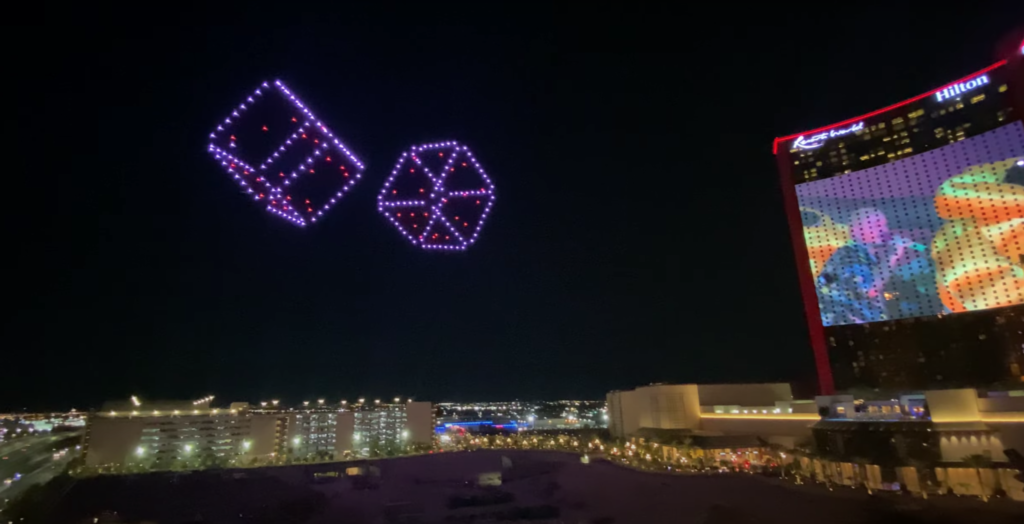
San Jose is the centre of the strongest corporate drone show market in the country. Most enquiries here are product launches, company milestones and campus events rather than municipal celebrations, and the brief usually starts with a logo. Hire UAV Pro produces those shows across Silicon Valley.
1,000+
Shows flown
$10M
Insured
50–5,000
Drones per show
Brand work in the Bay Area
We have produced a 300-drone brand activation in San Francisco and a 400-drone show for a global consulting firm on the Monterey Peninsula, alongside regular Bay Area work. Corporate shows here tend to be tightly branded and heavily filmed, which shapes how we design and where we recommend flying.
Where San Jose drone shows fly
Corporate campuses across the valley give private, controlled ground and are the most common venue by a wide margin. Downtown plazas and the convention centre precinct work for conferences. The stadium and arena district handles seated crowds, and parks across Santa Clara County suit community and civic events.
Season and clear evenings
Late spring through autumn is peak, and the South Bay gets noticeably clearer summer evenings than San Francisco or the coast — the marine layer that fogs the peninsula often does not reach this far inland. That makes San Jose one of the more reliable summer venues in the Bay Area, though wind thresholds still apply.
Silicon Valley airspace
San Jose International sits just north of downtown, with Moffett Field, Palo Alto and Reid-Hillview nearby and SFO and Oakland further up the bay. This is dense, busy airspace and campus locations vary considerably in what they allow. Send us the venue first and we will confirm early rather than after a plan is built around it.
Product launches and brand shows
For a launch, the sky is the largest brand surface available and the most filmed. We animate logos from vector files, match brand colours, form product silhouettes, and can fly a scannable QR code that puts your campaign in the audience’s hands mid-show. Every formation is previewed in 3D before approval, which makes brand and legal sign-off straightforward. See corporate drone shows and events.
What every San Jose show includes
Custom show design previewed in 3D before approval, the drone fleet sized to your audience, FAA Part 107 certified pilots and ground crew, airspace authorization and FAA coordination, $10 million insurance with certificates issued to your venue, site survey and crowd separation planning, music synchronization, and full production and teardown. Travel is built into the quote — no surprise mobilization fees.
San Jose Has One of the Friendliest Airspace Grids in California
This is the headline fact for drone shows in the South Bay, and it runs against the assumption that a Class C airport next to a dense metro means a closed sky.
We queried the FAA’s UAS Facility Map feature service directly at the coordinates of each venue below.
The San Jose grid, measured
San Jose Mineta’s facility map runs 357 cells, of which 188 — more than half — sit at the full 400 feet. Ceiling values present are 0, 100, 200, 300 and 400, and 347 of 357 cells are LAANC-enabled, so where authorization is needed it processes in near real time rather than through a federal queue.
More than half the mapped grid at full show altitude, with app-based approval, is a genuinely good position. Compare the rest of the state:
899 of LAX’s 969 cells are zero-foot. Only two cells anywhere in the Los Angeles grid reach 200 feet, and none reach 300 or 400. Anything inside the LAX surface area needs a Further Coordination Request rather than an instant approval.
San Diego’s entire grid tops out at 200 feet — not a single 300 or 400-foot cell anywhere in it — and Petco Park sits at 100.
San Jose, Ontario, Sacramento and Palm Springs are the friendliest of the big California grids, with a large majority of cells at 400 feet: San Jose 188 of 357, Ontario 170 of 365, Sacramento 162 of 342, Palm Springs 204 of 376.
So the South Bay is, on airspace, one of the easier places in California to put a fleet at real altitude.
Levi’s Stadium is the best big-stadium airspace position in the state
Levi’s Stadium in Santa Clara sits at a 400-foot ceiling under San Jose Mineta Class C, LAANC-enabled.
Full show altitude at a roughly 68,500-seat NFL venue, with an authorization that processes in minutes rather than months. As far as our measurements go, that is the most permissive big-stadium grid position in California — and the contrast with Petco Park’s 100 feet, or the LAX grid’s near-total zero-ceiling coverage, is stark.
For a client weighing Bay Area stadium venues, that is a material difference and it is not visible from any venue’s website.
The caution that comes with a varied grid
A grid with five distinct ceiling values is good news and a warning together. It means real altitude is available — and it means the ceiling can change over a short distance. Ten of San Jose’s 357 cells are not LAANC-enabled at all, which means a manual FAA DroneZone authorization rather than an instant approval, on a completely different timeline.
So the answer depends on the exact launch point and the full flight envelope, not on the city. We query the actual coordinates and the envelope rather than the venue centroid, and we re-check rather than relying on a lookup done weeks earlier. “San Jose is mostly 400 feet” is true and not sufficient.
Stadium restrictions
A standing FAA restriction covers stadiums with a seating capacity of 30,000 or more during regular and postseason MLB, NFL and NCAA Division I football, plus major races — a three nautical mile radius, surface up to and including 3,000 feet AGL, from one hour before the scheduled start until one hour after the end. It restricts all aircraft operations, unmanned included.
In the South Bay and the wider region that reaches Levi’s Stadium during the NFL season, Stanford Stadium and California Memorial Stadium at Berkeley during NCAA Division I football, Oracle Park during the MLB season, and the Oakland Coliseum.
The key operational point is that the restriction is event-triggered, not permanent. A show at Levi’s on a non-event date is unaffected — and given its 400-foot ceiling, a non-event-date show there is one of the most straightforward large-venue drone show prospects in California. A show timed to an actual game has to address the window explicitly, and a post-game show needs the window addressed rather than assumed to have lapsed, which is the most common planning error at venues this size. We verify your date against the FAA’s own Sporting Event Automated Monitoring System feed rather than reading a published schedule.
The South Bay Heat Penalty — and Why It Matters More Here Than in San Francisco
This is the trade San Jose makes against the rest of the Bay Area, and it is quantifiable.
Static propeller thrust scales roughly with air density, so what governs aircraft performance is density altitude rather than field elevation. We computed the figures below from the moist-air density equation at an altimeter setting of 29.92, using representative summer-afternoon conditions.
San Jose Mineta sits at 43 feet field elevation — essentially at sea level. On a hot summer afternoon at 91°F, the density altitude is about 2,298 feet.
That is a +2,255-foot excursion above field elevation, from heat alone.
The intra-Bay contrast is nearly 1,400 feet
Here is the comparison worth having in hand, because most people assume the Bay Area is one climate.
San Francisco International, 45 miles north, computes to about 902 feet density altitude on a typical summer afternoon — the lowest figure of any major California metro.
San Jose computes to about 2,298.
That is nearly 1,400 feet of density altitude difference inside a single metropolitan area, driven almost entirely by inland summer heat. The marine influence that keeps San Francisco cool, foggy and windy also keeps its air dense; San Jose, tucked at the south end of the Bay behind the coastal hills, trades that fog and wind for heat.
A fleet and flight plan built for a San Francisco waterfront evening is operating with materially more margin than the same show in Santa Clara on a hot afternoon. We plan to the venue rather than to the region, and we would tell you which side of that trade your date sits on.
Where San Jose still sits comfortably
In state context, 2,298 feet is a middling figure rather than a difficult one. For comparison across California: San Francisco about 902 feet, San Diego about 1,662, Los Angeles about 1,994, San Jose about 2,298, Sacramento about 2,722, Burbank about 3,578, Van Nuys about 3,658, Ontario about 3,903.
And the genuinely hard California venues are elsewhere entirely. Thermal, in the Coachella Valley, sits 128 feet below sea level and still exceeds 3,100 feet density altitude on a 109°F day — the terrain is beneath the ocean and the air performs as though it were three thousand feet up. Palm Springs shows the largest excursion we computed at +3,375 feet above field elevation. Mammoth exceeds 10,000 feet on a mild 79°F summer afternoon, which is the one California venue class where fleet sizing genuinely has to change.
Note the inversion of intuition in those numbers: Mammoth’s excursion above field elevation (+2,936 feet) is smaller than Palm Springs’ (+3,375). The mountains are harder in absolute terms; the desert is harder in relative terms. San Jose is in neither regime.
What that means practically
Your fleet size in San Jose is set by what the choreography needs to read at your audience’s viewing distance and by the airspace ceiling at your site — not by what the air will support.
Where the heat does matter is the setup-to-show delta. Density altitude falls after sunset, so a crew staging, test-flying and verifying a fleet in South Bay afternoon heat is working at a meaningfully higher density altitude than the show itself will see. A pre-flight that passes comfortably in the afternoon has margin to spare by showtime — and one that looks marginal at 3 p.m. is not necessarily a problem. Knowing which is which is the difference between an unnecessary scrub and a confident launch.
And an honest note on wind data
We have ten years of computed gust climatology for San Francisco International, and we are not going to extrapolate it to San Jose.
The reason is that the two stations measure genuinely different environments. SFO sits exposed to the marine gap and runs 28.6 days a year with gusts at or above 25 mph in July, its windiest month. San Jose sits 45 miles south behind the coastal hills with far less marine exposure and considerably more heat. Applying SFO’s numbers to Santa Clara County would overstate the wind and understate the temperature.
What we will do is compute the climatology for your actual venue and date before quoting, from the nearest station with usable records, and show you the numbers. That is a better answer than a regional average dressed up as local knowledge.
The Questions San Jose Producers Actually Ask
Can we fly at 400 feet in San Jose?
Across much of the city, yes, through LAANC. More than half of San Jose Mineta’s 357 grid cells — 188 of them — sit at the full 400 feet, and 347 of 357 are LAANC-enabled, so the authorization processes in near real time.
That is one of the friendliest big-airport grids in California. For contrast, 899 of LAX’s 969 cells are zero-foot, and San Diego’s entire grid tops out at 200 feet with Petco Park at 100.
So the airspace is never a problem here?
Mostly not, with two real caveats. The grid carries five distinct ceiling values — 0, 100, 200, 300 and 400 — so the ceiling can change over a short distance, and the answer depends on your exact launch point and full flight envelope rather than on the city. And ten of the 357 cells are not LAANC-enabled at all, which means a manual FAA DroneZone authorization on a completely different timeline.
“San Jose is mostly 400 feet” is true and not sufficient. We query the actual coordinates and the envelope.
What’s the best large venue in the area?
Levi’s Stadium in Santa Clara — a 400-foot ceiling under San Jose Mineta Class C, LAANC-enabled. Full show altitude at a roughly 68,500-seat NFL venue with a near-real-time authorization. As far as our measurements go that is the most permissive big-stadium grid position in California.
On a non-event date it is one of the most straightforward large-venue drone show prospects in the state.
Can we do a post-game show at Levi’s?
Yes, outside the restriction window. The standing restriction covers stadiums seating 30,000 or more during NFL, MLB and NCAA Division I football — three nautical miles, surface to 3,000 feet AGL, from an hour before the scheduled start to an hour after the end.
It is event-triggered, not permanent. A show on a non-event date is unaffected. A post-game show must address the window explicitly rather than assume it has lapsed — the most common error at venues this size. We verify your date against the FAA’s own Sporting Event Automated Monitoring System feed rather than a published schedule. Regionally that restriction also reaches Stanford Stadium, California Memorial Stadium, Oracle Park and the Oakland Coliseum in their seasons.
Are fireworks legal here?
Not for consumers. San Jose prohibits all consumer fireworks, including the “safe and sane” category that remains legal in Bakersfield, Fresno, Sacramento and Stockton. San Francisco, Oakland, Los Angeles, San Diego, Chula Vista, Irvine, Long Beach and Riverside are in the same position.
So there is no neighbourhood-fireworks trade competing with your event for a dark sky, and the local posture is already restrictive. A drone show here extends a direction the city has taken rather than fighting a tradition.
What does a professional fireworks display need that we don’t?
Two keys, and either one can stop the show.
A display in California requires a state Office of the State Fire Marshal licence — a pyrotechnic operator licence plus the appropriate public display class, special, general or limited — and a local fire-authority permit. Health and Safety Code §12522 defines a permit as one “granted by the public agency having local jurisdiction”; §12643 routes applications to the fire chief or another designated issuing authority; §12685 makes it unlawful to run a display without one; and §12541 makes local prohibition supreme over the state scheme. Penalties under §12700 run to a misdemeanour with a $500 to $1,000 fine and up to a year in county jail.
A drone show enters none of that chain. It is governed by the FAA under Part 107, by whatever land manager controls the ground, and by the local fire authority’s own operating conditions. We carry $10 million in drone aviation liability, multiples of any published floor in the country.
What actually stops a California drone show, then?
Usually the local fire authority, and the clearest case anywhere in the state is Long Beach. After Coastal Commission staff denied a fireworks permit and urged a switch to drones, the organiser said three meetings with Commission staff, city staff and the Long Beach Fire Department concluded a drone show over Alamitos Bay was not feasible.
The Fire Department’s conditions were: vertical movement only, no people underneath the flight path, and takeoff and landing from the same spot. The organiser says none of three drone companies he contacted could meet them.
Those are design and planning decisions rather than equipment decisions. An operator who can satisfy vertical-only flight, no overflight of people and single-point launch and recovery wins work that competitors turn down — and we would rather tell you that is how the hard California jobs get decided than pretend the FAA is the only gatekeeper.
Will the summer heat hurt our show?
It is the one real trade San Jose makes, and it is quantifiable. San Jose Mineta sits at 43 feet field elevation, but on a hot summer afternoon at 91°F the density altitude is about 2,298 feet — a +2,255-foot excursion from heat alone.
For context inside your own metro: San Francisco International computes to about 902 feet on a typical summer afternoon, the lowest of any major California metro. That is nearly 1,400 feet of difference inside one metropolitan area, driven by inland heat. The marine influence that keeps San Francisco cool, foggy and windy also keeps its air dense; San Jose trades the fog and wind for heat.
In state context 2,298 feet is middling rather than difficult — San Diego is about 1,662, Los Angeles 1,994, Sacramento 2,722, Burbank 3,578, Ontario 3,903. The genuinely hard California venues are elsewhere: Thermal sits 128 feet below sea level and still exceeds 3,100 feet on a 109°F day, Palm Springs shows the largest excursion at +3,375 feet, and Mammoth exceeds 10,000 feet.
Where the heat matters operationally is the setup-to-show delta. Density altitude falls after sunset, so a crew test-flying in South Bay afternoon heat is working meaningfully higher than the show will see. A pre-flight that passes comfortably in the afternoon has margin to spare by showtime, and one that looks marginal at 3 p.m. is not necessarily a problem.
What about fog and wind — isn’t the Bay Area bad for that?
San Francisco is; San Jose considerably less so, and we are not going to pretend our San Francisco numbers describe your venue.
We have ten years of computed gust climatology for San Francisco International, which runs 28.6 days a year with gusts at or above 25 mph in July, its windiest month, with the fog season overlapping the windy season from April through July. SFO sits exposed to the marine gap.
San Jose sits 45 miles south behind the coastal hills, with far less marine exposure and considerably more heat. Applying SFO’s numbers here would overstate the wind and understate the temperature, so we do not. We compute the climatology for your actual venue and date from the nearest station with usable records and show you the numbers — which is a better answer than a regional average dressed up as local knowledge.
When should we schedule?
Across coastal and Bay California, September and October are the strongest months — near-zero precipitation, falling wind, and the marine layer well past its May-to-July peak. In San Francisco specifically, October carries 18.1 days a year above 25 mph against July’s 28.6.
For a South Bay venue the calculus shifts slightly: less marine exposure means summer is more workable than it is on the coast, but inland heat makes the density altitude and the crew conditions worse in July and August. Early autumn remains the best combination of both, and we would rather talk you into it than take a July booking and hope.
How many drones do we need?
It depends on viewing distance, the airspace ceiling at your site, and what you want the audience to read in the sky. For California reference: the La Jolla Sky Show runs 500 drones, SeaWorld San Diego’s coastal permit allows up to 1,000, and Napa carries a city celebration for an estimated 24,000 people on 400.
More drones means more resolution in the imagery rather than simply more lights. At Levi’s 400-foot ceiling you have the full canvas to work with, which is not true at most big California venues, and we size to the geometry rather than to a package tier.
Should we replace our fireworks or add to them?
California gives you both templates. Pasadena replaced the Rose Bowl’s 4 July fireworks with a drone show in 2025, citing fire and air-quality risk and the Eaton Fire burn scars. Napa is on its third consecutive drone show — 400 drones, 15 minutes, 24,000 people downtown, a city council decision citing fire risk, debris found on private property near the old launch site, particulates triggering asthma, and noise impacts on animals and on people with PTSD. La Jolla is in its fourth year on 500 drones. Oceanside ran fireworks and drones together as one combined production.
One honest note: SeaWorld San Diego brought fireworks back specifically for 4 July 2026 despite its drone transition. So “drones are replacing fireworks in California” is directionally true and not absolute. The realistic pattern is drones as the regular programme with pyrotechnics kept for the biggest night, or the two together as one show. We will build either and be straight about what each costs.
Why hire a Colorado company for a San Jose show?
Because what you are buying is the analysis on this page plus the aircraft and crew to execute it. That more than half your grid is at the full 400 feet while LAX is almost entirely zero-ceiling and San Diego caps at 200; that Levi’s Stadium has the most permissive big-stadium airspace in California; that ten of your 357 cells need a manual authorization on a different timeline; that your density altitude runs nearly 1,400 feet above San Francisco’s inside the same metro; that the Long Beach Fire Department’s vertical-only, no-overflight, single-point conditions are what actually kill California jobs — that is work done because it decides whether a show flies and on which date. We fly nationally, we carry $10 million in drone aviation liability, and we would rather tell you a venue or a date is wrong in the first conversation than in week eleven.
San Jose drone show FAQ
Can you put our logo or product in the sky?
Yes — logos, brand colours, product shapes and scannable QR codes, all previewed in 3D before approval.
How much does a San Jose drone show cost?
Fleet size drives the price, then animation, travel and duration, with exact pricing in 24 hours. See our cost guide.
How many drones does a corporate event need?
Most corporate audiences are well served at 100 to 200. Launches with large or distant crowds want 300 or more.
Can you fly on our campus?
Often yes, but it depends on the exact location. We confirm the airspace before anything is planned.
Drone shows near San Jose
We fly across the region. Nearby: San Francisco · Oakland · Sacramento · Fresno. See California drone light shows for everything we have flown statewide, or explore drone show rental and corporate drone shows and events.
Book a San Jose drone show
Tell us your date, venue and audience and we will send a custom concept and exact pricing within 24 hours.
More Drone Light Shows in California
We fly across California. See all California drone light shows, or a nearby city or venue:
Santa Barbara · Santa Monica Pier · Stanford · UCLA · USC · Ventura · Bakersfield · Coronado Beach · Fresno · Fresno · Golden Gate Bridge Overlook · Hollywood Bowl
Book a San Jose drone show
Tell us your date, venue and audience and we will send a custom concept and exact pricing within 24 hours.