
San Diego Drone Light Shows
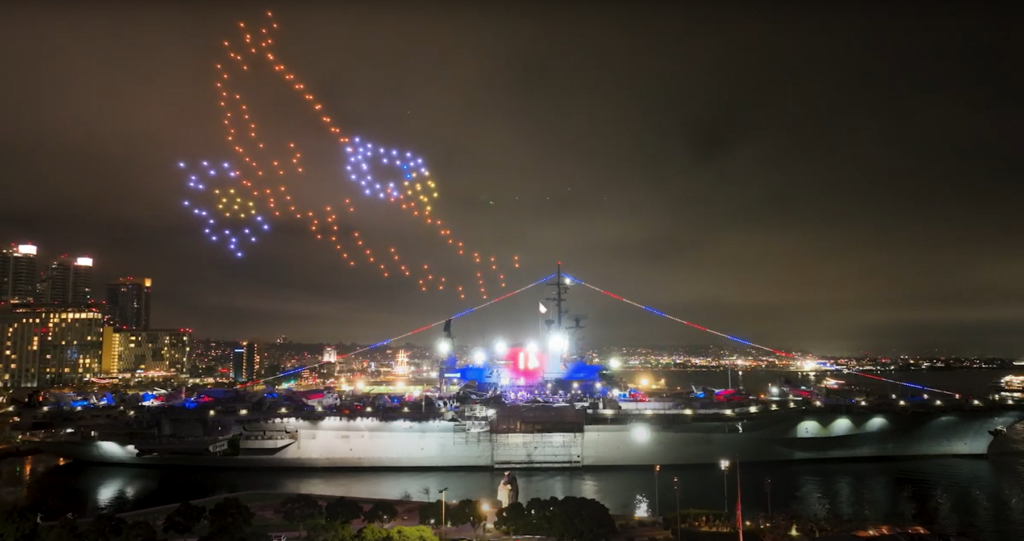
San Diego’s relationship with the ocean is foundational. The city wraps around the bay—a natural amphitheater of water where sightlines span miles and the skyline is defined by aircraft carriers, sailboats, and the Coronado Bridge stretched across turquoise water. We’ve flown drone shows above the USS Midway with 200 drones synchronized against the Pacific, creating a moment that felt simultaneously military-historical and cutting-edge technological. San Diego offers waterfront venues unlike anywhere else: bay-adjacent parks, beachfront resorts, maritime neighborhoods, and the unique geometry of a city where water and urban infrastructure intersect intimately. For brands and event organizers, that geography creates natural stages where drone shows become not just entertainment but visual narratives built directly into the landscape.
Aerial Light Shows for San Diego Game Days and Stadium Activations
San Diego gives event producers an unusually long runway. Padres baseball fills spring and summer, San Diego FC brings Major League Soccer matchdays, San Diego Wave FC draws its own strong following, the Gulls skate through the winter, and San Diego State Aztecs football anchors the college schedule. Marketing managers and activation agencies working any of those properties can use a drone display to mark a home opener, a rivalry night, a sponsor takeover, a jersey reveal or a postgame sendoff. Our fleets scale from seventy aircraft up past three hundred, and the animation can be timed to a broadcast window, a walk-off moment or a plaza concert.
Fire risk shapes what is allowed here. Santa Ana winds and dry coastal brush push restrictions onto anything that sparks, and a stadium owner has little appetite for shell debris landing on a playing surface. Drone formations burn nothing and drop nothing, which is why they clear reviews that ground a pyro plan. Pilots on every job hold FAA Part 107 certification, the company carries aviation liability of ten million dollars, and the crew has logged over one thousand shows. Send details through the contact form and we will map the airspace.
More Drone Light Shows in California
We fly across California. See all California drone light shows, or a nearby city or venue:
San Francisco · San Jose · San Jose · Santa Barbara · Santa Monica Pier · Stanford · UCLA · USC · Ventura · Bakersfield · Coronado Beach · Fresno
San Diego Airspace, Measured Site by Site
San Diego has one airspace constraint that shapes every show in the city, and it is worth knowing before you choose a venue.
We queried the FAA’s UAS Facility Map feature service directly at the coordinates of each venue below.
The whole San Diego grid caps at 200 feet
Across the entire San Diego International Class B facility map, the ceiling values present are 0, 50, 100, 150 and 200 feet. There is not a single 300-foot or 400-foot cell anywhere in it.
That is unusual, and it is the defining fact for drone shows in this city. 312 of the grid’s 318 cells are LAANC-enabled, so where a ceiling exists the authorization processes in near real time — but the ceiling itself is the binding constraint, not the paperwork.
Petco Park sits at a 100-foot ceiling.
One hundred feet. A 100-foot cap is a severe choreographic constraint — a quarter of the vertical canvas available at a 400-foot venue — and it changes what content can read at any audience distance. It is a workable show designed very differently, and anyone quoting you a 400-foot show at Petco has not queried the coordinates.
A zero-foot or low-ceiling cell does not mean flight is prohibited. It means no automated LAANC auto-approval at a useful altitude, and a higher operation requires an FAA airspace authorization or a Further Coordination Request — a roughly 90-day process rather than a near-real-time one. For a marquee downtown show, that is a long-lead project, and the lead time is what we want to establish in the first conversation rather than the eleventh week.
How San Diego compares across California
Worth stating plainly, because the state varies enormously.
Los Angeles is worse. 899 of LAX’s 969 cells are zero-foot; only two cells anywhere in the LAX grid reach 200 feet, and none reach 300 or 400. Anything inside the LAX surface area needs a Further Coordination Request rather than an instant approval.
San Diego is similar in character — a low ceiling across the board, topping out at 200.
The Bay Area and the Inland Empire are much friendlier. San Jose’s grid has 188 of 357 cells at the full 400 feet, Ontario 170 of 365, Sacramento 162 of 342. San Francisco has the most granular grid in the state, with nine distinct ceiling values from 0 to 400.
So a San Diego client should understand that the constraint here is real and local, and that venue selection carries more weight in this city than almost anywhere else in the state.
The restricted area north of the city
One hard caution for North County venues. Camp Pendleton’s restricted area R-2503A runs from the surface to 2,000 feet and sits immediately north of Oceanside.
That matters specifically because the SoCal Soccer Complex at El Corazon on El Corazon Drive in Oceanside — which ran a combined fireworks and drone show on 3 July 2026 — sits close to it. A restricted area is not a grid ceiling; it is a different legal animal requiring coordination with the controlling agency, and the flight envelope has to be checked against the boundary rather than against the venue’s street address.
Stadium restrictions
A standing FAA restriction covers stadiums with a seating capacity of 30,000 or more during regular and postseason MLB, NFL and NCAA Division I football, plus major races — a three nautical mile radius, surface up to and including 3,000 feet AGL, from one hour before the scheduled start until one hour after the end. It restricts all aircraft operations, unmanned included.
In San Diego that reaches Petco Park at roughly 40,200 seats during the MLB season, and Snapdragon Stadium during NCAA Division I football.
The key operational point is that the restriction is event-triggered, not permanent. A show on a non-event date is unaffected. A show timed to an actual game has to address the window explicitly, and a post-game show needs the window addressed rather than assumed to have lapsed — the most common planning error at venues this size. We verify your date against the FAA’s own Sporting Event Automated Monitoring System feed rather than reading a published schedule.
At Petco specifically, though, the 100-foot grid ceiling is the larger constraint by a wide margin.
The SeaWorld Permit — California’s Only Published Drone Show Operating Conditions
This is the most valuable document in the California drone show market, and almost nobody in the events business has read it.
In April 2026 the California Coastal Commission considered Coastal Development Permit application 6-26-0102 from SeaWorld San Diego: up to 110 drone shows over Mission Bay in a one-year pilot, each roughly 15 minutes, each using up to 1,000 illuminated drones, replacing fireworks as the end-of-evening display. Staff recommended approval with conditions.
Those conditions are, as far as we can find, the only hard, published set of drone show operating parameters in California regulation. They are worth knowing because they are now the template a coastal regulator is likely to reach for.
What the permit actually requires
Altitude: capped at 660 feet MSL with a floor of 165 feet MSL, except during launch and landing. Note that is a floor as well as a ceiling — the show is required to stay above 165 feet.
Containment: show boundaries fixed by exhibit. Drones must return to the performance area or deactivate if they drift outside it. Any drone landing outside the leasehold must be retrieved and reprogrammed before reuse.
Frequency: 15 minutes, once per night.
Sound: music through the existing park sound system, with no new outdoor speakers.
Monitoring: at least 20% of shows monitored each month, across the full pilot to capture seasonal variation. Noise and light monitored at the Stony Point least tern site and the Perez Cove heron rookery. Bird strikes monitored. At least one fireworks show monitored for comparison. Behavioural monitoring at FAA Island during breeding season.
Suspension thresholds: 65 dB(A) — or ambient if higher — or a light increase of more than 0.1 footcandle.
Term: no fireworks on a drone show night, and each drone show reduces the annual fireworks quota of 150 by one.
Why that matters to your event
Three things.
First, it gives you numbers to design to. 65 dB(A) and 0.1 footcandle are measurable engineering targets, not vague environmental concerns. An operator who can tell a regulator or a venue what their show measures against those thresholds is in a different conversation from one who cannot.
Second, the altitude floor is instructive. A 165-foot minimum is a wildlife and public-safety measure, and it sits oddly alongside San Diego’s grid ceilings. On the Mission Bay leasehold the permit allows up to 660 feet MSL; across much of the city the UASFM caps auto-approval at 100 or 200 feet AGL. Reconciling those two numbers is a real planning exercise and it is site-specific.
Third, what the permit does NOT contain is as instructive as what it does. There is no marine-mammal protection condition and no nesting-season blackout on scheduling. Marine mammals are noted as present in Mission Bay; breeding season appears only as a behavioural-monitoring trigger, not as a date restriction. That is useful to know before someone tells you a coastal show cannot be scheduled in spring.
How it came about
The permit follows a March 2025 lawsuit by the Coastal Environmental Rights Foundation and San Diego Coastkeeper over alleged pollution of Mission Bay and violation of the park’s Clean Water Act fireworks permit. The settlement has SeaWorld end summer fireworks and adopt drone shows as a permanent replacement, contingent on the one-year pilot. The first drone show ran Memorial Day weekend 2026.
Phillip Musegaas of San Diego Coastkeeper framed it carefully: “Our goal from the beginning was to stop the pollution and protect Mission Bay… We are not seeking a ban on fireworks across San Diego. That’s not our goal.”
And the Commission’s general posture is now on record. A Coastal Commission analyst told the Los Angeles Times that “there has been direction from the commission to see a transition to drones,” while noting that shows are reviewed case by case.
The counter-case, which is the most commercially useful item of all
In Long Beach, Commission staff denied the fireworks permit for “Big Bang on the Bay” and repeatedly urged a switch to drones. The organiser appealed, and said that three meetings with Commission staff, Long Beach city staff and the Long Beach Fire Department concluded a drone show over Alamitos Bay was not feasible without limiting boat traffic and beach access.
Here is the part that matters. The Fire Department’s conditions for drone flight were: vertical movement only, no people underneath the flight path, and takeoff and landing from the same spot. The organiser says none of the three drone companies he contacted could meet them.
That is the authority-having-jurisdiction constraint, not the FAA, and it is what killed the job. An operator who can satisfy vertical-only flight, no overflight of people, and single-point launch and recovery wins work that competitors turn down — and those are design and planning decisions, not equipment decisions.
We would rather tell you that is how the hard jobs in California get decided than pretend the FAA is the only gatekeeper.
Fireworks Law, Fire Risk, and Why San Diego Has Already Moved
All consumer fireworks are illegal in the City of San Diego
San Diego prohibits all consumer fireworks, including the “safe and sane” category that is legal in parts of the state. It is in company — Chula Vista, Irvine, Long Beach, Los Angeles, Oakland, Riverside, San Francisco and San Jose all prohibit them outright, while Bakersfield, Fresno, Sacramento and Stockton permit safe and sane.
So in San Diego there is no neighbourhood-fireworks trade competing with your event for a dark sky, and the local posture is already restrictive. Proposing a drone show here means extending a direction the city has already taken.
The two keys a professional display needs — and a drone show does not
This is the structural point worth understanding, because it is where the risk lives.
A professional pyrotechnic display in California requires both a state Office of the State Fire Marshal licence — a pyrotechnic operator licence plus the appropriate public display class, special, general or limited — and a local fire-authority permit.
Health and Safety Code §12522 defines a permit as one “granted by the public agency having local jurisdiction.” §12643 routes applications to the chief of the city or county fire department, the chief fire prevention officer, or another designated issuing authority. §12685 makes it unlawful to conduct a public display “without possessing a valid permit for this purpose.”
Either key can stop the show. And §12541 makes local supremacy explicit: nothing in the state law authorises the sale, use or discharge of fireworks in any city or county where it “is otherwise prohibited or regulated by law or ordinance.”
Penalties under §12700 run to a misdemeanour with a $500 to $1,000 fine and up to a year in county jail, with far larger exposure for possession of dangerous fireworks by weight.
None of that chain applies to a drone show. A drone show is governed by the FAA under Part 107, by whatever land manager controls the ground, and — on the coast — by the Coastal Commission and the local fire authority’s own operating conditions. It needs no OSFM pyrotechnic operator licence and no fireworks display permit.
We carry $10 million in drone aviation liability, which is multiples of any published floor in the country.
San Diego County has already converted, repeatedly
This is not a speculative market here. It is a market with four years of local precedent.
La Jolla Sky Show — 2026 was the fourth consecutive year La Jolla ran a drone show instead of fireworks. 500 synchronised drones over La Jolla Cove at 8:45 p.m., best viewed from Kellogg Park at La Jolla Shores.
SeaWorld San Diego — up to 110 drone shows a year under the Coastal Development Permit described above, with up to 1,000 drones each.
Fallbrook — a drone show at Ingold Sports Park at 9 p.m., organised by the Rotary Club and the Fallbrook Chamber of Commerce for the America 250 celebration.
Oceanside — a combined fireworks and drone show at the SoCal Soccer Complex at El Corazon on 3 July 2026.
Further north in the state the same pattern holds. Pasadena replaced the Rose Bowl’s 4 July fireworks with a drone show in 2025, citing fire and air-quality risk and the burn scars from the Eaton Fire. Napa ran its third consecutive drone show in 2026 — 400 drones, 15 minutes, with an estimated 24,000 people downtown — a city council decision citing regional fire risk, firework debris found on private property near the old launch site, inhalable particulates triggering asthma, strontium and barium content, and noise impacts on animals and on people with PTSD.
Two honest notes we would rather you heard from us
SeaWorld brought fireworks back specifically for 4 July 2026, despite its drone transition. So “drone shows are replacing fireworks in California” is directionally true and not absolute — the realistic pattern is drones as the regular programme with pyrotechnics retained for the single biggest night, or the two running together as one production.
And the counter-argument deserves airing. Stephen Houser, a former president of the National Fireworks Association, put it this way: “The audience reaction to a show involving fireworks is much more positive than just a drone show.”
We think that is sometimes true and sometimes not, and it depends entirely on whether the drone show was designed for the venue and the audience distance or pulled off a shelf. A 100-drone show at the wrong standoff reads as a toy. A properly sized fleet, synchronised to music, telling a story specific to the event, does something fireworks cannot. We would rather have that conversation honestly with you than lead with a claim that the audience will not back up.
Oceanside is the model worth looking at
Of all the San Diego County examples, the Oceanside structure — fireworks and drones as one combined production — is the one we would point a nervous committee toward. It keeps the thing the audience expects, adds the thing that can carry a brand, a message or a story, and lets you measure the response before making a permanent decision.
When To Fly in San Diego, and What the Heat Costs
The marine layer is the scheduling hazard, not the wind
San Diego’s wind is genuinely benign by national standards. What catches shows out here is cloud, and specifically the way it arrives.
The marine layer — May Gray and June Gloom — forms over the cool California Current, capped by a temperature inversion from the North Pacific High. It is strongest in May and June, and San Diego sees roughly 58% and 57% of possible sunshine in those two months respectively.
The diurnal cycle is the operationally important part. Cloud usually moves in after midnight, reaches its maximum at dawn, and typically clears between mid-morning and early afternoon. But on strong days it can persist into the evening.
Here is why that matters more for a drone show than for almost any other outdoor event. A drone show is viewed from the ground looking up. A stratus deck at or below show altitude does not dim the display — it hides it entirely. And it can arrive after a go/no-go call made in clear late-afternoon conditions.
That evening-persistence case is the real San Diego scheduling hazard, and it is a reason to be wary of May and June dates and to build the decision point later in the afternoon than instinct suggests.
Late August through early October is the best window on the Southern California coast — near-zero precipitation, minimal marine-layer influence compared with May through July, and Santa Ana activity not yet at its peak.
What “sea level” actually costs you
Static propeller thrust scales roughly with air density, so what governs aircraft performance is density altitude rather than field elevation. We computed the figures below from the moist-air density equation at an altimeter setting of 29.92, using representative summer-afternoon conditions.
San Diego International sits at 10 feet field elevation. On a typical summer afternoon — 81°F with an 18°C dewpoint — the density altitude is about 1,662 feet.
That is the point worth making: “sea level” is not the same as “sea-level performance.” A city effectively at the waterline still flies at better than 1,600 feet density altitude on a warm afternoon, purely from temperature and humidity.
It is still an excellent number. For comparison, the same calculation gives Los Angeles about 1,994 feet, San Jose about 2,298, Sacramento about 2,722, Burbank about 3,578 and Ontario about 3,903. San Diego has the second-lowest density altitude of any major California metro, behind only San Francisco at about 902 feet.
And the California numbers that put it in perspective
Two comparisons are worth having in hand, because they explain where in this state fleet sizing actually has to change.
Thermal, in the Coachella Valley, sits 128 feet below sea level and still reaches a density altitude above 3,100 feet on a 109°F day. The terrain is beneath the ocean and the air performs as though it were three thousand feet up. Palm Springs shows the largest excursion of any site we computed: +3,375 feet above field elevation. The desert resorts, not the mountains, are California’s hot-and-high problem in relative terms.
Mammoth exceeds 10,000 feet density altitude on a mild 79°F summer afternoon — the one California venue class where fleet sizing genuinely has to change.
San Diego is nowhere near either regime. Your fleet size here is set by the airspace ceiling and by what the choreography needs to read at your audience’s viewing distance — not by what the air will support.
The Questions San Diego Producers Actually Ask
Can we do a 400-foot show in San Diego?
Not under an automated authorization, and this is the defining constraint in this city. The entire San Diego International Class B facility map tops out at 200 feet — the ceiling values present across all 318 cells are 0, 50, 100, 150 and 200. There is not a single 300 or 400-foot cell anywhere in it.
A higher operation is possible through an FAA airspace authorization or Further Coordination Request, on roughly a 90-day timeline rather than a near-real-time one. So a high-altitude downtown show is a long-lead project, and the lead time is what we want to establish in the first conversation.
What about Petco Park specifically?
100-foot ceiling. That is a quarter of the vertical canvas available at a 400-foot venue, and it fundamentally changes what content can read at any audience distance. It is a workable show designed very differently — and anyone quoting you a 400-foot show at Petco has not queried the coordinates.
Petco also carries MLB stadium restriction windows in season, but at 100 feet the grid ceiling is the far larger constraint.
Is San Diego worse than other California cities?
Better than Los Angeles, worse than the Bay Area and the Inland Empire. 899 of LAX’s 969 cells are zero-foot, with only two cells anywhere in that grid reaching 200 feet and none reaching 300 or 400. San Diego at least has a consistent 200-foot ceiling across much of its grid.
The friendlier California grids are inland and north: San Jose has 188 of 357 cells at the full 400 feet, Ontario 170 of 365, Sacramento 162 of 342. San Francisco has the most granular grid in the state with nine distinct ceiling values.
The practical upshot: venue selection carries more weight in San Diego than almost anywhere else in California, and it is worth having that conversation before a date is promised.
We’re in North County. Anything we should know?
Yes, and it is a hard one. Camp Pendleton’s restricted area R-2503A runs from the surface to 2,000 feet and sits immediately north of Oceanside. A restricted area is a different legal animal from a grid ceiling — it requires coordination with the controlling agency, not a LAANC request.
That matters specifically for venues like the SoCal Soccer Complex at El Corazon on El Corazon Drive. We check the flight envelope against the actual boundary rather than against the venue’s street address.
Will we need a Coastal Commission permit?
For a show over or adjacent to coastal waters, very possibly — and the good news is that there is now a published template. The SeaWorld Coastal Development Permit, application 6-26-0102, authorises up to 110 shows a year over Mission Bay, each about 15 minutes with up to 1,000 drones.
Its conditions are, as far as we can find, the only hard published set of drone show operating parameters in California regulation: altitude capped at 660 feet MSL with a floor of 165 feet MSL; drones must return to the performance area or deactivate if they drift out; any drone landing outside the leasehold must be retrieved and reprogrammed before reuse; 15 minutes, once per night; music through existing speakers only; at least 20% of shows monitored monthly, including noise and light at a least tern site and a heron rookery, plus bird-strike monitoring; and suspension thresholds of 65 dB(A) or a light increase above 0.1 footcandle.
Those are measurable engineering targets, and an operator who can tell a regulator what their show measures against them is in a completely different conversation from one who cannot.
Worth knowing what the permit does not contain: no marine-mammal protection condition and no nesting-season blackout on scheduling. Breeding season appears only as a behavioural-monitoring trigger, not a date restriction.
Is the Coastal Commission hostile to this?
The opposite. A Commission analyst told the Los Angeles Times that “there has been direction from the commission to see a transition to drones,” while noting shows are reviewed case by case. In Long Beach, Commission staff denied a fireworks permit and repeatedly urged a switch to drones.
So what actually stops a coastal drone show?
Usually the local fire authority, not the FAA — and the Long Beach case is the clearest example anywhere in the state.
When “Big Bang on the Bay” lost its fireworks permit, the organiser said three meetings with Commission staff, city staff and the Long Beach Fire Department concluded a drone show over Alamitos Bay was not feasible. The Fire Department’s conditions were: vertical movement only, no people underneath the flight path, and takeoff and landing from the same spot. The organiser says none of three drone companies he contacted could meet them.
That is the authority-having-jurisdiction constraint, and it is what killed the job. Those are design and planning decisions rather than equipment decisions — an operator who can satisfy vertical-only flight, no overflight of people and single-point launch and recovery wins work competitors turn down. We would rather tell you that is how the hard coastal jobs get decided than pretend the FAA is the only gatekeeper.
Are fireworks legal here at all?
Not for consumers. San Diego prohibits all consumer fireworks, including the “safe and sane” category that is legal in Bakersfield, Fresno, Sacramento and Stockton. Chula Vista, Irvine, Long Beach, Los Angeles, Oakland, Riverside, San Francisco and San Jose are in the same position.
A professional display needs two keys: a state Office of the State Fire Marshal licence — pyrotechnic operator plus the right public display class — and a local fire-authority permit under Health and Safety Code §12643. Health and Safety Code §12685 makes it unlawful to run a display without a valid permit, and §12541 makes local prohibition supreme over the state scheme. Either key can stop the show.
A drone show enters none of that chain.
When should we schedule?
Late August through early October. Near-zero precipitation, minimal marine-layer influence compared with May through July, and Santa Ana activity not yet at its peak.
Be wary of May and June. San Diego sees roughly 58% and 57% of possible sunshine in those months, and the marine layer is at its strongest.
Why does the marine layer matter so much for a drone show?
Because of the viewing geometry. A drone show is watched from the ground looking up, so a stratus deck at or below show altitude does not dim the display — it hides it entirely.
And the timing is the trap. Cloud typically moves in after midnight, peaks at dawn and clears between mid-morning and early afternoon — but on strong days it can persist into the evening, arriving after a go/no-go call made in clear late-afternoon conditions. We set the decision point later in the afternoon than instinct suggests, and we build the contingency into the plan rather than discovering it at showtime.
Will the heat affect performance?
Barely, and San Diego is one of the best markets in the state for it. San Diego International sits at 10 feet field elevation, and on a typical warm summer afternoon the density altitude is about 1,662 feet — second-lowest of any major California metro behind San Francisco at about 902.
Worth knowing the honest version though: “sea level” is not the same as “sea-level performance.” A city at the waterline still flies at better than 1,600 feet density altitude on a warm afternoon, purely from temperature and humidity. For comparison, Los Angeles computes to about 1,994 feet, San Jose 2,298, Burbank 3,578 and Ontario 3,903.
Where it genuinely changes the engineering is inland and up. Thermal, in the Coachella Valley, sits 128 feet below sea level and still exceeds 3,100 feet density altitude on a 109°F day, and Palm Springs shows the largest excursion we computed at +3,375 feet above field elevation. Mammoth exceeds 10,000 feet. San Diego is nowhere near any of that.
How many drones do we need?
It depends on viewing distance, the airspace ceiling at your site, and what you want the audience to read in the sky. For local reference: the La Jolla Sky Show runs 500 drones over La Jolla Cove, and SeaWorld’s permit allows up to 1,000. Napa carries a city celebration for an estimated 24,000 people on 400.
More drones means more resolution in the imagery rather than simply more lights — and at a 100-foot ceiling the right number is different from a 660-foot one. We size to the geometry and to the ceiling, and we tell you where extra aircraft stop buying you anything.
Should we replace our fireworks or add to them?
San Diego County gives you both templates, and we would point a cautious committee at the hybrid.
La Jolla replaced outright and is now in its fourth consecutive year on 500 drones. Oceanside ran fireworks and drones as one combined production on 3 July 2026 — which keeps what the audience expects, adds what can carry a brand or a story, and lets you measure the response before committing permanently.
One honest note: SeaWorld brought fireworks back specifically for 4 July 2026 despite its drone transition. So “drones are replacing fireworks in California” is directionally true and not absolute. The realistic pattern is drones as the regular programme with pyrotechnics kept for the single biggest night, or the two together as one show.
And the counter-argument deserves airing: a former president of the National Fireworks Association has said audience reaction to a show involving fireworks “is much more positive than just a drone show.” Sometimes that is true. It depends entirely on whether the drone show was designed for the venue and the audience standoff or pulled off a shelf — a badly sized fleet at the wrong distance reads as a toy, and a properly sized one synchronised to music does something fireworks cannot.
Why hire a Colorado company for a San Diego show?
Because what you are buying is the analysis on this page plus the aircraft and crew to execute it. That the whole San Diego grid caps at 200 feet and Petco is 100; that Camp Pendleton’s restricted area reaches the surface immediately north of Oceanside; that the SeaWorld permit sets a 165-foot floor and 65 dB(A) and 0.1 footcandle suspension thresholds you can design to; that the Long Beach Fire Department’s vertical-only, no-overflight, single-point conditions are what actually killed a job there; that the marine layer can arrive after your go/no-go call — that is work done because it decides whether a show flies and on which date. We fly nationally, we carry $10 million in drone aviation liability, and we would rather tell you a venue or a date is wrong in the first conversation than in week eleven.
San Diego’s Unique Geography for Drone Operations
San Diego’s bay-centric layout offers operational advantages distinct from other coastal cities. The bay itself—protected from open ocean, relatively constrained in geography—serves as an ideal launch and flight zone for large drone shows. Water-based operations eliminate ground-level crowd management complexities and offer open airspace away from urban congestion. We demonstrated this at the USS Midway, where 200 drones flew coordinated shows above and around the historic carrier, creating a visual narrative that merged historical significance with technological spectacle.
The city’s weather is remarkably cooperative year-round. San Diego averages 260 days of sunshine, and winds rarely approach the thresholds that challenge drone operations. Unlike coastal cities where marine layers and temperature inversions constrain flight windows, San Diego offers consistent, reliable conditions across seasons. This operational reliability translates to scheduling flexibility and minimal weather-related contingencies.
San Diego’s airspace proximity to military operations (Naval Air Station North Island, Naval Base San Diego) requires specific regulatory expertise. We’ve navigated these constraints successfully, as evidenced by our USS Midway execution. Our Part 107 certification, multi-UAS waiver, and night operations authorization—combined with our experience coordinating with military airspace managers—enable operations that less-experienced operators cannot access.
For a full breakdown of everything drone light shows, visit our comprehensive drone light show guide page
Event Types That Leverage San Diego’s Assets
Waterfront corporate events are natural fits. Product launches, brand activations, company celebrations at bay-adjacent venues or beachfront resorts—these benefit dramatically from the visual drama of drone shows coordinated over water. The combination of water backdrop, downtown skyline, and synchronized aerial formations creates visual impact that terrestrial events cannot achieve.
Tourism and hospitality events thrive here. Resort openings, hotel anniversary celebrations, destination-level event activations—San Diego’s status as a premier tourism and hospitality destination creates demand for spectacular entertainment moments. A drone show above a beachfront resort, coordinated with sunset and music, becomes a signature brand moment guests remember and share.
Military and historical commemoration events represent another opportunity. Naval anniversaries, military appreciation events, historical celebrations tied to San Diego’s maritime heritage—drone shows can integrate respectfully with these narratives. The USS Midway show demonstrated how drones can honor historical significance while showcasing technological capability.
Festival and public celebration events in neighborhoods like Little Italy, the Gaslamp Quarter, or beachfront parks attract large crowds and create natural venues for drone shows. Summer concert series, cultural festivals, seasonal celebrations—these events benefit from the novelty and visual drama drones provide to downtown and waterfront audiences.
Entertainment partnerships with major venues—the Zoo, the Fleet Science Center, beachfront amphitheaters—create integrated entertainment moments. Drone shows can serve as signature elements of larger entertainment programs, drawing crowds and generating media attention.
San Diego Drone Show Pricing
We offer shows ranging from 100 to 5,000 drones, with pricing starting as low as $10,000. The final cost depends on drone count, animation complexity, location, and timing. Our team will put together a transparent, all-inclusive quote based on your event’s specific needs.
All packages include design, choreography, San Diego permitting (including military airspace coordination where applicable), staffing, insurance, and music synchronization. Our $10 million aviation and umbrella insurance covers all San Diego operations. Custom quotes available for shows exceeding 2,000 drones or for multi-venue regional campaigns.
How We Work: Waterfront Expertise in Execution
San Diego operations begin with detailed site assessment. We visit your venue, understand the waterfront geometry, assess crowd management logistics, and map airspace constraints in relation to military corridors and commercial traffic. If military airspace coordination is required, we manage those conversations directly with relevant authorities.
Design and choreography follow. We develop fully custom animations matched to your event narrative, your brand, your music, and your venue. San Diego’s waterfront settings allow for visually distinctive compositions—formations that leverage the bay as backdrop, the bridge as reference point, or the downtown skyline as visual context. Every show is unique.
Testing and weather contingency planning begin weeks before launch. San Diego’s cooperative weather makes contingency planning simpler than many markets, but we still conduct full simulations and maintain clear communication about any climate considerations. Our proprietary software runs detailed animations against your specific venue’s geometry and waterfront conditions.
Deployment day is comprehensive and professional. Our team arrives early, sets up launch zones (whether land-based or water-based), conducts full fleet inspection, and manages all regulatory coordination with local authorities, port agencies, and military airspace managers. Launch typically occurs at sunset, providing optimal visual contrast against the Pacific and downtown lights.
Our Fleet: Two Systems Built for Every Event
We operate two professional drone platforms, giving you the flexibility to match your event’s scale and budget.
The Kaiken is our lightweight, durable, and cost-effective system — built for events that want professional quality at an accessible price point. It’s reliable, proven, and delivers clean formations and vivid color across the night sky.
The Damoda V4 is our premium platform — powerful, bright at 2,200+ lumens RGBW, and equipped with cutting-edge safety features including parachute recovery, GPS-fenced flight boundaries, automatic return-to-home, and fail-safe landing. The Damoda V4 also comes with a free second launch the same night, giving your audience up to 20 minutes of aerial entertainment across two performances.
Both systems are operated by FAA Part 107 certified pilots under multi-UAS and night operations waivers, backed by $10 million in aviation and umbrella insurance.
Ready to Create a San Diego Moment?
Whether you’re planning a corporate waterfront event, launching a brand experience, celebrating a milestone, activating a major venue, or creating a public celebration, we have the experience and expertise to deliver something memorable.
Ready to get started? Book a drone show and our team will put together a custom proposal within 48 hours.
San Diego has always been defined by water, sunshine, and ambition. Your drone show should reflect that character.
Hire UAV Pro is a drone light show company flying shows across San Diego and the rest of the United States.