
Hire a Drone Light Show in Fort Worth
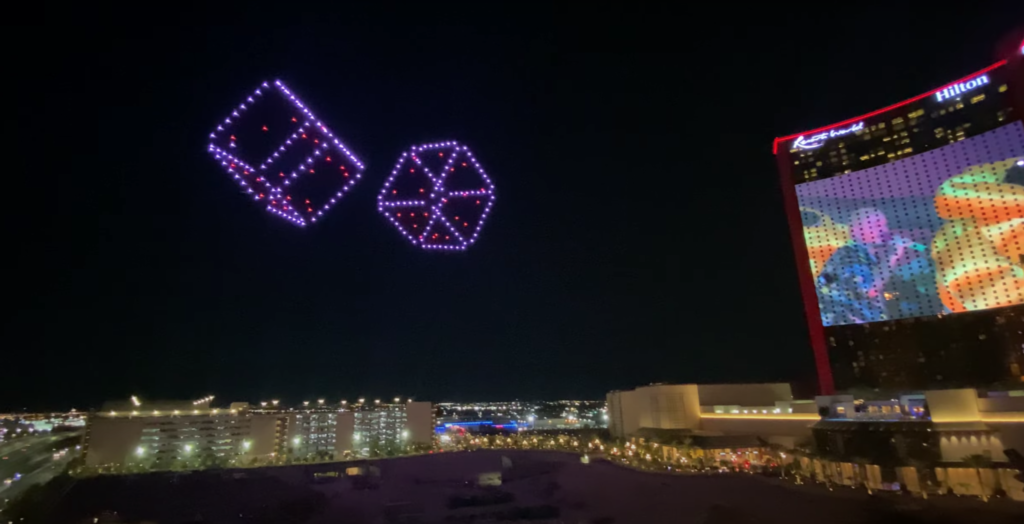
Fort Worth runs on events — rodeo season, the Stockyards, festivals along the Trinity, and a corporate base that books private entertainment year round. Hire UAV Pro brings drone light shows to Fort Worth and the wider Metroplex, with 50 to 5,000 drones, FAA-certified pilots and $10 million in insurance.
1,000+
Shows flown
$10M
Insured
50–5,000
Drones per show
Already flying in Texas
We have produced shows across Texas, including a 300-drone Damoda V4 show in San Antonio for a high-profile private event and a 150-drone show at a private golf club in Austin. Our crews travel with the fleet, so a Fort Worth show is planned the same way and travel is built into the quote rather than added later.
Where Fort Worth drone shows fly
The Stockyards draw the crowds and the cameras, and Panther Island and the Trinity River corridor give open ground close to downtown with water for sightlines. Will Rogers Memorial Center handles rodeo and expo audiences. Downtown parks work for civic celebrations, and ranch and country club venues west of the city give the clearest airspace in the region.
Texas weather and scheduling
Autumn is the most reliable season. Spring brings storm risk, so those bookings carry a backup window as standard. Summer shows fly later in the evening once the heat drops, and winter suits corporate and holiday events well. Wind matters more than heat for a drone fleet, and we plan go/no-go thresholds into every show.
Fort Worth airspace
DFW International sits east of the city, with Alliance to the north and Meacham inside the city limits, and stadium events in Arlington add their own temporary flight restrictions. None of that prevents a show, but the venue determines feasibility. Send us the location first and we confirm the airspace before planning anything around it.
Rodeo, festivals and livestock
Fort Worth events frequently involve animals, and that is one of the strongest practical arguments for drones over fireworks. A drone show is close to silent, so stock stays calm in the pens and barns. There is no fire risk during a dry Texas summer, nothing falls on the arena or the crowd, and the show can display a brand, a sponsor or the event name in the sky.
What every Fort Worth show includes
Custom show design previewed in 3D before approval, the drone fleet sized to your audience, FAA Part 107 certified pilots and ground crew, airspace authorization and FAA coordination, $10 million insurance with certificates issued to your venue, site survey and crowd separation planning, music synchronization, and full production and teardown. Travel is built into the quote — no surprise mobilization fees.
Fort Worth Airspace, Measured Site by Site
Fort Worth has one airspace fact that will change your venue choice, and we have not seen another operator state it.
We queried the FAA’s UAS Facility Map feature service directly at the coordinates of each venue below.
Panther Island is capped at 50 feet
Panther Island sits at a 50-foot UASFM ceiling under Meacham Field Class D.
Fifty feet. Not 400, not 200. For a drone show that is effectively a non-starter — a fleet at 50 feet AGL cannot build the vertical imagery that makes the medium work, and it cannot be seen over a crowd from any distance.
That matters because Panther Island is the city’s flagship waterfront development and the obvious instinct for a riverside show. Anyone quoting you a Panther Island drone show without mentioning the ceiling has not queried the coordinates, and a show promised there and discovered later is a conversation nobody wants to have.
A higher authorization is theoretically obtainable through the FAA’s manual further-coordination process rather than LAANC, on roughly a 90-day timeline, and we would be straight with you about the odds before you built a date around it.
What works instead, and it is good
The rest of the Meacham Class D grid is generous.
Dickies Arena — 400 feet, Meacham Class D, LAANC-enabled. About 14,000 for concerts.
Will Rogers Memorial Center — 400 feet, Meacham Class D, LAANC-enabled. The stock show and rodeo campus, with the acreage and the parking to hold a real audience.
That pair is the honest answer for a Fort Worth civic or ticketed show: full 400-foot show altitude, an authorization that processes in near real time, and venues already built to handle crowds.
Alliance Town Center, in the north of the city, sits at 400 feet under Perot Field/Fort Worth Alliance Class D — a 456-cell grid with ceilings at 0, 100, 200, 300 and 400, LAANC-enabled.
Texas Motor Speedway is capped at 200
Texas Motor Speedway — 75,000 capacity — sits at a 200-foot ceiling under Perot Field Class D.
A 200-foot cap halves the vertical canvas. It is a show designed differently rather than an impossible one, but the difference is real: content that reads at 400 feet from a given audience distance does not automatically read at 200.
Worth knowing how that compares. Charlotte Motor Speedway is also capped at 200. Circuit of the Americas near Austin, at roughly 120,000 capacity, sits at the full 400 feet with LAANC available — the best airspace position of any major American speedway we have measured. If a client is choosing between Texas motorsport venues for a show, that is a material difference.
One LAANC caution specific to this area
Most of these facilities are LAANC-enabled, but not uniformly. Meacham has five cells at 200 feet that are not LAANC-enabled, and Arlington Municipal has sixteen at 200 and 300 feet in the same position. A non-LAANC cell means a manual FAA DroneZone authorization rather than an instant approval — a different timeline entirely.
That is why we query the launch point and the flight envelope rather than the facility. “Meacham is LAANC-enabled” is true and not sufficient.
The Arlington stadium district, since clients always ask
The Arlington entertainment district is governed by Grand Prairie Municipal Class D, not by Dallas-Fort Worth International.
AT&T Stadium: 400 feet. Choctaw Stadium: 400 feet. Six Flags Over Texas: 400 feet. Globe Life Field: 300 feet. All LAANC-enabled.
That is a strong set, and it is why Arlington has become the most active drone show district in North Texas.
Stadium restrictions
A standing FAA restriction covers stadiums with a seating capacity of 30,000 or more during regular and postseason MLB, NFL and NCAA Division I football, plus NASCAR Cup, IndyCar and Champ Series races — a three nautical mile radius, surface up to and including 3,000 feet AGL, from one hour before the scheduled start until one hour after the end. It restricts all aircraft operations, unmanned included.
In the Fort Worth area that reaches Texas Motor Speedway under the motorsport clause, AT&T Stadium at about 80,000, Choctaw Stadium at 48,114, Globe Life Field at about 40,300 and Amon G. Carter Stadium at TCU, 53,294.
Dickies Arena, at about 14,000, is well below the threshold and not covered by the standing restriction at all.
The key point is that the restriction is event-triggered, not permanent. A show at AT&T Stadium or the speedway on a non-event date is unaffected. A show timed to an actual game or race has to address the window explicitly, and a post-game or post-race show needs the window addressed rather than assumed to have lapsed — the single most common planning error at venues this size. We verify your date against the FAA’s own Sporting Event Automated Monitoring System feed rather than reading a published schedule.
When To Fly in Fort Worth, and What the Heat Costs
We computed both of the figures below rather than looking them up.
The evening window, measured directly
Most wind data quoted in this industry is a daily average, which is close to useless for a show that flies after dark. So we computed the show-hour distribution — hourly observations between 8 and 10 p.m. local, across six years, in the Dallas-Fort Worth area.
September is the best month: 7.3 knots mean, with 86.1% of evening hours at or below 10 knots and 97.8% at or below 15.
August is close and actually better on the upper tail: 8.1 knots mean, 79.2% of hours at or below 10 knots, and 98.6% at or below 15 — the best figure of any month in the year.
April is the worst: 10.0 knots mean, with only 61.2% of evening hours at or below 10 knots and 85.2% at or below 15. February and March are close behind.
July sits in reasonable shape at 8.9 knots mean and 97.7% of hours at or below 15 knots, which is the honest answer to whether a 4 July show in North Texas is a sound bet on wind. It is — the upper tail is well-behaved, even though the mean is higher than September’s.
So the rule for Fort Worth is straightforward: August and September are the most reliable evenings of the year, July is sound, and February through April is the stretch to price defensively or avoid.
Heat is the real constraint here, not altitude
Static propeller thrust scales roughly with air density, so what governs aircraft performance is density altitude rather than field elevation. We computed the figures below from actual temperature, dewpoint and pressure, with the water-vapour term calculated properly, because moist air is less dense than dry air and in Texas that correction is not a rounding error.
The Dallas-Fort Worth area sits at about 607 feet field elevation. The numbers that follow from that:
A typical July afternoon — 96°F with a 70°F dewpoint — runs about 3,537 feet density altitude.
A hot day at 100°F runs about 3,844 feet.
An extreme heat event at 107°F runs about 4,441 feet.
That last figure is the one worth sitting with. In performance terms, a fleet staging in a North Texas heat event is operating as though it were at the elevation of Flagstaff, Arizona — in a city at 600 feet. The constraint in Texas is heat, not elevation, and in July it is comparable to what we deal with at home in Colorado.
The number that actually matters: the show flies at night
Here is the part almost nobody quantifies, and it is the most useful thing on this page.
The same location at 9 p.m. in July runs about 3,024 feet density altitude, against 3,844 on a hot afternoon.
Moving a show from afternoon conditions to its actual evening slot recovers roughly 800 feet of density altitude.
So a crew staging, test-flying and verifying a fleet in Fort Worth’s afternoon heat is working about 800 feet higher than the show itself will ever see. A pre-flight that passes comfortably at 3 p.m. has real margin by 9 p.m. — and one that looks marginal in the afternoon is not necessarily a problem at all.
Knowing which is which is the difference between an unnecessary scrub and a confident launch. It only comes from computing the actual hourly data rather than quoting a field elevation off a chart, and it is the main reason we are comfortable quoting a July date in North Texas.
The humidity correction, stated honestly
North Texas humidity is a real factor, though less than on the Gulf coast.
In Dallas at 100°F with a 70°F dewpoint, the water-vapour correction adds about 359 feet of density altitude over the dry calculation. On the Gulf coast at 95°F with a 76°F dewpoint it adds about 429 feet. In El Paso at 100°F with a 55°F dewpoint, only about 239 feet.
So any density altitude figure quoted for a Texas city without the humidity correction understates it by roughly 10 to 15%. We compute it rather than ignoring it, which means the number we give you is the real one rather than the flattering one.
It does not change where North Texas ranks, which is comfortably in the easier half of the state. On a hot afternoon El Paso runs about 7,900 feet density altitude, Amarillo about 7,100, Lubbock about 6,900. A fleet spec’d and choreographed for Fort Worth is in a completely different performance regime from one working the Panhandle.
The Questions Fort Worth Producers Actually Ask
Can we do a drone show at Panther Island?
This is the question we get most, and the honest answer is no — not as a standard show. Panther Island sits at a 50-foot UASFM ceiling under Meacham Field Class D.
Fifty feet is not enough to build the vertical imagery that makes a drone show work, or to be seen over a crowd from any distance. A higher authorization is theoretically obtainable through the FAA’s manual further-coordination process rather than LAANC, on roughly a 90-day timeline, and we would be straight with you about the odds before you built a date around it.
Dickies Arena and the Will Rogers Memorial Center both sit at the full 400 feet with LAANC available, and that is the answer we would actually recommend for a Fort Worth show.
What’s the best Fort Worth venue on airspace alone?
Will Rogers Memorial Center — 400 feet, LAANC-enabled, with the acreage and parking of the stock show and rodeo campus already built to handle a crowd. Dickies Arena is the same airspace position at about 14,000 for concerts, and it sits below the stadium restriction threshold, so it carries no event-triggered window either. Alliance Town Center in the north of the city is also 400 feet, under Perot Field Class D.
What about Texas Motor Speedway?
200-foot ceiling under Perot Field Class D, and it falls inside the motorsport clause of the standing stadium restriction on race dates. A 200-foot cap halves the vertical canvas, so it is a show designed differently rather than an impossible one.
Worth knowing the comparison: Charlotte Motor Speedway is also 200. But Circuit of the Americas near Austin, at roughly 120,000 capacity, sits at the full 400 feet with LAANC — the best airspace position of any major American speedway we have measured. If you are choosing between Texas motorsport venues, that is a material difference.
And the Arlington stadium district?
Strong, and governed by Grand Prairie Municipal Class D rather than DFW International — which surprises people. AT&T Stadium: 400 feet. Choctaw Stadium: 400. Six Flags Over Texas: 400. Globe Life Field: 300. All LAANC-enabled. That airspace is a large part of why Arlington has become the most active drone show district in North Texas.
Can we do a post-game show at AT&T Stadium?
Yes, outside the restriction window. The standing restriction covers venues seating 30,000 or more during NFL, MLB, NCAA Division I football and major races — three nautical miles, surface to 3,000 feet AGL, from an hour before the scheduled start to an hour after the end.
It is event-triggered, not permanent. A show on a non-event date is unaffected. A post-game show must address the window explicitly rather than assume it has lapsed — the most common error at venues this size. We verify against the FAA’s own Sporting Event Automated Monitoring System feed rather than a published schedule.
In the Fort Worth area that restriction reaches Texas Motor Speedway, AT&T Stadium, Choctaw Stadium, Globe Life Field and Amon G. Carter Stadium at TCU. Dickies Arena is below the threshold entirely.
Is LAANC always available around Fort Worth?
Nearly, but not uniformly, and the exceptions matter. Meacham has five cells at 200 feet that are not LAANC-enabled, and Arlington Municipal has sixteen at 200 and 300 feet in the same position. A non-LAANC cell means a manual FAA DroneZone authorization rather than an instant approval — a completely different timeline.
That is why we query your launch point and flight envelope rather than the facility. “Meacham is LAANC-enabled” is true and not sufficient.
When should we schedule?
September first, August second. We computed the show-hour distribution — 8 to 10 p.m. local across six years — rather than quoting daily averages. September runs 7.3 knots mean with 86.1% of evening hours at or below 10 knots; August is 8.1 knots mean with 98.6% of hours at or below 15 knots, the best upper tail of any month.
April is the worst at 10.0 knots mean with only 61.2% of evening hours at or below 10 knots; February and March are close behind.
Is a 4 July show a bad bet on wind?
No. July runs 8.9 knots mean in the evening window with 97.7% of hours at or below 15 knots — the upper tail is well-behaved even though the mean is higher than September’s. July is a sound date on wind in North Texas. The bigger July consideration is heat and burn bans, not gusts.
Will the heat hurt our show?
Heat is the real constraint here, not altitude, and it is quantifiable. The Dallas-Fort Worth area sits at about 607 feet field elevation, but a typical July afternoon runs about 3,537 feet density altitude, a 100°F day about 3,844, and a 107°F heat event about 4,441. In performance terms a fleet staging in a North Texas heat event is operating as though it were at the elevation of Flagstaff.
The number that matters is what happens by show time. At 9 p.m. in July the same location runs about 3,024 feet — so moving the show to its actual evening slot recovers roughly 800 feet. A crew test-flying in the afternoon is working about 800 feet higher than the show will ever see, which means a marginal afternoon check is not necessarily a problem. Knowing that is the difference between an unnecessary scrub and a confident launch.
Does humidity make it worse?
Yes, measurably. In Dallas at 100°F with a 70°F dewpoint the water-vapour correction adds about 359 feet of density altitude over the dry calculation. On the Gulf coast it runs about 429 feet; in El Paso at 100°F with a 55°F dewpoint, only about 239.
So any density altitude figure quoted for a Texas city without the humidity correction understates it by roughly 10 to 15%. We compute it, which means our numbers are real rather than rounded in our favour.
Can you fly during a burn ban?
Yes, and in Texas this is the strongest version of the argument anywhere in the country. Texas has 254 counties. 236 were under a burn ban on 1 July 2011; 215 on 13 September 2023; 120 in October 2024. In a dry year somewhere between half and over nine-tenths of the state can be banned at once — and 1 July sits squarely inside that window.
We read the county orders rather than a summary. A typical order under Local Government Code § 352.081 prohibits burning outside a containing enclosure across all unincorporated county areas, runs up to ninety days, lifts only when the Texas Forest Service ends its drought determination, and carries a Class C misdemeanor with a fine up to $500. It does not mention drones or unmanned aircraft anywhere. A burn ban, as written, regulates outdoor burning — it does not restrict a drone light show.
Should we replace our fireworks or add to them?
The documented North Texas pattern is hybrid, and your own neighbours are the evidence.
Arlington’s “Light Up Arlington” ran fireworks and drones together as one coordinated production, launched from the east side of Choctaw Stadium at 9:30 p.m. for 18 to 20 minutes, funded by the Arlington Tomorrow Foundation. Mansfield, in Tarrant County, ran at least 400 drones including 50 carrying pyrotechnics at its “Mansfield Rocks” celebration, with the drones opening and the fireworks following — a supplement, not a substitute.
Further afield, Galveston did replace its 4 July fireworks outright with a 200-drone show, citing safety, no debris in the water and no loud bangs, though reporting indicates the island later moved back toward fireworks.
So the honest framing in Texas is “drones alongside, or instead of, fireworks.” We will build either and tell you straight what each costs.
How many drones do we need?
It depends on viewing distance and what you want the audience to read, not on a package tier. Locally, Mansfield ran at least 400 as a hybrid and Galveston carried a full replacement on 200. More drones means more resolution in the imagery rather than simply more lights — and at Texas Motor Speedway’s 200-foot ceiling the right number is different from a 400-foot venue. We size to the geometry.
Who else operates in North Texas?
Sky Elements Drones is headquartered here and flew both the Mansfield and Galveston shows. We would rather tell you that than let you find it in a procurement meeting.
What we would ask you to compare is not drone count or mileage. It is whether the proposal in front of you tells you the grid ceiling at your exact coordinates — and specifically whether it mentions Panther Island’s 50 feet before you have committed to a date — the restriction windows against your exact date, the authorization timeline that follows, the density altitude at show time rather than at noon, and the liability limit standing behind it. Everything on this page is the output of that work.
Why hire a Colorado company for a Fort Worth show?
Because what you are buying is the analysis on this page plus the aircraft and crew to execute it. That Panther Island is capped at 50 feet while Dickies Arena and Will Rogers are at 400; that Texas Motor Speedway is 200 while COTA is 400; that the Arlington district is governed by Grand Prairie rather than DFW; that Meacham and Arlington Municipal have non-LAANC pockets needing a manual authorization; that August has the best evening upper tail of any month; that a 107°F heat event puts the fleet at Flagstaff’s elevation and the 9 p.m. slot gives 800 feet of it back — that is work done because it decides whether a show flies and on which date. We fly nationally, we carry $10 million in drone aviation liability, and we would rather tell you a venue or a date is wrong in the first conversation than in week eleven.
Fort Worth drone show FAQ
How much does a Fort Worth drone show cost?
Fleet size drives the price, then custom animation, travel and show length, with exact pricing within 24 hours. See our cost guide.
Do you cover Dallas and Arlington as well?
Yes — the whole Metroplex, one crew and one quote.
Will it frighten livestock?
Drone shows are close to silent compared with fireworks, which is why fairs and rodeo events increasingly choose them.
How many drones do we need?
Large public crowds want 300 or more; corporate and private events work well at 100 to 200.
Drone shows near Fort Worth
We fly across the region. Nearby: Dallas · Austin · Houston · San Antonio. See Texas drone light shows for everything we have flown statewide, or explore drone show rental and corporate drone shows and events.
Book a Fort Worth drone show
Tell us your date, venue and audience and we will send a custom concept and exact pricing within 24 hours.
More Drone Light Shows in Texas
We fly across Texas. See all Texas drone light shows, or a nearby city or venue:
Fort Worth · Galveston · Houston · Lady Bird Lake · San Antonio · South Padre Island Beach · Space Center Houston · TCU · Texas A&M · The Alamo · Tyler · UT Austin
Book a Fort Worth drone show
Tell us your date, venue and audience and we will send a custom concept and exact pricing within 24 hours.