
Hire a Drone Light Show in Columbus
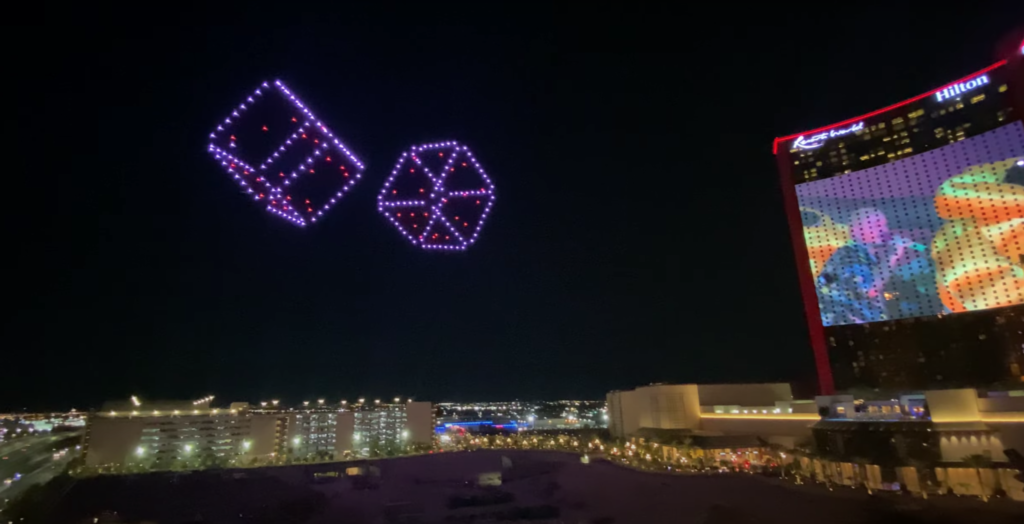
Columbus has the two things that make a city easy to fly: a river corridor running through the centre with genuine open space beside it, and a civic calendar built around large outdoor events. Hire UAV Pro brings drone light shows to central Ohio with 50 to 5,000 drones and full production.
1,000+
Shows flown
$10M
Insured
50–5,000
Drones per show
Where Columbus drone shows fly
The Scioto Mile and the downtown riverfront give water, open parkland and a skyline backdrop in one location, which is unusual in a city this size. The Ohio Expo Center and state fairgrounds handle very large public crowds with parking and fixed viewing. University grounds host campus celebrations, and the stadium and arena districts work for seated audiences.
Season and Ohio weather
Late spring through autumn is peak. Winter shows work well here too, and the early sunset is an advantage rather than a problem — a show can start at six or seven, which suits family audiences and holiday events far better than a nine o’clock summer start. Wind off open ground is the main scheduling factor, and every booking carries go/no-go thresholds.
Columbus airspace
John Glenn Columbus International sits east of downtown, with Rickenbacker to the south and Ohio State University Airport to the north-west. It is manageable airspace, and stadium events add temporary restrictions during games. Tell us your venue first and we confirm what can fly there before anything else is planned.
Fairs and campus events
The Ohio State Fair is one of the largest in the country, and fairgrounds are full of livestock. A drone show is near-silent compared with fireworks, carries no fire risk, and leaves nothing on the midway to clean up. Campus events are the other steady market here — homecoming, commencement and anniversary shows. See college and university drone shows.
What every Columbus show includes
Custom show design previewed in 3D before approval, the drone fleet sized to your audience, FAA Part 107 certified pilots and ground crew, airspace authorization and FAA coordination, $10 million insurance with certificates issued to your venue, site survey and crowd separation planning, music synchronization, and full production and teardown. Travel is built into the quote — no surprise mobilization fees.
Columbus Sports and Stadium Drone Light Shows
Columbus has two major league clubs plus one of the largest college athletic departments anywhere. The Blue Jackets own the NHL winter, the Columbus Crew have been a fixture of Major League Soccer since the league’s first season, the Ohio State Buckeyes draw six-figure crowds on football Saturdays, and the Columbus Clippers keep Triple-A baseball busy all summer. For a club marketer or an activation agency, that is a long list of openers, rivalry nights, trophy moments and fan festivals to program against. We fly formations from seventy aircraft up through three hundred and beyond, synchronized to a stadium feed or a live performance.
Going without pyrotechnics is often what makes the booking possible. Soccer and baseball operations here guard their natural playing surfaces, and arena districts sit close to residential blocks where smoke and noise complaints land fast. A drone display produces no spark, no shell fragments and nothing falling onto grass. Each show is flown under FAA Part 107 certified pilots, with ten million dollars of aviation liability behind it and a history of more than one thousand shows. Reach our team through the contact form with your event details.
Columbus Airspace, Measured Site by Site
Columbus is one of the easiest major American cities to fly a drone show in, and most people assume the opposite because it has a Class C airport sitting east of downtown.
We queried the FAA’s UAS Facility Map feature service directly at the actual coordinates of every venue below, against the current map effective date. The finding is better than expected.
Downtown and the university district are uncontrolled surface airspace
Ohio Stadium. Lower.com Field and Astor Park. Huntington Park. Bicentennial Park and the Scioto Mile.
All four return no UAS Facility Map grid cell at all.
We widened the query envelope to make sure that was a real gap rather than missing data. John Glenn Columbus International does carry a Class C grid, with ceilings running 0, 50, 100, 150, 200 and 400 feet, and there is a separate Bolton Field Class D pocket to the east and south of downtown. But the central business district, the Scioto riverfront and the Ohio State campus all fall outside both — roughly beyond John Glenn’s five-nautical-mile core.
What that means in practice: for a 400-foot show at any of those four venues, there is no LAANC request on the critical path. No authorization step, no waiting on an app, no 90-day federal coordination. Federal airspace is not what gates a downtown Columbus show.
For a city of this size that is genuinely unusual. Nearly a quarter of the mapped grid over New York City carries a zero-foot ceiling. Almost half of Newark’s does. Cleveland’s own lakefront — North Coast Harbor and the Browns stadium — sits at zero because Burke Lakefront Airport is right there on the water. Columbus has none of those problems.
The Ohio Expo Center is inside the grid, at full altitude
The Ohio Expo Center sits at a 400-foot ceiling under John Glenn Class C, available through LAANC.
Full show altitude, with an authorization that processes in near real time rather than over a quarter.
That matters because of what the venue now is. The fairgrounds completed a $460 million overhaul in time for the 2026 fair, and the 2025 Ohio State Fair drew close to a million visitors with more than $11 million in revenue. A venue that has just put that kind of capital into its grounds, pulling that kind of attendance, with the full 400 feet available through an app — on the numbers that is the strongest single drone show prospect in Ohio.
A multi-night fair run is also a better proposition than a one-evening holiday show. The same fleet and crew amortise across several performances, and the content can change night to night rather than being a single fixed sequence.
Stadium restrictions at Ohio Stadium
A standing FAA restriction applies to stadiums seating 30,000 or more during NCAA Division I football, from an hour before the event. Ohio Stadium is well above that threshold.
We check your date against the FAA’s Sporting Event Automated Monitoring System feed — the authoritative machine-readable source for active and scheduled windows — rather than reading a published football schedule and hoping. Outside those windows a stadium show is routine, and a post-game show sits just outside the window by design, which is usually exactly what a stadium client wants.
The more interesting question at Ohio Stadium is not the airspace, since there is no grid cell. It is fleet sizing. A bowl above 100,000 seats is a different geometry problem from a riverfront park, because what sets drone count is the distance across which your content has to stay legible.
Standing security guidance
Standing FAA guidance advises operators to avoid loitering over power plants, dams, refineries, industrial complexes, military installations and correctional facilities. In central Ohio that is a real planning input against specific sites rather than boilerplate, and we check the flight geometry against it rather than the venue’s street address.
Columbus Already Bought This, and the Model Is Worth Copying
Columbus is not a market that needs persuading that drone shows work. It is the market that set Ohio’s benchmark.
Red, White & BOOM! is Ohio’s flagship Independence Day event — held 3 July in downtown Columbus, with more than 400,000 expected spectators.
In 2025 it added its first drone show: 216 drones, flying at 10 p.m. as the night’s opening act ahead of the traditional fireworks, funded by a presenting sponsor marking a corporate centenary. The drones ran alongside the pyrotechnics rather than replacing them.
Three things about that are worth any Columbus event committee’s attention.
The additive model works at scale
A 400,000-person event did not have to choose between the two technologies. The drone show got its own 10 p.m. slot and its own identity; the fireworks kept theirs.
For a committee that is nervous about taking fireworks away from an audience which has expected them for decades, that is the low-risk route. It is also, repeatedly, the route that leads to a full conversion two or three years later — once the crowd has seen what a fleet can actually do, the appetite changes on its own rather than having to be argued for.
The funding structure is repeatable
It was sponsor-funded against an anniversary, and that is the detail most people skip past.
A drone fleet is a far better sponsorship asset than a fireworks display, because it can spell a name, render a product, count a centenary, or carry a message that reads clearly from a quarter mile away. A shell burst cannot do any of that. Which means the show becomes sellable inventory rather than a line in the events budget — and that is usually the thing that unsticks a stalled budget conversation at a parks department or a downtown commission.
It set the local number
216 drones at the state’s flagship event is now the figure other central Ohio committees measure themselves against. Worth knowing before you walk into a budget meeting, in either direction: it tells you what “serious” looks like locally, and it tells you that you do not need four figures of aircraft to be taken seriously in this market.
An honest word on the competition
That show was flown by NiteBrite, a local Ohio operator. We would rather tell you that than let you discover it later.
What we would ask you to compare is not the drone count or whose truck is closer. It is whether the proposal in front of you tells you the grid ceiling at your exact coordinates, the restriction windows against your exact date, the authorization timeline that follows from both, and the liability limit standing behind it. Everything on this page is the output of that work. If a competing proposal shows the same analysis, you have two good options. If it does not, that gap is the question to ask.
The Questions Columbus Producers Actually Ask
Do we need FAA authorization for a show downtown?
At the main venues, no. Ohio Stadium, Lower.com Field, Huntington Park and Bicentennial Park on the Scioto Mile all return no UAS Facility Map grid cell — they sit outside John Glenn’s Class C core and outside the Bolton Field pocket, in uncontrolled surface airspace. For a 400-foot show there is no LAANC request on the critical path at all. The Ohio Expo Center is inside the Class C grid, at a 400-foot ceiling available through LAANC, which is a near-real-time step rather than a federal process.
How much lead time do you need?
Less here than almost anywhere comparable. A downtown Columbus show in uncontrolled airspace can work on a few weeks’ notice if the venue and the date are clear. An Expo Center show adds a LAANC authorization that processes quickly. We would still rather have more time than less — content, music licensing and site survey all improve with it — but in Columbus the airspace is not what sets your floor.
By contrast, a show at Cleveland’s North Coast Harbor needs 90 days minimum, because Burke Lakefront Airport puts that site at a zero-foot grid ceiling with no automated authorization route. That is the kind of difference that only shows up if someone queries the actual coordinates.
Can we fly over Ohio Stadium?
Not during a covered game. A standing FAA restriction closes the airspace around stadiums seating 30,000 or more during NCAA Division I football, from an hour before the event. We check your date against the FAA’s own Sporting Event Automated Monitoring System feed rather than a published schedule. Outside those windows it is routine — and a post-game show sits just outside the window by design, which is usually what a stadium client is actually asking for.
Are fireworks even legal where our event is?
In Ohio, that genuinely depends on the township. Consumer fireworks became legal for in-state discharge on an enumerated list of days as of 1 July 2022, on private property with the owner’s permission — but a county, a township or a municipality may restrict the dates and times or ban discharge outright, and where a township resolution conflicts with a county one, the township prevails.
For a professional display you additionally need a State Fire Marshal exhibitor licence, plus local approval from both the fire chief and the police chief, a premises inspection beforehand, at least $1,000,000 in bond or liability coverage, and a fire official physically on site before, during and after the show.
A drone show enters none of that chain. Ohio’s fireworks statutes do not mention drones or unmanned aircraft anywhere.
Can you fly during a burn ban, or at a no-open-flame venue?
Yes. Burn bans, drought restrictions, fire-weather advisories and venue no-open-flame policies prohibit combustion, and a drone show has nothing to burn. Every element of Ohio’s fireworks regime regulates ignition, premises, storage and discharge points — none of which describes an aircraft.
Will heat or altitude affect the show?
No, and Columbus is a good market on this. Static propeller thrust scales roughly with air density, so what matters is density altitude. Columbus sits at about 810 feet field elevation, and a July evening show here operates at roughly 2,000 feet density altitude.
The same show at our own base in Arvada, Colorado flies at about 7,500 feet on a July evening, and Phoenix at about 3,700. Part of why Columbus does well is the diurnal swing — July overnight minima here run in the sixties, so the evening cooling genuinely arrives. In Phoenix, July minima sit in the mid-eighties and that relief never comes.
Practically: your fleet size in Columbus is set by what the choreography needs to read at your audience’s viewing distance, not by what the air will support.
How many drones do we need?
It depends on viewing distance and what you want the audience to read in the sky. For local reference, Red, White & BOOM! flew 216 drones in front of a 400,000-plus crowd. More drones means more resolution in the imagery rather than simply more lights — the right number is the one that renders your content legibly at your audience’s distance. A Scioto Mile show seen along a river corridor is a different sizing problem from the Ohio Stadium bowl, and we size to the geometry rather than to a package tier.
Should we replace our fireworks or add to them?
Either works, and Columbus is the local evidence for adding. Red, White & BOOM! put 216 drones at 10 p.m. as an opening act and kept the fireworks, at a 400,000-person event, paid for by a presenting sponsor. For a committee worried about taking something away from an audience that expects it, that is the low-risk path — and it frequently becomes a full conversion a couple of years later once people have seen the drones. We will build either version and be straight with you about what each one costs.
Can you fly in winter, or indoors?
Winter, yes — cold shortens battery endurance and we plan fleet sizing and segment length around it; the larger winter variable in the Midwest is wind rather than temperature. Lansing, Michigan has already carried a full downtown holiday celebration on a 100-drone show in place of fireworks, which is useful evidence that a winter civic event does not need a summer-scale fleet.
Why hire a Colorado company for a Columbus show?
Because what you are buying is the analysis on this page plus the aircraft and crew to execute it. That downtown Columbus and the Ohio State campus have no grid cell while the Expo Center sits at a 400-foot LAANC ceiling; that Cleveland’s lakefront is zero-ceiling and Edgewater is the workable alternative; that a township resolution outranks a county one on fireworks; that Ohio requires a fire official on site through an entire pyrotechnic display — that is work we do because it decides whether a show flies and on which date. We fly nationally, we carry $10 million in drone aviation liability, and we would rather tell you a venue or a date is wrong in the first conversation than in week eleven.
Columbus drone show FAQ
How much does a Columbus drone show cost?
Fleet size drives the price, then custom animation, travel and show length, with exact pricing within 24 hours. See our cost guide.
Can you fly in winter?
Yes, and the early sunset means an earlier, family-friendly show time.
Do you fly fairs and festivals?
Yes — it is one of our strongest markets, particularly where livestock or fire restrictions rule out fireworks.
How many drones do we need?
Large public audiences want 300 or more; corporate and private events work well at 100 to 200.
Drone shows near Columbus
We fly across the region. Nearby: Cincinnati · Cleveland · Indianapolis · Louisville. See Ohio drone light shows for everything we have flown statewide, or explore drone show rental and corporate drone shows and events.
Book a Columbus drone show
Tell us your date, venue and audience and we will send a custom concept and exact pricing within 24 hours.
More Drone Light Shows in Ohio
We fly across Ohio. See all Ohio drone light shows, or a nearby city or venue:
Columbus · COSI Scioto Mile · Dayton · Ohio State · Put-in-Bay · Rock and Roll Hall of Fame · Toledo · Akron · Canton · Cincinnati · Cincinnati · Cincinnati Riverfront
Book a Columbus drone show
Tell us your date, venue and audience and we will send a custom concept and exact pricing within 24 hours.