
Drone Light Shows: Ohio
The night sky over Ohio has a new story to tell. When hundreds or thousands of synchronized drones lift off, painting coordinated patterns against the darkness, you’re watching something that feels like the future has arrived—because it has. Drone light shows have transformed how major events celebrate, from corporate milestones to civic pride moments. Ohio’s lakes, parks, and urban centers provide stunning backdrops for shows that blend cutting-edge technology with the kind of scale that stops a crowd mid-conversation.
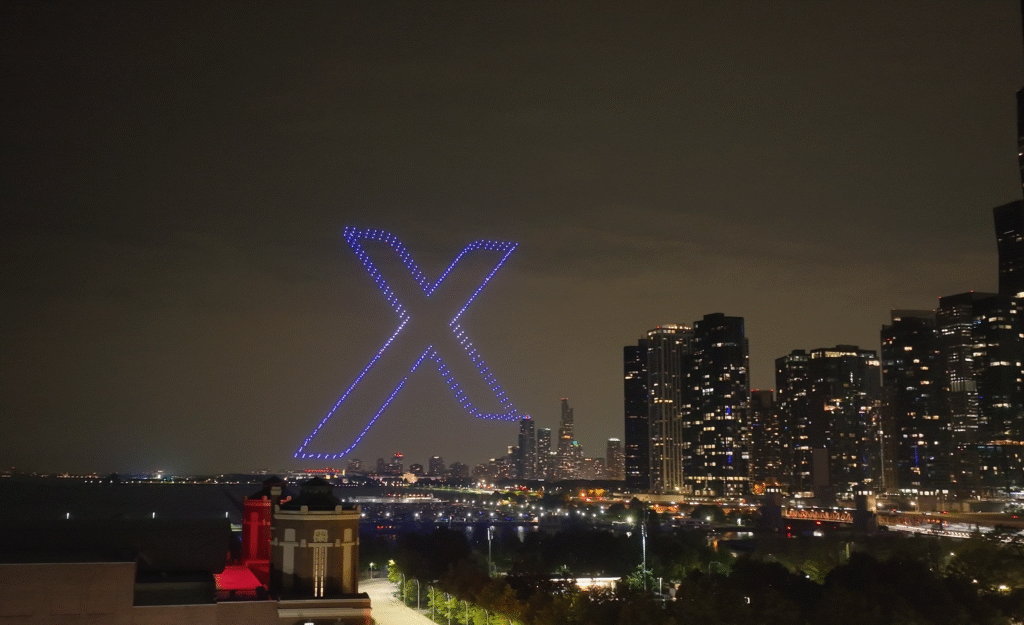
What a Professional Drone Light Show Looks Like
A drone light show isn’t a fireworks display with drones. It’s choreography at scale. Each drone is piloted in real time or pre-programmed with microsecond-level precision to move through three-dimensional space while holding formation and changing color. The effect is hypnotic—waves of light shifting from red to gold to blue, geometric shapes dissolving and reforming, the sky itself becoming a canvas.
The technical backbone is equally impressive. A team of FAA-certified pilots, visual observers, and engineers work in parallel to keep every drone where it needs to be, every second. Each aircraft carries onboard safety systems: GPS-fenced flight boundaries, automatic return-to-home, parachute recovery, and fail-safe landing. You’re not just watching a show; you’re watching a fully redundant system that prioritizes safety as non-negotiable.
For a full breakdown of everything drone light shows, visit our comprehensive drone light show guide page
Drone Light Shows in Ohio Cities
We bring professional drone light shows to cities across Ohio. Explore our services in your area:
- Akron Drone Light Shows
- Canton Drone Light Shows
- Cincinnati Drone Light Shows
- Cleveland Drone Light Shows
- Columbus Drone Light Shows
- Dayton Drone Light Shows
- Toledo Drone Light Shows
Don’t see your city? We serve all of Ohio. Book a drone show anywhere in the state.
Drone Fleet Options for Ohio Events
Hire UAV Pro operates two primary drone systems, each with distinct advantages:
Kaiken Drones: Lightweight and durable, Kaiken units are ideal for budget-conscious events or outdoor conditions where reliability matters. They’re proven performers at festivals, municipal celebrations, and corporate events where you want professional quality without premium positioning.
Damoda V4 Drones: The premium platform. Each Damoda V4 carries 2,200+ lumens of RGBW LED brightness—vivid enough to see clearly even in well-lit urban environments. These drones include redundant safety systems: parachute recovery for controlled descent, GPS-fenced boundaries, automatic return-to-home in case of signal loss, and fail-safe landing logic. Damoda V4 shows come with a free second launch the same night, allowing for both a pre-show element (around dusk) and a full-duration core show after dark. That flexibility means tighter production control and better storytelling across your entire event timeline.
Scale and Customization for Ohio Venues
Hire UAV Pro designs shows for 100 to 5,000 drones. That range matters because the show you need depends entirely on your venue and audience. A 200-drone show above a downtown park creates an intimate, high-impact moment. A 1,000-drone show above a waterfront transforms the entire skyline. A 5,000-drone show becomes regional event spectacle—the kind of thing people drive hours to see.
Custom animations are built in-house. Your choreographer works with your audio, your brand colors, your story. Shows synchronize millisecond-tight to FM radio simulcast, so the entire crowd hears the same music at the same moment. Whether you’re celebrating a company milestone, a city anniversary, a product launch, or a civic event, the show is designed specifically for you—not a template applied to your event.
Why Ohio Events Choose Hire UAV Pro
Since 2017, Hire UAV Pro has completed 1,000+ shows across major U.S. markets. The company maintains $10 million in aviation and umbrella insurance. Every pilot holds FAA Part 107 Remote Pilot Certification. The fleet includes multi-UAS waivers and night operations waivers—authorizations that allow the scale and timing your event requires.
Operations are staffed by dedicated professionals. Graham Hill, the founder, personally directs shows. Lead pilots Jacob Gould and Isaac Henry bring combined decades of flight experience. Visual observers work redundantly to monitor airspace and safety parameters in real time. This isn’t a startup with borrowed equipment—this is a production company built around the drone show format.
Cost and Booking
Pricing runs $10,000 to $50,000+ depending on drone count, design complexity, and logistics. Music, staffing, permits, and site coordination are included. The range is wide because every event is different—an intimate 150-drone show over a parking lot carries different costs than a 1,000-drone celebration over a lakefront.
Timeline: Inquire today, receive a custom proposal within 48 hours. Hire UAV Pro operates across Ohio’s major markets—Cleveland, Columbus, Cincinnati, and smaller cities with the right venue. Site surveys are part of the process; the team assesses wind, airspace clearance, lighting, audio logistics, and launch/recovery zones before confirming feasibility.
The Experience
When the first drone lifts off, the crowd goes quiet. They’re watching machines, yes, but the choreography is so fluid, the formations so deliberate, that the technology becomes invisible—what remains is wonder. Colors bloom across the sky. Shapes materialize, evolve, scatter. The show lasts 12–20 minutes, long enough to tell a story but short enough to end before the moment fades. Afterward, people check social media, pull up videos on phones, and tell the story of what they saw. That’s the real impact: a shared moment that lasts far longer than the show itself.
Ready to bring a drone show to Ohio? Book a drone show and our team will put together a custom proposal within 48 hours.
Flying in Ohio Airspace
Ohio splits cleanly into three metro airspace environments, and they are not equally easy. We queried the FAA’s UAS Facility Map feature service directly for the named venues below, against the current map effective date.
Columbus is the easiest downtown in the state
Ohio Stadium, Lower.com Field and Astor Park, Huntington Park, and Bicentennial Park on the Scioto Mile all return no UAS Facility Map grid cell at all.
We widened the query envelope to confirm that is real rather than an artifact. John Glenn Columbus International does carry a Class C grid with ceilings running 0, 50, 100, 150, 200 and 400 feet, and there is a separate Bolton Field Class D pocket to the east and south — but downtown Columbus and the university district fall outside both, roughly beyond John Glenn’s five-nautical-mile core.
The practical result is that the four highest-profile outdoor event spaces in Columbus sit in uncontrolled surface airspace. For a 400-foot show, there is no LAANC request on the critical path. That is unusual for a city of this size and it is the single most useful airspace fact in Ohio.
The Ohio Expo Center, by contrast, is inside John Glenn’s Class C grid — at a 400-foot ceiling, available through LAANC. Full show altitude, with an authorization step that runs in near real time.
Cleveland’s lakefront is the trap, and it is a severe one
Everyone assumes a Cleveland lakefront show is the obvious move. The airspace says otherwise, and the reason is Burke Lakefront Airport, which sits directly on the waterfront downtown.
North Coast Harbor: zero-foot ceiling. Huntington Bank Field: zero-foot ceiling.
A zero-foot grid ceiling means no automated LAANC authorization is available at all. The operation requires the FAA’s manual further-coordination process, which runs on roughly a 90-day timeline rather than a near-real-time one. Those are the two most requested show sites on the Cleveland waterfront, and both of them are long-lead projects rather than bookable-in-six-weeks projects.
Nearby, the picture improves fast. Progressive Field sits at a 300-foot ceiling under Burke Class D, and Edgewater Park — two and a half miles west along the shore — sits at the full 400 feet. Both are LAANC-available.
So a Cleveland lakefront show is entirely possible. It just has to be at Edgewater rather than at North Coast Harbor, or it has to be planned ninety days out. An operator who quotes you a six-week turnaround on a show at the Rock Hall or the Browns stadium has not checked the grid.
Cincinnati is straightforward
Great American Ball Park: 400 feet. Paycor Stadium: 400 feet. Sawyer Point and Yeatman’s Cove: 400 feet. All three under Lunken Field Class D, all LAANC-available.
Riverbend Music Center is the one to watch, at a 200-foot ceiling. That is a real choreographic constraint — it halves the vertical canvas — and it changes what content can read at distance. It is a workable show, designed differently.
Blossom Music Center in Cuyahoga Falls returns no grid cell at all.
Stadium restrictions
A standing FAA restriction applies to stadiums seating 30,000 or more during MLB, NFL and NCAA Division I football games, and during NASCAR Cup, IndyCar and Champ Series races, from an hour before the event until after it concludes. We work those windows from the FAA’s Sporting Event Automated Monitoring System feed — the authoritative machine-readable source — rather than guessing from a published schedule.
In Ohio that covers Ohio Stadium, Huntington Bank Field, Paycor Stadium and Great American Ball Park during their respective seasons. Outside the windows, stadium shows are routine, and a post-game show sits just outside the window by design — which is usually what a stadium client actually wants.
Separately, standing FAA guidance advises operators to avoid loitering over power plants, dams, refineries, industrial complexes, military installations and correctional facilities. In a state with Ohio’s industrial geography, that is a genuine planning input rather than boilerplate.
Ohio Fireworks Law, and Where Drones Sit
Ohio’s consumer fireworks law changed materially in 2022, and the change is the reason the landscape is now a patchwork rather than a rule.
Consumer fireworks — ORC 3743.45 as amended
Under House Bill 172, effective 1 July 2022, Ohio legalised in-state discharge of 1.4G consumer fireworks. Before that, a buyer could purchase in Ohio but had to transport the product out of state within 48 hours.
Discharge is now permitted on private property with the owner’s authorisation, on an enumerated list of days: 1 January; Chinese New Year; 5 May; the last Monday in May plus the preceding Saturday and Sunday; 19 June; 3, 4 and 5 July; the first Friday, Saturday and Sunday before and after 4 July; the first Monday in September plus the preceding Saturday and Sunday; Diwali; and 31 December. The statute sets no permitted hours — only days. Noise, peace-disturbance and disorderly-conduct law still applies.
Then the provision that matters most: local opt-out. A county in its unincorporated territory, a township in its unincorporated territory, or a municipal corporation may restrict the dates and times, or ban discharge entirely. And where a township resolution conflicts with a county resolution, the township’s prevails.
So the honest answer to “are fireworks legal where my event is” in Ohio is: it depends on the township, and the township outranks the county. That is a genuinely difficult thing for an event planner to research, and it is one of the practical reasons communities move to drones — the answer stops depending on which side of a township line the venue sits on.
Public exhibitions — the licensing chain a drone show does not enter
A professional display in Ohio runs through two levels.
First, the State Fire Marshal licenses fireworks exhibitors under ORC 3743.51, each licence carrying a distinct number, with the Fire Marshal maintaining the list of licensed exhibitors and reciprocity available for qualifying out-of-state licensees.
Second, and more demanding, ORC 3743.54 requires a licensed exhibitor to obtain local approval before every public exhibition. In a municipal corporation that means approval from both the fire chief and the police chief or their designees; in unincorporated areas, the township or fire district fire chief plus the township or district police chief. Approval is evidenced by signature on an exhibition permit on a form prescribed by the State Fire Marshal.
Before the permit issues, the fire chief or fire prevention officer inspects the premises and confirms the applicant holds a current exhibitor licence, which must be produced. Officials may re-inspect immediately before the exhibition and may revoke for non-compliance. Bond or liability insurance of at least $1,000,000 is required — the local legislative authority may demand more — and no permit issues until it is provided. And a certified fire safety inspector, fire chief or fire prevention officer must be present before, during and after the exhibition.
That last requirement is worth sitting with. Ohio requires a fire official physically on site through the entire display. For a municipality running a tight events budget on a holiday weekend, that is staffing cost and scheduling friction on top of everything else.
Where drones sit
Ohio’s fireworks chapters do not mention drones or unmanned aircraft anywhere.
That is structural rather than a loophole. Every element of the regime regulates combustion — licensed exhibitors, premises inspection, bonding against fire and explosion damage, an on-site fire official, enumerated discharge days. None of it describes an aircraft, because an aircraft is not what the chapter is about.
A drone show in Ohio is not unregulated. It is governed by the FAA under Part 107, by whatever land manager controls the ground, and by the venue’s own event permitting. It simply does not enter the fire-law chain — which is why a burn ban, a drought restriction, a fire-weather advisory or a venue’s own no-open-flame policy closes a fireworks display and leaves a drone show available.
We carry $10 million in drone aviation liability — ten times the $1,000,000 floor Ohio sets for a fireworks exhibition permit. Because that floor is written into statute, it is a comparison you can verify rather than a claim you have to accept.
One drone-specific development worth knowing
Ohio passed a drone law in 2025 that codifies FAA licensure and pilot-responsibility requirements into state law without creating any new state licence, and adds four state-level prohibitions: reckless operation endangering others, operation in violation of FAA regulations, interference with first responders, and recording or loitering over or near critical infrastructure. It also directs the Ohio Department of Transportation’s Office of Aviation to publish all state drone regulations in one place.
It includes a grant of local authority — but on its face that grant covers recreational drone use in or above parks and other local public property, not commercial operations. We read that as leaving professionally operated shows where they were, under Part 107 plus the land manager’s own permission, and we check the current position against the venue’s municipality rather than assuming it.
Ohio Venues, With the Airspace Attached
Columbus
Ohio Stadium — no facility map grid cell; uncontrolled surface airspace. Stadium restriction windows apply during NCAA Division I football.
Lower.com Field and Astor Park — no grid cell. Huntington Park — no grid cell. Bicentennial Park and the Scioto Mile — no grid cell, and the natural civic site for a downtown riverfront show.
Ohio Expo Center — 400-foot ceiling under John Glenn Class C, LAANC-available. The fairgrounds completed a $460 million overhaul in time for the 2026 fair, and the 2025 Ohio State Fair drew close to a million visitors with more than $11 million in revenue. A venue that has just spent that kind of capital on its grounds, drawing that kind of attendance, with full 400-foot show altitude available through an app — that is as good a drone show prospect as exists in the state.
Cleveland
North Coast Harbor — zero-foot ceiling under Burke Lakefront Class D. No LAANC. Manual FAA coordination, roughly 90 days.
Huntington Bank Field — zero-foot ceiling. Same position, plus NFL stadium restriction windows in season.
Progressive Field — 300-foot ceiling, LAANC-available, plus MLB restriction windows in season.
Edgewater Park — 400 feet, LAANC-available. This is the Cleveland lakefront answer. Full show altitude, open shoreline, Lake Erie behind the fleet and the downtown skyline to the east, with an authorization that runs in near real time instead of over a quarter.
Blossom Music Center, Cuyahoga Falls — no grid cell.
Cincinnati
Great American Ball Park — 400 feet, Lunken Field Class D, LAANC. Paycor Stadium — 400 feet, LAANC. Both carry restriction windows in their seasons.
Sawyer Point and Yeatman’s Cove — 400 feet, LAANC-available. The Ohio River waterfront with the Roebling Bridge and the Kentucky bank as backdrop, at full show altitude.
Riverbend Music Center — 200 feet, LAANC. Half the vertical canvas of the venues above, which changes the choreography rather than ruling it out. We would design that show differently and tell you why.
What that adds up to
Ohio has three distinct metros with three different answers, and the difference between them is worth real money. A Columbus downtown show has no authorization step at all. A Cincinnati riverfront show has a 400-foot LAANC request. A Cleveland North Coast Harbor show has a ninety-day federal process.
None of that is visible from a venue’s website or a general drone show company’s location page. It comes from querying the FAA’s own feature service at the actual coordinates, and we do that before quoting rather than after.
Ohio Is Already Buying This, and the Model Is Worth Copying
The strongest datapoint in the state is Red, White & BOOM! in downtown Columbus — Ohio’s flagship Independence Day event, held on 3 July with more than 400,000 expected spectators.
In 2025 it added its first drone show: 216 drones, flying at 10 p.m. as the night’s opening act before the traditional fireworks. It was funded by a presenting sponsor — G&J Pepsi, marking the bottler’s hundredth anniversary — and the drones ran alongside the pyrotechnics rather than replacing them.
Three things about that are instructive for anyone planning a civic event in Ohio.
First, the additive model works at scale. A 400,000-person event did not have to choose. The drone show became a distinct 10 p.m. moment with its own identity, and the fireworks kept their slot. For a committee nervous about taking fireworks away from a crowd that expects them, that is the low-risk route — and it is often the route that leads to a full conversion two or three years later, once the audience has seen what the drones can do.
Second, the funding structure is repeatable. It was sponsor-funded against a corporate anniversary. A drone show is a far better sponsorship asset than a fireworks display, because the fleet can spell a logo, render a product, count a centenary or carry a message in a way that a shell burst simply cannot. That makes the show a sellable inventory item rather than a line in the events budget, and it is the single most useful thing to know when the budget conversation stalls.
Third, it sets the local benchmark. 216 drones at the state’s flagship event is now the number other Ohio committees compare themselves against.
The other Ohio anchor
The Ohio State Fair at the Ohio Expo Center — close to a million visitors in 2025, more than $11 million in revenue, and a $460 million overhaul of the fairgrounds completed for 2026 — sits at a 400-foot LAANC ceiling. A multi-night fair run is a different and better proposition than a single holiday show, because the same fleet and crew amortise across several performances and the content can change night to night.
And an honest note on the competition
The Columbus show was flown by NiteBrite, a local Ohio drone show company. We would rather tell you that than pretend we are the only option in the state.
What we would ask you to compare is not the drone count. It is whether the proposal in front of you tells you the grid ceiling at your specific venue, the restriction windows against your specific date, the authorization timeline that follows from both, and the liability limit behind it. Everything on this page is the output of that work. If a competing proposal contains the same analysis, you have two good options — and if it does not, that gap is the thing to ask about.
The Questions Ohio Producers Actually Ask
Do we need FAA authorization for a show in downtown Columbus?
For the main venues, no. Ohio Stadium, Lower.com Field, Huntington Park and Bicentennial Park on the Scioto Mile all return no UAS Facility Map grid cell — they sit outside John Glenn’s Class C core and outside the Bolton Field pocket, in uncontrolled surface airspace. For a 400-foot show there is no LAANC request on the critical path. The Ohio Expo Center is inside the Class C grid, at a 400-foot ceiling available through LAANC.
Can we do a show on the Cleveland lakefront?
Yes, but probably not where you were thinking. Burke Lakefront Airport sits directly on the downtown waterfront, which puts North Coast Harbor and Huntington Bank Field at a zero-foot grid ceiling — no automated authorization at all, and roughly a 90-day manual FAA process. Edgewater Park, two and a half miles west, sits at the full 400 feet with LAANC available. That is the Cleveland lakefront answer, and it is a better show anyway: open shoreline, Lake Erie behind the fleet, downtown skyline to the east.
How much lead time do you need?
It depends entirely on the venue, which is the point. A downtown Columbus show in uncontrolled airspace can work on a few weeks. A 400-foot LAANC venue — the Expo Center, Cincinnati’s riverfront, Edgewater — adds an authorization that runs in near real time. A zero-ceiling site like North Coast Harbor needs 90 days minimum because the FAA’s manual coordination process is the only route. Tell us the venue early and we will tell you honestly which bucket it falls into.
Are fireworks even legal where our event is?
In Ohio that genuinely depends on the township. Consumer fireworks became legal for in-state discharge on an enumerated list of days as of 1 July 2022, on private property with the owner’s permission — but a county, a township or a municipality may restrict the dates and times or ban discharge outright, and where a township and a county conflict, the township prevails. For a professional display you additionally need a State Fire Marshal exhibitor licence plus local approval from both the fire chief and the police chief, with a premises inspection, at least $1,000,000 in bond or liability coverage, and a fire official on site before, during and after the show.
A drone show enters none of that. Ohio’s fireworks chapters do not mention drones at all.
Can you fly during a burn ban or at a no-open-flame venue?
Yes. Burn bans, drought restrictions, fire-weather advisories and venue no-open-flame policies prohibit combustion, and a drone show has nothing to burn. Every element of Ohio’s fireworks regime regulates ignition, premises, storage and discharge — none of which describes an aircraft.
Will altitude or heat affect the show?
Not meaningfully, and Ohio is one of the better markets in the country on this. Static propeller thrust scales roughly with air density, so what matters is density altitude. Columbus sits at about 810 feet field elevation, and on a July evening a show there operates at roughly 2,000 feet density altitude.
For comparison, the same show at our own base in Arvada, Colorado flies at about 7,500 feet on a July evening, and Phoenix at about 3,700. Ohio’s large diurnal temperature swing is part of why — July overnight minima here run in the sixties, so the evening relief actually arrives, which is exactly what does not happen in Phoenix where July minima sit in the mid-eighties.
The practical meaning: your fleet size in Ohio is set by what the choreography needs to read at your audience’s viewing distance, not by what the air will support.
Can we fly over a stadium?
Not during a covered game. A standing FAA restriction closes the airspace around stadiums seating 30,000 or more during MLB, NFL and NCAA Division I football, from an hour before the event. In Ohio that means Ohio Stadium, Huntington Bank Field, Paycor Stadium and Great American Ball Park in their seasons. We check your date against the FAA’s own Sporting Event Automated Monitoring System feed rather than a published schedule. Outside the windows, stadium shows are routine, and a post-game show sits just outside the window by design.
How many drones do we need?
It depends on viewing distance and what you want the audience to read in the sky. For reference, the state’s flagship event — Red, White & BOOM! in Columbus, with 400,000-plus spectators — flew 216 drones in 2025. More drones means more resolution in the imagery rather than simply more lights. The right number is the one that renders your content legibly at your audience’s distance, and at Riverbend’s 200-foot ceiling it is a different number than at a 400-foot venue.
Should we replace our fireworks or add to them?
Either works, and Columbus is the evidence for adding. Red, White & BOOM! put the drones at 10 p.m. as an opening act and kept the fireworks, at a 400,000-person event, funded by a presenting sponsor. For a committee worried about taking something away from an audience that expects it, that is the low-risk path — and it very often becomes a full conversion two or three years later once people have seen the drones. We will build whichever version you want and be straight with you about what each one costs.
Why hire a Colorado company for an Ohio show?
Because what you are buying is the analysis on this page plus the aircraft and crew to execute it. That downtown Columbus has no grid cell while North Coast Harbor is zero-ceiling; that Edgewater is the workable Cleveland lakefront site; that Riverbend is capped at 200 feet; that a township resolution outranks a county one on fireworks; that Ohio requires a fire official on site through an entire display — that is work done because it decides whether a show flies and on which date. We fly nationally, we carry $10 million in coverage, and we would rather tell you a venue is wrong in the first conversation than in week eleven.
Drone Light Shows Across Ohio
We fly drone light shows throughout Ohio. Explore the cities and venues we serve:
Hire UAV Pro is a U.S. drone light show company serving Ohio and markets nationwide.