
Hire a Drone Light Show in Tucson
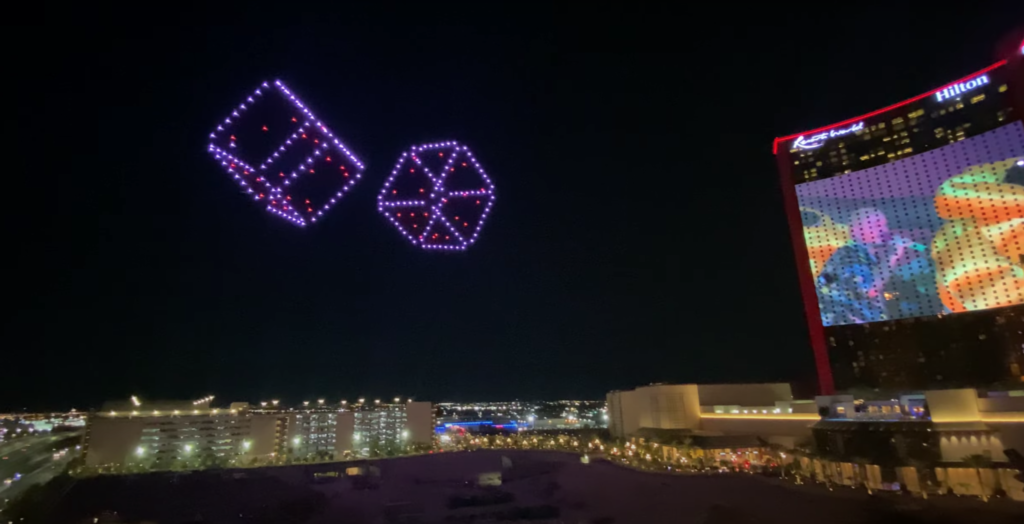
Tucson is about to become a drone show city. After decades of Independence Day fireworks over “A” Mountain, the city has announced the display is finished and a drone show is planned in its place. Hire UAV Pro produces exactly that kind of show — 50 to 5,000 drones, FAA Part 107 certified pilots, $10 million in insurance, and a design built around your event rather than a stock animation.
1,000+
Shows flown
$10M
Insured
50–5,000
Drones per show
Why Tucson is moving to drones
The reasoning is the same one driving the switch across the Southwest: fire risk. Sonoran Desert summers are dry, and a pyrotechnic display over open desert or a mountainside is a hazard that gets harder to justify every year. Flagstaff has run drone shows for its Independence Day celebration for the same reason. A drone show carries no explosives, produces no sparks and leaves nothing on the ground afterwards, so it flies on nights when fireworks are cancelled.
Where Tucson drone shows fly
Reid Park and the larger city parks give open ground and clear sightlines for a public crowd. The Tucson Convention Center precinct works for downtown events and conferences. Resort and golf properties in the Catalina Foothills suit private, corporate and wedding shows, with the mountains as a backdrop. University grounds host campus celebrations, and desert event sites outside the city give the darkest skies and the cleanest airspace in the region.
Heat, monsoon and the Tucson calendar
Autumn through spring is the comfortable season here, and it is when most Tucson events book. Summer shows are possible but fly late, after the heat drops and full darkness arrives, which in June can mean well past nine o’clock. Monsoon season from July into September brings fast-building storms, so every summer booking carries go/no-go thresholds and a planned backup window rather than a decision made on the night.
Tucson airspace
Tucson International sits south of the city and Davis-Monthan Air Force Base occupies a large footprint immediately south-east, which shapes what can fly where across much of the metro. That does not rule out a show, but it does mean the venue determines feasibility. Send us the location first and we confirm the airspace before anything else is planned. Every show is authorized in advance under FAA rules and flown by Part 107 certified pilots.
For city and parks departments
If you are replacing a fireworks display, the practical differences matter: no fire risk during burn bans, no debris cleanup, near-silent operation for neighbourhoods and wildlife, and the ability to put the city seal, an anniversary year or a sponsor logo in the sky. Sponsorship often offsets a meaningful share of the cost, because a presenting sponsor gets its mark displayed above the whole crowd. Multi-night runs cost far less per show once the crew and fleet are on site.
What every Tucson show includes
Custom show design previewed in 3D before approval, the drone fleet sized to your audience, FAA Part 107 certified pilots and ground crew, airspace authorization and FAA coordination, $10 million insurance with certificates issued to your venue, site survey and crowd separation planning, music synchronization, and full production and teardown. Travel is built into the quote — no surprise mobilization fees.
Tucson Has Already Decided to Switch
This is not a market that needs persuading. The City of Tucson has already made the decision.
On 1 July 2026 the city announced it will replace the long-running “A” Mountain fireworks at Sentinel Peak with a drone show for future Independence Day celebrations.
The reasoning given was specific and it was about fire. The “A” Mountain fireworks have sparked fires multiple times, most recently a brush fire in 2017. Councilmember Paul Cunningham cited safety. Tucson Fire Deputy Chief Antonio Canizales said fires started by fireworks are common, particularly in southern Arizona’s dry summer vegetation.
And a second argument came from an unexpected direction. Nikki Reck of the Pima Animal Care Center noted that drones “are quieter than fireworks” — the shelter takes in hundreds of extra dogs around the holiday, and she hoped a quieter show would mean fewer lost pets.
The incumbent pyrotechnic operator, who has run the show since 2019, is a named local firm. We mention that because a transition of this kind is a procurement decision with an incumbent relationship behind it, and anyone pitching into it should know that rather than discover it.
Why this matters beyond one event
A city that has publicly committed to drones for its flagship civic celebration has also, in effect, resolved the internal argument for every other event in the city. The parks department, the fire department, the council and the animal shelter are all now on record.
For a Tucson festival, resort, university event or neighbourhood association weighing a drone show, the hard part — persuading a city that this is the right direction — is already done. What remains is execution, and execution in Tucson has one genuine technical complication that most operators handle badly.
The Sentinel Peak airspace position
Worth noting what the city chose. Sentinel Peak Park sits in Class G airspace, which is the easiest airspace position in the Tucson basin — and that is not true of most of the city’s other marquee venues, as the next section sets out.
Whoever advised on that site choice got it right. It is also a reminder that in Tucson the venue decision and the airspace decision are the same decision.
Tucson Airspace — Two Overlapping Class C Surface Areas
Tucson has an airspace structure that almost no other American city of its size has, and it catches operators out.
We queried the FAA’s UAS Facility Map feature service directly at the coordinates of each venue below.
Two Class C cores overlap over the city
Tucson International and Davis-Monthan Air Force Base both operate Class C airspace, each with an outer tier at a 4,200-foot MSL floor and a surface core — and their surface areas overlap over south-central Tucson.
That is the structural fact. Tucson International’s Class C reaches up to 6,600 feet MSL. Most cities have one controlling facility to deal with; across a large part of Tucson there are two, one of them military.
What that means at named venues
Kino Sports Complex on East Ajo Way: zero-foot ceiling, under both Davis-Monthan and Tucson International Class C. LAANC is available only as a further-coordination request.
Reid Park: zero-foot ceiling under Davis-Monthan Class C, again further-coordination only.
Casino Del Sol Stadium — formerly Arizona Stadium, at 545 North National Champion Drive, capacity 50,782: 200 feet under Davis-Monthan Class C.
A zero-foot grid ceiling means no automated LAANC auto-approval at all. The operation requires the FAA’s manual further-coordination process, which runs on roughly a 90-day timeline rather than a near-real-time one — and a further-coordination request against a military controlling facility is a different conversation from the same request at a civil field.
So two of the most obvious large-audience venues in Tucson — Kino Sports Complex and Reid Park — are long-lead federal projects, and the university stadium is capped at half the vertical canvas.
Where the airspace is clean
Sentinel Peak (“A” Mountain) Park: Class G. Pima County Fairgrounds: Class G. Rillito Park: Class G.
Class G at the surface means no FAA airspace authorization is required for a Part 107 operation at or below 400 feet AGL.
That is the practical answer in Tucson: the clean sites exist, and they are not the ones in the middle of the two overlapping Class C cores. The city’s own choice of Sentinel Peak for its civic show is consistent with that, and the Pima County Fairgrounds is the obvious multi-night venue.
Stadium restrictions
The FAA’s own Stadiums feature service lists exactly five Arizona venues, and Casino Del Sol Stadium is one of them.
A standing FAA restriction covers stadiums with a seating capacity of 30,000 or more during NCAA Division I football and the other listed events — a three nautical mile radius, surface up to and including 3,000 feet AGL, from one hour before the scheduled start until one hour after the end. It restricts all aircraft operations, unmanned included. At 50,782 seats, University of Arizona home games and homecoming fall squarely inside it.
The restriction is event-triggered, not permanent — a show on a non-event date is unaffected, and a post-game show has to address the window explicitly rather than assume it has lapsed. We verify your date against the FAA’s own Sporting Event Automated Monitoring System feed rather than reading a published schedule.
At Casino Del Sol Stadium, though, the 200-foot grid ceiling binds every day of the year, not just on game days.
One comparison worth having
For scale on how constrained some Arizona venues are: WestWorld of Scottsdale sits at a 50-foot ceiling, the tightest grid at any major Arizona venue. Tucson’s zero-ceiling sites are in that same category of difficulty.
The lesson is the same one that runs through all of this work: in Tucson the launch point decides the project, and it has to be queried rather than assumed.
Tucson Flies at Colorado Altitudes — Which Is Exactly What We Do
Across almost every market we work in, the physics runs against our home ground. Tucson is the exception, and it is the reason we think we are the right operator here rather than merely an available one.
The numbers
Static propeller thrust scales roughly with air density, so what governs aircraft performance is density altitude. Tucson International’s field elevation is 2,643 feet — not the roughly 2,400 feet usually quoted for the city, and the airport figure is the one to compute from.
On a hot afternoon:
At 95°F, Tucson’s density altitude is about 5,704 feet — air density 84.3% of sea-level standard.
At 100°F, about 6,007 feet — 83.6%.
At 108°F, about 6,521 feet — 82.3%.
So a Tucson summer show flies at a density altitude between about 5,700 and 6,500 feet.
Put that next to the rest of the country. A Florida summer evening computes to around 2,300 feet. Dallas on a 100°F day reaches about 3,844. Phoenix on a July evening runs about 4,000. Tucson in the afternoon heat is operating in the same regime as Denver — and Denver is where we are from.
What that actually costs, and how we size for it
At 108°F in Tucson, the thrust requirement multiplier works out to roughly 1.103 — about ten per cent more motor output for the same lift, against sea-level standard conditions.
That compounds in three directions at once. It reduces payload headroom per airframe. It shortens hover endurance from the same battery. And — the one that governs whether a show launches — it eats the reserve available for gust rejection, because the same control authority has to come out of more motor output. A drone holding station in a 20-knot gust at 82% air density has materially less in hand than the same aircraft doing the same job at sea level.
This is not a reason to avoid Tucson. It is a reason to size the fleet, the segment lengths and the battery plan to the actual conditions rather than to a catalogue figure — and it is precisely the engineering discipline that operating out of Arvada at 5,400 feet forces you to build.
An operator who quotes you the same fleet size, flight duration and wind limit for a Tucson July evening as for a Tampa one has not run the numbers. We have, because we run them on our own home field every week.
And the right way to use it
The practical consequence is a scheduling one. Density altitude falls sharply after sunset, so the gap between a 108°F mid-afternoon setup and a post-sunset show is substantial — several hundred feet of density altitude, and the thrust margin that comes with it.
A crew staging and test-flying in Tucson’s afternoon heat is working at a meaningfully harder density altitude than the show itself will ever see. A pre-flight that passes comfortably at 4 p.m. has real margin by 9 p.m., and one that looks marginal in the afternoon is not necessarily a problem.
Knowing which is which is the difference between an unnecessary scrub and a confident launch, and in a 108°F desert city that distinction matters more than almost anywhere.
The Monsoon Is the Real Scheduling Constraint
Tucson’s weather risk is not generic desert heat. It is a specific, dated, named season with specific hazards, and planning around it is straightforward once you know the dates.
The season
The official monsoon season runs 15 June through 30 September. Both the National Weather Service Phoenix and Tucson offices state those dates.
And Tucson gets considerably more of it than Phoenix does. Average monsoon precipitation: Tucson 5.69 inches against Phoenix’s 2.43. More than double.
So Tucson’s monsoon window swallows 4 July, the entire summer, and September. Which is to say: the single largest demand date in this business sits two and a half weeks inside the monsoon.
That is not a reason to refuse a 4 July booking — the city has just committed to one — but it absolutely is a reason to build the contingency structure into the plan from the first conversation rather than bolting it on at the end.
The specific hazards, in the NWS’s own words
Two things make the monsoon different from ordinary thunderstorm risk, and both matter for an aerial show.
Wind. The NWS Tucson office states that “thunderstorm wind gusts in Arizona almost always exceed 40 mph” and that “the strongest straight line wind gusts can exceed 100 mph.” A 40-mph floor on thunderstorm gusts is a different planning assumption from most of the country.
Dust. This is the hazard nobody outside the Southwest accounts for. Straight-line thunderstorm winds “can lift huge clouds of dust and reduce visibilities to near zero in seconds.” A Dust Storm Warning is issued for visibilities of a quarter mile or less, and means wind gusts between 40 and 60 mph are also likely; above 60 mph it becomes a Severe Thunderstorm Warning instead.
Events “usually last a few minutes, and up to an hour at most”, and they are “more common during the early part of the monsoon.”
Why dust is the one to plan for
Read those two facts together: near-zero visibility in seconds, lasting a few minutes to an hour, with 40-to-60-mph gusts.
For a drone show that is a specific and unusual failure mode. It is not a forecastable all-day scrub like a nor’easter; it is a sudden-onset event that can arrive after a go decision, degrade visual line of sight to nothing, and exceed wind limits simultaneously. And the fact that it is more common early in the monsoon puts the peak of that risk in late June and early July.
The honest planning answer: a Tucson summer show needs a real abort plan, a crew briefed on dust-event behaviour, and a contingency date agreed in advance — not an optimistic forecast and a hope. We would rather set that out at the proposal stage than discover it on the night.
The windows that work
October through early December, and February through April, are the strong windows in southern Arizona — outside the monsoon, outside the worst heat, with the density altitude benefit of cooler air on top.
Tucson’s own event calendar is already built around exactly that. The Tucson Gem, Mineral and Fossil Showcase, the Tucson Rodeo and Parade, the Tucson Festival of Books, El Tour de Tucson, the Tucson Jazz Festival, the 4th Avenue Street Fair, Tucson Meet Yourself, the All Souls Procession, DUSK Music Festival, the Arizona Bowl and the Cologuard Classic all fall in the cool season.
That is a long list of large, established, non-monsoon-season events in a city that has just publicly committed to drone shows — and most of them have no incumbent aerial display at all. On the numbers and on the calendar, Tucson’s cool-season festival circuit is the strongest unclaimed opportunity we found in Arizona.
The Questions Tucson Producers Actually Ask
Is the city really switching from fireworks to drones?
Yes. On 1 July 2026 the City of Tucson announced it will replace the long-running “A” Mountain fireworks at Sentinel Peak with a drone show for future Independence Day celebrations.
The reasons given were fire and noise. The “A” Mountain fireworks have sparked fires multiple times, most recently a brush fire in 2017; Councilmember Paul Cunningham cited safety; and Tucson Fire Deputy Chief Antonio Canizales said fires started by fireworks are common in southern Arizona’s dry summer vegetation. Separately, Pima Animal Care Center noted that drones are quieter, and that the shelter takes in hundreds of extra dogs around the holiday.
For any other Tucson event weighing this, the useful point is that the internal argument is already settled city-wide — parks, fire, council and the animal shelter are all on record.
Why is Tucson airspace more complicated than Phoenix?
Because Tucson International and Davis-Monthan Air Force Base both operate Class C airspace, each with an outer tier at a 4,200-foot MSL floor and a surface core — and their surface areas overlap over south-central Tucson. Tucson International’s Class C reaches 6,600 feet MSL.
Most cities have one controlling facility. Across a large part of Tucson there are two, one of them military — and a further-coordination request against a military facility is a different conversation from the same request at a civil field.
Which Tucson venues are hard?
Kino Sports Complex on East Ajo Way sits at a zero-foot ceiling, under both Davis-Monthan and Tucson International Class C, with LAANC available only as a further-coordination request. Reid Park is also zero-foot under Davis-Monthan.
A zero-foot ceiling means no automated authorization at all — the operation needs the FAA’s manual further-coordination process on roughly a 90-day timeline. So two of the most obvious large-audience venues in the city are long-lead federal projects rather than six-week bookings.
Casino Del Sol Stadium — formerly Arizona Stadium, 50,782 seats — is 200 feet under Davis-Monthan Class C. Half the vertical canvas, workable, and it needs designing to rather than discovering.
And which are easy?
Sentinel Peak (“A” Mountain) Park, the Pima County Fairgrounds and Rillito Park are all Class G at the surface — no FAA airspace authorization required at or below 400 feet AGL.
The city’s own choice of Sentinel Peak for its civic show is consistent with that, and whoever advised on it got it right. The Pima County Fairgrounds is the obvious multi-night venue — Class G, with the acreage and parking to hold a crowd, and a fair run amortises fleet, crew and content across several performances rather than one evening.
Can we do a show at a University of Arizona game?
Outside the restriction window, and at 200 feet. Casino Del Sol Stadium is one of only five Arizona venues on the FAA’s own Stadiums feature service, and at 50,782 seats it sits well above the 30,000 threshold — so the standing restriction applies during NCAA Division I football: three nautical miles, surface to 3,000 feet AGL, from an hour before the scheduled start to an hour after the end.
It is event-triggered, not permanent, and a post-game show has to address the window explicitly rather than assume it has lapsed. We verify your date against the FAA’s own Sporting Event Automated Monitoring System feed rather than a published schedule. But the 200-foot grid ceiling binds every day of the year, not just on game days, and that is the larger constraint.
When should we schedule?
October through early December, or February through April. Outside the monsoon, outside the worst heat, and with the density-altitude benefit of cooler air on top.
The official monsoon season runs 15 June through 30 September, and Tucson gets more of it than Phoenix — 5.69 inches of average monsoon precipitation against Phoenix’s 2.43. So the monsoon window swallows 4 July, the whole summer and September.
What exactly is the monsoon risk for a drone show?
Two things, and the second is the one outsiders miss.
Wind: the National Weather Service states that “thunderstorm wind gusts in Arizona almost always exceed 40 mph” and that the strongest straight-line gusts “can exceed 100 mph.” A 40-mph floor on thunderstorm gusts is a different planning assumption from most of the country.
Dust: straight-line thunderstorm winds “can lift huge clouds of dust and reduce visibilities to near zero in seconds.” A Dust Storm Warning is issued for visibility of a quarter mile or less and means gusts of 40 to 60 mph are also likely. Events last a few minutes to an hour at most, and are more common early in the monsoon — which puts the peak of that risk in late June and early July.
For an aerial show that is an unusual failure mode: sudden onset after a go decision, visual line of sight degraded to nothing, and wind limits exceeded at the same time. A Tucson summer show needs a real abort plan, a crew briefed on dust-event behaviour, and a contingency date agreed in advance. We set that out at the proposal stage rather than discovering it on the night.
Can you fly a 4 July show here at all?
Yes — the city has just committed to one. It needs the contingency structure built in from the first conversation rather than bolted on, because 4 July sits two and a half weeks inside the monsoon and inside the early-monsoon dust peak. That is a planning problem with a known shape, not a reason to decline.
Will the altitude and heat hurt the show?
They are a genuine factor in Tucson, unlike in most of the country — and this is the one market where our own geography is an advantage rather than something to argue around.
Tucson International’s field elevation is 2,643 feet, not the roughly 2,400 usually quoted for the city. On a hot afternoon the density altitude runs about 5,704 feet at 95°F, 6,007 at 100°F, and 6,521 at 108°F — air density of 84.3%, 83.6% and 82.3% of sea-level standard respectively. At 108°F the thrust requirement multiplier is roughly 1.103, about ten per cent more motor output for the same lift.
Tucson in the afternoon heat is operating in the same regime as Denver — and Denver is where we are from. A Florida summer evening, by comparison, computes to around 2,300 feet; Dallas on a 100°F day about 3,844.
That compounds in three directions: less payload headroom per airframe, shorter hover endurance from the same battery, and — the one that governs whether a show launches — less reserve for gust rejection. An operator who quotes you the same fleet size, flight duration and wind limit for a Tucson July evening as for a Tampa one has not run the numbers.
So is a Tucson show harder than one in Phoenix?
Technically yes, on both counts. Tucson sits about 1,500 feet higher than Phoenix Sky Harbor, and it gets more than twice Phoenix’s monsoon rainfall. The airspace is also more complicated, because of the two overlapping Class C surface areas.
None of that is a reason to avoid Tucson. It is a reason to plan it properly: size the fleet and the battery plan to the actual density altitude, pick a Class G venue where you can, schedule outside the monsoon where the event allows, and brief the crew on dust events where it does not.
How many drones do we need?
It depends on viewing distance, the ceiling at your site, and what you want the audience to read in the sky — and in Tucson it also depends on the density altitude, which is unusual. At 82% air density a fleet carries less margin per airframe, so the sizing conversation is a performance conversation here rather than purely a content one.
Reference points from comparable markets: Napa carried a city celebration for an estimated 24,000 people on 400 drones; Ohio’s flagship Independence Day event flew 216 to a 400,000-plus crowd; Lansing carried a full downtown holiday celebration on 100. More drones means more resolution in the imagery rather than simply more lights. We size to the geometry, the ceiling and the air.
What else should we be looking at besides 4 July?
The cool-season festival circuit, and we think it is the strongest unclaimed opportunity in Arizona.
The Tucson Gem, Mineral and Fossil Showcase, the Tucson Rodeo and Parade, the Tucson Festival of Books, El Tour de Tucson, the Tucson Jazz Festival, the 4th Avenue Street Fair, Tucson Meet Yourself, the All Souls Procession, DUSK Music Festival, the Arizona Bowl and the Cologuard Classic all fall outside the monsoon, in the best weather and best air-density window of the year — and most of them have no incumbent aerial display at all.
A city that has just publicly committed to drone shows, with a dozen large established cool-season events and no competing pyrotechnic tradition at most of them, is an unusually open market.
Why hire a Colorado company for a Tucson show?
Because in this market the physics is on our side rather than against it. Tucson flies at 5,700 to 6,500 feet density altitude on a hot afternoon — the same regime as our own home field in Arvada at 5,400 feet. The fleet sizing, battery planning and wind-limit discipline that altitude forces you to build is exactly what a Tucson summer show needs, and it is not something a sea-level operator acquires by reading about it.
Add the rest: that Kino Sports Complex and Reid Park are zero-ceiling under two overlapping Class C cores while Sentinel Peak and the Pima County Fairgrounds are Class G; that Casino Del Sol Stadium is capped at 200 feet every day of the year; that the monsoon runs 15 June to 30 September and Tucson gets more than double Phoenix’s monsoon rain; that dust events reduce visibility to near zero in seconds and are worst in early July. We fly nationally, we carry $10 million in drone aviation liability, and we would rather tell you a venue or a date is wrong in the first conversation than in week eleven.
Tucson drone show FAQ
How much does a drone show cost in Tucson?
Fleet size drives the price, then custom animation, travel and show length. Every show is quoted individually with exact pricing within 24 hours. See our cost guide.
Can you fly during a burn ban or fire restrictions?
Yes. Drone shows carry no ignition source, which is the main reason Arizona communities are moving to them.
How many drones does a public Tucson event need?
Large public audiences viewing from a distance want 300 or more. Corporate events, resort celebrations and weddings work well at 100 to 200.
How far in advance should we book?
Sixty to ninety days is comfortable. July 4th and New Year’s Eve book earliest and sell out first.
Do you serve Phoenix, Flagstaff and Sedona too?
Yes, we fly statewide, with travel built into your quote.
Drone shows near Tucson
We fly across the region. Nearby: Phoenix · Mesa. See Arizona drone light shows for everything we have flown statewide, or explore drone show rental and corporate drone shows and events.
Book a Tucson drone show
Tell us your date, venue and audience and we will send a custom concept and exact pricing within 24 hours.
More Drone Light Shows in Arizona
We fly across Arizona. See all Arizona drone light shows, or a nearby city or venue:
University Of Arizona · Arizona State University · Camelback Mountain Base · Chandler · Chase Field · Flagstaff · Mesa · Mesa · Phoenix · Scottsdale · Sedona · Sedona Red Rocks
Book a Tucson drone show
Tell us your date, venue and audience and we will send a custom concept and exact pricing within 24 hours.