
Tennessee Drone Light Shows
Tennessee’s event landscape is built around spectacle. Nashville’s entertainment infrastructure, Memphis’s historic venues, Knoxville’s urban growth, and Chattanooga’s riverfront all create natural stages for drone light shows that demand audience attention. When hundreds or thousands of synchronized drones take flight above Tennessee’s cities, the effect is immediate and powerful. Choreography unfolding in real time, colors shifting across the night sky, formations dissolving and reforming at the moment of maximum impact—it’s the kind of visual storytelling that transforms an event from memorable into legendary. Tennessee audiences know entertainment; drone light shows deliver a different kind of spectacle that respects that sophistication.
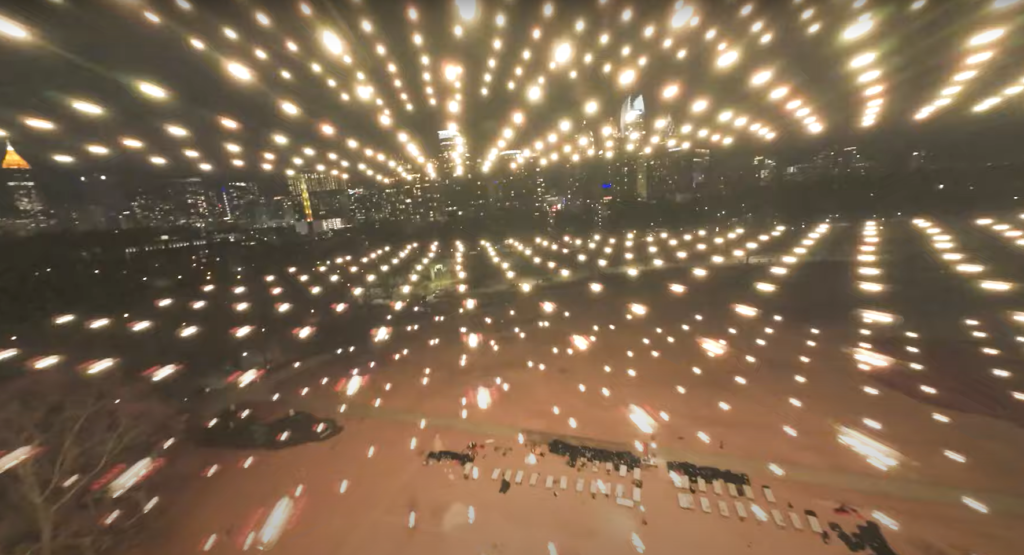
Understanding Drone Light Show Technology
A drone light show is real-time or pre-programmed choreography executed by hundreds or thousands of aircraft in formation. Each drone carries LED lights and maintains precise three-dimensional position relative to every other aircraft in the show. Pilots on the ground monitor real-time telemetry from the entire fleet. Visual observers maintain continuous situational awareness. Every color shift, every formation change, every moment of the show is executed with computer precision or real-time pilot control.
Safety is foundational to the system. Each drone operates under GPS-fenced boundaries that prevent drift outside approved airspace. Every drone can automatically return home if signal is lost. Each carries parachute recovery systems for controlled descent. Fail-safe landing logic ensures controlled descent even in power loss scenarios. This redundancy is what allows shows to operate over crowds in major metropolitan venues like Nashville and Memphis.
Two Drone Platforms for Distinct Event Needs
Kaiken Drones: The cost-effective professional platform. Kaiken units are lightweight and durable, delivering synchronized choreography at efficient cost. They excel at outdoor festivals, city celebrations, and regional events where budget efficiency matters but professional quality is non-negotiable. Kaiken shows are fully professional—the difference is pricing structure, not execution quality.
Damoda V4 Drones: The premium professional system purpose-built for high-visibility events. Each drone carries 2,200+ lumens of RGBW LED brightness—visible even in well-lit urban environments like downtown Nashville. Damoda V4s include full safety redundancy: parachute recovery, GPS-fenced boundaries, automatic return-to-home, and fail-safe landing. The production advantage is the free second launch included with every Damoda V4 show—meaning you can run a pre-show at dusk (6–8 minutes) and a full core show after dark (up to 16 minutes). That flexibility lets you structure an entire evening’s visual storytelling within a single booking.
Custom Choreography and Event-Specific Design
Your show is choreographed specifically for your event. Not templated. Not generic. In-house design team works with your music, your brand colors, your narrative. Choreography syncs at millisecond precision with FM radio simulcast, so the entire crowd hearing broadcast audio experiences perfect visual-audio synchronization.
Scale ranges from 100 to 5,000 drones. A 200-drone show creates high-impact visual interest above a downtown plaza or venue. A 500-drone show dominates the skyline. A 1,000-drone show becomes the kind of spectacle that defines an event. A 5,000-drone show is regional phenomenon. Your venue, audience size, and creative vision determine the right platform.
Tennessee Market Experience and Operations
Hire UAV Pro, founded in 2017, has completed 1,000+ shows across major U.S. markets, including extensive operations in the Southeast. Every pilot holds FAA Part 107 Remote Pilot Certification. The fleet operates under multi-UAS waivers (enabling simultaneous operation of multiple aircraft) and night operations waivers (required for post-sunset flight). Insurance is $10 million in aviation and umbrella coverage—essential for professional operations in major Tennessee venues.
Operations are led by Graham Hill (founder and show director), Jacob Gould (lead pilot with 6+ years experience), Isaac Henry (pilot and programmer), and visual observers who maintain real-time flight monitoring. This is a dedicated, full-time production team. Tennessee events work with professionals, not weekend operators.
Show Duration and Production Timeline
A full drone light show typically runs 12–20 minutes of flight time. That duration allows for narrative—opening, development, climax, conclusion—while ending before audience attention naturally declines. With Damoda V4’s two-launch option, you structure the entire evening: lighter pre-show at dusk, then full-power core show after dark for maximum visual impact.
Booking process: Submit your inquiry, receive a custom proposal within 48 hours. Site assessment follows—evaluation of airspace restrictions, weather patterns, launch/recovery zones, sight lines, and production logistics. Tennessee airspace (Nashville, Memphis, Knoxville, Chattanooga) is well-defined; Hire UAV Pro has routine experience across all major markets. Permits are coordinated with local authorities. Final details lock 14 days prior to event.
For a full breakdown of everything drone light shows, visit our comprehensive drone light show guide page
Drone Light Shows in Tennessee Cities
We bring professional drone light shows to cities across Tennessee. Explore our services in your area:
- Chattanooga Drone Light Shows
- Clarksville Drone Light Shows
- Gatlinburg Drone Light Shows
- Knoxville Drone Light Shows
- Pigeon Forge Drone Light Shows
Don’t see your city? We serve all of Tennessee. Book a drone show anywhere in the state.
Why Hire UAV Pro for Tennessee Events
Professional drone light show production is specialized work. It requires FAA waivers, commercial insurance, multi-aircraft coordination systems, custom animation software, and pilots with significant formation-flying experience. Most local operators lack this depth. Hire UAV Pro brings 1,000+ completed shows, a dedicated team, a purpose-built fleet, and proprietary systems. You’re not renting equipment and hoping for results; you’re partnering with an established production company that knows how to execute at scale.
Cost, Pricing, and What’s Included
Pricing ranges from $10,000 to $50,000+ depending on drone count (100–5,000), design complexity, and site logistics. Music production, on-site staffing, permits, safety coordination, and contingency planning are included. The range reflects the reality that every event is genuinely different—a 150-drone celebration over a small venue is a different scope from a 1,000-drone show over a major metropolitan event.
For Tennessee events—whether you’re celebrating a corporate milestone, city anniversary, product launch, or entertainment venue activation—drone light shows deliver visual impact that few other production elements can match. The choreography is specific to your story. The execution is professional. The result is memorable.
Ready to bring a drone show to Tennessee? Book a drone show and our team will put together a custom proposal within 48 hours.
Flying in Tennessee Airspace
We queried the FAA’s UAS Facility Map feature service directly at the coordinates of each venue below. Nashville’s downtown core turns out to be one of the least constrained in the country for show altitude.
Every gridded downtown Nashville venue sits at 400 feet
Nissan Stadium: 400 feet. Geodis Park: 400 feet. Ascend Amphitheater: 400 feet. Riverfront Park: 400 feet. All under Nashville International Class C, all LAANC-enabled, meaning the authorization processes in near real time rather than through a federal coordination queue.
And two of the best downtown sites are not gridded at all. First Horizon Park and Bicentennial Capitol Mall State Park are Class G at the surface — no FAA airspace authorization required for a Part 107 operation at or below 400 feet AGL.
Across the full Nashville International grid: 713 cells, of which 509 allow the complete 400 feet and only 64 — about 9% — are zero-ceiling.
That 9% figure is the number to hold onto. Nearly a quarter of the mapped grid over New York City is zero-ceiling. Almost half of Newark’s is. Charlotte’s is 17%. Nashville is cleaner than all of them. John C. Tune Airport’s Class D grid matches it at 9% — 32 zero-ceiling cells out of 363.
One precision caution, and it is a real one
First Horizon Park and Bicentennial Capitol Mall are Class G at the surface, but they sit only 0.7 to 0.8 nautical miles from grid cells belonging to both Nashville International Class C and John C. Tune Class D.
That is a tight boundary. A park centroid returning “no grid” does not guarantee that a launch position two hundred yards across the lawn returns the same answer, and a fleet with lateral spread can occupy both sides of a line that does not exist on the ground.
We verify the actual launch coordinates and the flight envelope rather than the venue centroid, and we check B4UFLY on the day rather than relying on a lookup done weeks earlier. That is the kind of detail that does not show up in a proposal until it matters.
Smyrna is the constrained one
Of the Nashville-area facilities, Smyrna Airport’s Class D grid is the hardest: 40 of 172 cells — 23% — are zero-ceiling, with 50 at 200 feet and 82 at the full 400. If your venue is in Rutherford County, the airspace question is materially less forgiving than it is downtown, and it needs checking by point rather than by metro.
Stadium restrictions, including one venue right on the line
A standing FAA restriction covers stadiums with a seating capacity of 30,000 or more during regular and postseason MLB, NFL and NCAA Division I football, plus NASCAR Cup, IndyCar and Champ Series races — a three nautical mile radius, surface up to and including 3,000 feet AGL, from one hour before the scheduled start until one hour after the end. It restricts all aircraft operations, unmanned included.
In Tennessee that reaches Nissan Stadium at roughly 69,100 seats, Neyland Stadium in Knoxville at about 101,900 — the largest stadium in the Southeast region — and Simmons Bank Liberty Stadium in Memphis at about 58,300.
Geodis Park sits right on the threshold at roughly 30,000 seats, which means it should be checked per event rather than assumed either way. That is exactly the kind of borderline case that gets guessed at, and guessing wrong in either direction costs you — either an unnecessary 90-day process or an unlawful flight.
The crucial operational point is that the restriction is event-triggered, not permanent. A show at Nissan Stadium on a non-event date is unaffected. A show timed to an actual game has to address the window explicitly, and a post-game show needs the restriction addressed rather than assumed away — which is the single most common planning error at SEC and NFL venues. We verify your date against the FAA’s own Sporting Event Automated Monitoring System feed rather than reading a published schedule.
Elsewhere in the state
Memphis — Simmons Bank Liberty Stadium, AutoZone Park at about 10,000, Liberty Park, and Tom Lee Park on the Mississippi riverfront, which has recently been rebuilt and is now one of the better large-audience civic spaces in the state.
Knoxville — Neyland Stadium, World’s Fair Park and Chilhowee Park.
Chattanooga — Finley Stadium at about 20,700, Coolidge Park, and Ross’s Landing on the Tennessee River.
For each of those we would query the actual coordinates before quoting, rather than extrapolating from Nashville’s numbers. The whole point of this page is that the answer is site-specific.
Tennessee Fireworks Law — and the Nashville and Memphis Carve-Out
Tennessee’s fireworks law contains a provision that most people in the events business do not know about, and it changes the argument in the state’s two biggest cities.
Consumer fireworks are banned from sale in Nashville and Memphis
Under T.C.A. § 68-104-112(a)(4), retail sales of Class C common fireworks are prohibited in counties with a population over 355,000, subject to narrow grandfather exceptions.
That captures Davidson County — Nashville — and Shelby County — Memphis.
And it is not the only local lever. Under § 68-104-116, in counties where sales are not already prohibited, a city may regulate, restrict or totally prohibit fireworks sales by ordinance or private act. Under § 68-104-105, anyone manufacturing, distributing, selling or displaying fireworks needs a state fire marshal permit, and a retailer’s application must include a statement signed by the mayor confirming that sales are permissible in that jurisdiction.
The practical consequence for an event planner in Tennessee’s two largest markets: there is no consumer-fireworks retail trade competing with your show for the sky, and the local political posture on pyrotechnics is already restrictive rather than permissive. If you are proposing a drone show to a Nashville or Memphis committee, you are not fighting a tradition — you are extending a direction the county has already taken.
The professional display chain
A public display in Tennessee runs through two state licences and a local approval.
The state licenses display exhibitors and separately certifies display operators — both are required before a display permit issues. Under § 68-104-204, a licensed exhibitor must carry at least $1,000,000 in general liability insurance, and operators must be trained and certified.
Under § 68-104-203, a municipality running its own display need not itself be a licensed exhibitor, but it must have a certified operator supervise and fire the display, show proof of insurance, source its fireworks from a licensed exhibitor, and file with the state fire marshal at least ten days before the display.
Under § 68-104-211, the application must carry the fire department chief supervisory official’s signed approval, with written notice to the chief law enforcement officer.
None of the Tennessee display permit materials mention drones or unmanned aircraft.
So a drone show in Tennessee needs no state exhibitor licence, no certified pyrotechnic operator, no ten-day fire marshal filing and no fire chief signature. It is governed by the FAA under Part 107, by whatever land manager controls the ground, and by the venue’s own event permitting. That is not a loophole; fireworks law regulates combustion and an aircraft is not combustion.
We carry $10 million in drone aviation liability — ten times the $1,000,000 floor Tennessee sets for a licensed fireworks exhibitor. Because that floor is written into statute, it is a comparison you can verify rather than a claim.
The burn permit window, and why it matters more here
This is the detail that makes the fire argument unusually strong in Tennessee, and it is a calendar coincidence rather than a general claim.
The Tennessee Division of Forestry requires an open-air burning permit from 15 October through 15 May — the state’s declared fire season.
Now put that next to the weather. September and October are the two best months of the year for an outdoor evening show in Tennessee on wind, thunderstorm frequency and rainfall simultaneously. So the back half of the single best show window in the state falls inside the fire season, as does the entire late-autumn and winter events calendar — holiday shows, New Year’s Eve, early-spring festivals.
A drone show has nothing to burn. It requires no burn permit, is unaffected by a fire-weather cancellation, and remains available under a venue’s no-open-flame policy. For a mid-October fair, a Thanksgiving-weekend event, a holiday celebration or a New Year’s Eve show in Tennessee, that is not an abstract benefit — it is the difference between a plan and a contingency.
When To Fly in Tennessee
We computed this rather than looked it up. Ten years of NOAA daily summaries, 2016 through 2025, at Nashville International — peak five-second gusts, plus thunder-day counts from the GHCN daily thunder flag and tornado climatology from the NOAA Storm Prediction Center database.
September is the best month, and Tennessee’s case is stronger than its neighbours’
September at Nashville: 20.4 mph mean daily peak gust, 5.7 days a year above 25 mph, and only 2.0 days above 30. October is close behind at 21.4 mph, 8.4 and 3.1, and carries the year’s lowest precipitation frequency at 7.8 measurable-rain days.
March and April are the worst. April runs 27.2 mph mean with 17.2 days above 25 and 9.8 above 30 — nearly five times September’s figure. March is 27.0 and 17.3. April is also the primary tornado peak at 7.0 per year.
Thunderstorms agree. Nashville averages 60.4 thunder days a year — against Orlando’s 106.8 and Tampa’s 104.7, so roughly 57% of central Florida’s. July peaks at 12.4 thunder days, August falls to 8.6, and September drops to 3.9 and October to 1.7.
And here is the finding that makes Tennessee distinctive
Tennessee’s September is the quietest tornado month in the entire regional dataset — 0.3 per year.
That is not a rounding of a small number; it is the lowest figure for any month in any of the states we measured. North Carolina, by contrast, has a second tornado peak in September at 4.9 per year, driven by tropical systems tracking inland. Georgia’s January secondary peak runs 4.4.
Tennessee has neither. It sits far enough inland that landfalling tropical weather arrives weakened, and its severe-weather season is genuinely concentrated in spring.
So the three measures converge without a caveat: September in Tennessee is the lowest-wind month, among the lowest thunderstorm months of the warm season, and the quietest severe-weather month in the region. October is nearly as good and adds the year’s lowest rainfall frequency.
If you have date flexibility in Tennessee, late September through October is the recommendation, and it comes with fewer qualifications than the same recommendation in any neighbouring state.
One real risk, in a month people do not expect
The strongest single gust recorded at Nashville in the decade was 78.1 mph — in December. December also runs 24.5 mph mean with 13.6 days above 25 and 8.0 above 30, which is worse than every month from May through November.
Tennessee’s winter is windier than its reputation. A New Year’s Eve or holiday show here carries genuine weather risk, and we plan contingency dates into it from the first conversation rather than treating a hold as a failure.
One caveat about the numbers themselves
WSF5 is a daily peak gust, recorded at any hour of the day. Drone shows fly at dusk, when the boundary layer typically decouples and surface winds slacken.
These figures overstate the wind a show would actually see. They are valid for ranking months and cities against each other — which is exactly what we use them for — and they are not a show-time forecast or a scrub predictor. Anyone presenting a daily-peak gust statistic as a 9 p.m. condition is either confused or hoping you are.
Density Altitude, and What Humidity Actually Does
This section argues against our own geography, and it also corrects a claim that gets repeated a lot in this industry.
We are based in Arvada, Colorado, at about 5,400 feet, so we fly a great deal of work at altitude and have built the engineering discipline for it. In a Tennessee conversation the physics runs Tennessee’s way — and Nashville comes out best of the three major Southeastern markets we measured.
We computed the figures below from NCEI hourly observations, summers 2021 through 2025, using actual dry-bulb temperature, dewpoint and station pressure rather than altimeter estimates, with the water-vapour term calculated properly because moist air is less dense than dry air and the correction is real.
A Nashville show at 9 p.m. in summer operates at roughly 2,051 feet density altitude on average, rising to about 2,773 feet on a genuinely hot evening. Field elevation at Nashville International is 599 feet, so the elevation-to-density-altitude spread at show time is about 1,450 feet.
That 2,051-foot figure is the lowest of the three major Southeastern metros — Charlotte averages 2,236 and Atlanta 2,620 at the same hour.
For comparison, Phoenix at 9 p.m. in summer averages 3,996 feet. Nashville holds roughly a 1,950-foot advantage on an average summer evening, and a far larger one against the Mountain West.
The humidity claim, corrected
You will sometimes hear that Southeastern humidity cancels the altitude advantage over the desert Southwest. We checked, and it does not.
The water-vapour correction at Nashville runs about +277 to +313 feet of density altitude. In Phoenix it runs about +130 to +170 feet. So humidity does cost Nashville something real — roughly 140 feet more than it costs Phoenix.
But the gap between the two cities at show time is around 1,950 feet. Humidity closes about 140 feet of it. Field elevation and temperature dominate, and they dominate by an order of magnitude. The honest version: the humidity correction is real, we compute it rather than ignoring it, and it does not change the ranking.
The number that actually matters operationally
This is the one most people miss, and it concerns your crew rather than your show.
At 3 p.m. in summer, Nashville’s density altitude averages about 2,655 feet and reaches roughly 3,401 feet on a hot afternoon. By 9 p.m. the show flies at about 2,051.
So a crew staging, test-flying and verifying a fleet in the afternoon heat is working at a density altitude roughly 600 to 750 feet higher than the show itself will see. A pre-flight that passes comfortably at 3 p.m. has margin to spare by 9 p.m. — and one that looks marginal in the afternoon is not necessarily a problem.
Knowing which is which is the difference between an unnecessary scrub and a confident launch, and it is the sort of thing that only comes from computing the actual hourly data rather than quoting a field elevation.
What the margin buys
Static propeller thrust scales roughly with air density, so this translates directly into available thrust. More payload headroom per airframe. Longer hover endurance from the same battery. Higher climb rate. And the one that governs show reliability: a larger reserve for gust rejection, because the same control authority comes out of less motor output.
The thin-air derates that constrain fleet sizing, flight duration and wind limits in the Mountain West and Desert Southwest do not bind in Tennessee. Your fleet size here is set by what the choreography needs to read at your audience’s viewing distance, and by nothing else.
Nashville Already Set the National Benchmark
Tennessee is not a market that needs convincing. It holds one of the largest drone show datapoints in the country.
Nashville’s “Let Freedom Sing” on 4 July 2026 flew 1,000 drones, paired with what was billed as the largest fireworks show in the city’s history, over the Cumberland River. The drone and fireworks segment was staged at Ascend Amphitheater, with the Nashville Symphony playing from 9:30 to 10 p.m., organised by the Nashville Convention & Visitors Corp.
It was free. It ran five stages with more than thirty local artists across Walk of Fame Park, The Green at Riverfront Park, Public Square Park and a Broadway stage.
It drew 500,000 people.
What that number actually tells you
Three things worth taking from it, and they are not the obvious ones.
The additive model works at the very top of the scale. Nashville did not choose between technologies. A thousand drones and a record fireworks show ran on the same bill, with a symphony between them. For any committee worried that adopting drones means telling an audience the fireworks are gone, the country’s largest municipal Independence Day celebration already demonstrated that the answer is no.
The drones were programmed into a music and arts event, not bolted onto a fireworks slot. Five stages, thirty-plus artists, a symphony performance timed into the show window. That is the structure that makes a drone fleet worth its cost — it can be synchronised to a specific piece of music in a way a pyrotechnic sequence approximates and a fleet executes exactly. In Music City that is not a gimmick; it is the obvious use of the technology.
And the venue sits at a 400-foot LAANC ceiling. Ascend Amphitheater, Riverfront Park, Nissan Stadium and Geodis Park all do. The largest drone show benchmark in the region flew in airspace that processes its authorization in near real time, which is worth knowing when someone tells you a downtown show is complicated.
The regional conversion picture
Tennessee’s neighbours give you the other templates. Chapel Hill, North Carolina replaced its fireworks outright with a 300-drone show, following a 2024 community survey, with the mayor citing air pollution, chemical runoff, people who don’t enjoy explosions, and animals. Uptown Charlotte ran drones, a symphony and fireworks together under a civic-partnership structure. Atlanta replaced its Peach Drop with a drone show at 11:45 p.m. followed by fireworks at midnight for New Year’s Eve 2026.
So within a day’s drive of Nashville there are worked precedents for a full replacement at town scale, an additive civic partnership at city scale, a New Year’s Eve conversion, and a half-million-person additive event. Whichever version your committee is arguing about, someone nearby has already done it.
The dates nobody is competing for
Independence Day events cluster brutally on 1, 3 and 4 July across the entire Southeast — crews, aircraft and airspace all under pressure inside a single 96-hour window.
The better opportunities in Tennessee are elsewhere on the calendar, and two of them line up with the weather data on this page.
State and county fairs run in September and October — inside the best weather window in the state, and a multi-night run amortises the same fleet and crew across several performances while letting the content change night to night. That is a fundamentally stronger proposition than one holiday evening.
And anything from 15 October onward sits inside Tennessee’s declared fire season, when an open-air burning permit is required. Autumn festivals, holiday events, New Year’s Eve — the whole back half of the calendar is a period when a combustion-based show carries a permitting and cancellation risk that a drone show simply does not have.
An honest note on comparison
A thousand drones at a 500,000-person event sets a local expectation, and we would rather you walk into a budget conversation knowing it than discover it there. It also tells you something useful in the other direction: Chapel Hill carried a full Independence Day replacement on 300, and Lansing, Michigan carried a downtown holiday celebration on 100. Drone count is a function of viewing distance and content, not of seriousness.
What we would ask you to compare in any proposal is whether it tells you the grid ceiling at your exact coordinates, the stadium restriction windows against your exact date, the authorization timeline that follows from both, and the liability limit standing behind it. Everything on this page is the output of that work.
The Questions Tennessee Producers Actually Ask
Is downtown Nashville difficult airspace?
No — it is among the cleanest in the country. Nissan Stadium, Geodis Park, Ascend Amphitheater and Riverfront Park all sit at a 400-foot ceiling under Nashville International Class C, LAANC-enabled. First Horizon Park and Bicentennial Capitol Mall State Park are Class G at the surface — no FAA airspace authorization required at or below 400 feet AGL.
Across the full Nashville International grid, 509 of 713 cells allow the complete 400 feet and only about 9% are zero-ceiling. New York City’s is nearly a quarter; Newark’s almost half; Charlotte’s 17%.
So the park is Class G — can we just launch?
Careful, and this is a genuine precision issue rather than a disclaimer. First Horizon Park and Bicentennial Capitol Mall are Class G at the surface, but they sit only 0.7 to 0.8 nautical miles from grid cells belonging to both Nashville International Class C and John C. Tune Class D.
A “no grid” result at a park centroid does not guarantee the same answer two hundred yards across the lawn, and a fleet with lateral spread can straddle a line that is invisible on the ground. We verify the actual launch coordinates and the flight envelope rather than the venue centroid, and we re-check on the day rather than relying on a lookup done weeks earlier.
Our venue is in Rutherford County. Same answer?
No. Smyrna Airport’s Class D grid is the hardest in the Nashville area — 23% of its cells are zero-ceiling, against 9% at Nashville International. A zero-ceiling cell means no automated authorization at all and roughly a 90-day manual FAA coordination process. Outside the metro core, the airspace has to be checked by point rather than inferred from Nashville’s numbers.
Can we do a post-game show at Nissan Stadium or Neyland?
Yes, and this is where most planning goes wrong. The standing restriction covers stadiums seating 30,000 or more during MLB, NFL, NCAA Division I football and major races — three nautical miles, surface to 3,000 feet AGL, from an hour before the scheduled start until an hour after the end.
It is event-triggered, not permanent. A show on a non-event date is unaffected. A post-game show has to address the window explicitly rather than assume it has lapsed — the most common error at SEC and NFL venues. We verify your date against the FAA’s own Sporting Event Automated Monitoring System feed rather than reading a schedule.
One borderline case worth flagging: Geodis Park sits right on the 30,000 threshold and should be checked per event rather than assumed in either direction.
Are consumer fireworks legal where our event is?
In Nashville and Memphis, no — and most people do not know this. Retail sales of Class C common fireworks are prohibited in Tennessee counties with a population over 355,000, which captures Davidson and Shelby. Elsewhere, a city may regulate, restrict or totally prohibit sales by ordinance, and a retailer’s state permit application requires a statement signed by the mayor that sales are permissible locally.
So in the state’s two biggest markets there is no consumer-fireworks retail trade competing with your show for a dark sky, and the local posture is already restrictive. If you are pitching a drone show to a Nashville or Memphis committee, you are extending a direction the county has already taken rather than fighting a tradition.
What does a professional display have to do that we don’t?
Quite a lot. Tennessee requires a state exhibitor licence and a separately certified display operator, both before a permit issues. A licensed exhibitor must carry at least $1,000,000 in general liability. A municipality running its own display needs a certified operator to supervise and fire it, proof of insurance, fireworks sourced from a licensed exhibitor, and must file with the state fire marshal at least ten days before. The application needs the fire chief’s signed approval plus written notice to the chief law enforcement officer.
A drone show enters none of that. Tennessee’s display permit materials do not mention drones or unmanned aircraft. We carry $10 million in drone aviation liability — ten times the statutory exhibitor floor.
Can you fly during fire season?
Yes, and in Tennessee that matters more than in most states. The Division of Forestry requires an open-air burning permit from 15 October through 15 May. Look at what that covers: the back half of the state’s best show window, plus every autumn festival, every holiday event and New Year’s Eve.
A drone show has nothing to burn. It needs no burn permit, is unaffected by a fire-weather cancellation, and remains available under a venue’s no-open-flame policy. For a mid-October fair or a December event in Tennessee, that is the difference between a plan and a contingency.
When should we schedule?
September, then October — and Tennessee’s case is stronger than any neighbouring state’s. September runs 20.4 mph mean daily peak gust with only 2.0 days a year above 30, 3.9 thunder days, and — the distinctive part — 0.3 tornadoes per year, the quietest month in the entire regional dataset.
North Carolina has a second September tornado peak at 4.9 per year from tropical systems. Georgia has a January secondary peak at 4.4. Tennessee sits far enough inland that it has neither. October is nearly as good and adds the year’s lowest rainfall frequency at 7.8 measurable-rain days.
March and April are the worst: April runs 27.2 mph mean with 9.8 days above 30 mph and is the primary tornado peak at 7.0 per year.
What about a New Year’s Eve or holiday show?
Possible, and worth going in with eyes open. Tennessee’s winter is windier than its reputation — the strongest single gust at Nashville in the last decade was 78.1 mph, in December, and December runs worse than every month from May through November on gust frequency. We plan contingency dates in from the first conversation rather than treating a hold as a failure. The upside is that from 15 October a pyrotechnic alternative carries a burn-permit requirement that a drone show does not.
How many drones do we need?
It depends on viewing distance and what you want the audience to read in the sky, not on a package tier. For reference across the region: Nashville’s own “Let Freedom Sing” flew 1,000 drones to a 500,000-person crowd. Chapel Hill, North Carolina carried a full Independence Day replacement on 300. Lansing, Michigan carried a downtown holiday celebration on 100.
Drone count is a function of audience distance and content complexity, not of seriousness. More drones means more resolution in the imagery rather than simply more lights, and we size to the geometry.
Should we replace our fireworks or add to them?
Either, and Tennessee’s own flagship is the case for adding. “Let Freedom Sing” ran a thousand drones and a record fireworks show on the same bill, with the Nashville Symphony between them, in front of half a million people. If the country’s largest municipal Independence Day celebration did not have to choose, your committee does not either. Within a day’s drive there are also worked replacement precedents — Chapel Hill at town scale, Atlanta’s Peach Drop at New Year’s Eve. We will build whichever version you want and be straight about what each costs.
Why hire a Colorado company for a Tennessee show?
Because what you are buying is the analysis on this page plus the aircraft and crew to execute it. That Nashville’s grid is only 9% zero-ceiling while Smyrna’s is 23%; that First Horizon Park is Class G but sits 0.7 nm from two separate grids; that Geodis Park straddles the stadium threshold; that September in Tennessee is the quietest severe-weather month in the region while September in North Carolina is a tropical peak; that fire season opens 15 October and swallows the back half of your calendar; that setup-hour density altitude runs 600 feet above show-hour — that is work done because it decides whether a show flies and on which date. We fly nationally, we carry $10 million in drone aviation liability against a $1 million statutory exhibitor floor, and we would rather tell you a venue or a date is wrong in the first conversation than in week eleven.
Drone Light Shows Across Tennessee
We fly drone light shows throughout Tennessee. Explore the cities and venues we serve:
More about our drone light show company — how a show gets planned, and what a booking includes.