
Nashville Drone Light Shows
Music City’s stage is legendary—the Ryman, the Grand Ole Opry, honky-tonks on Broadway, and now, increasingly, outdoor festivals and destination events along the Cumberland River. Imagine 600 drones ascending above a concert venue, moving in perfect synchronization with a live performance or curated soundtrack, formations responding to every beat and bridge. Nashville’s vibrant music culture, riverside venues, and growing status as a destination event hub make it an ideal setting for large-scale drone light shows. Hire UAV Pro brings that possibility to concert promoters, festivals, corporate launches, and civic celebrations across the Nashville metro.
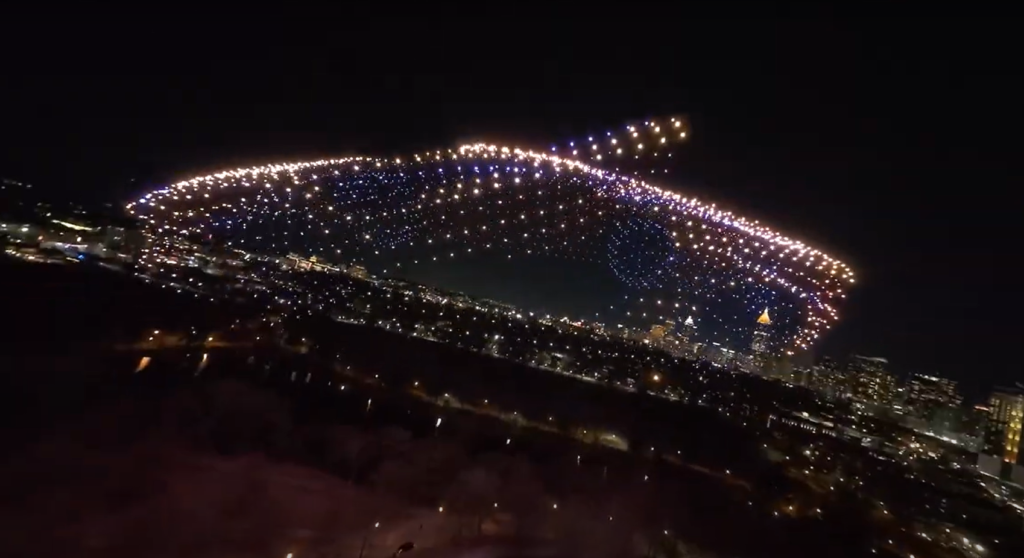
Nashville Drone Light Shows for Teams, Stadiums and Game Day Events
Nashville’s professional roster is the Titans, the Predators and Nashville SC, with the downtown venues sitting close to Broadway and the riverfront. That location is why a local activation gets seen by far more than the ticket holders. HireUAVPro produces drone light shows for home openers, playoff pushes, trophy celebrations, fan fests and branded pregame programming. FAA Part 107 pilots, aviation liability at the ten million dollar level, and a track record past a thousand performances support the work, and builds range from seventy aircraft up past three hundred.
Downtown Nashville packs bars, hotels, older masonry buildings and dense pedestrian traffic into a few blocks, and a show without pyrotechnics means no spark, no ember and nothing coming down over any of it. Turf goes unscorched and nothing has to be recovered off a rooftop. For a venue operator, that is usually the difference between a conversation and a flat refusal. Evening fixtures tend to put the launch near nine thirty. Questions and date checks go through the contact form.
More Drone Light Shows in Tennessee
We fly across Tennessee. See all Tennessee drone light shows, or a nearby city or venue:
Nissan Stadium Riverfront · Pigeon Forge · Shelby Farms Park · University Of Tennessee · Beale Street · Chattanooga · Clarksville · Dollywood · Gatlinburg · Knoxville
Nashville Airspace, Measured Site by Site
Nashville’s downtown core is one of the least constrained major-city airspace environments in the United States for show altitude. We queried the FAA’s UAS Facility Map feature service directly at the coordinates of each venue below.
Every gridded downtown venue sits at the full 400 feet
Nissan Stadium: 400 feet. Ascend Amphitheater: 400 feet. Riverfront Park: 400 feet. Geodis Park: 400 feet.
All of them under Nashville International Class C, and all LAANC-enabled — the authorization processes in near real time rather than sitting in a federal coordination queue for a quarter.
And two of the strongest downtown sites are not gridded at all. First Horizon Park and Bicentennial Capitol Mall State Park are Class G at the surface — no FAA airspace authorization required for a Part 107 operation at or below 400 feet AGL.
Across the full Nashville International grid: 713 cells, of which 509 allow the complete 400 feet and only 64 — about 9% — carry a zero-foot ceiling.
That 9% is the number worth remembering. Nearly a quarter of the mapped grid over New York City is zero-ceiling. Almost half of Newark’s is. Charlotte’s is 17%. Atlanta’s Truist Park is zero-ceiling outright, constrained by Dobbins Air Reserve Base. Nashville is cleaner than all of them, and John C. Tune Airport’s Class D grid matches it at 9% — 32 zero-ceiling cells out of 363.
One precision caution, and it is real rather than boilerplate
First Horizon Park and Bicentennial Capitol Mall are Class G at the surface — but they sit only 0.7 to 0.8 nautical miles from grid cells belonging to both Nashville International Class C and John C. Tune Class D.
That is a tight boundary. A park centroid returning “no grid” does not guarantee that a launch position two hundred yards across the lawn returns the same answer, and a fleet with real lateral spread can occupy both sides of a line that is invisible on the ground.
We verify the actual launch coordinates and the full flight envelope rather than the venue centroid, and we re-check on the day rather than relying on a lookup done weeks earlier. That distinction does not matter until it matters, and then it matters completely.
Outside the core, the answer changes
If your venue is in Rutherford County, the airspace is materially less forgiving. Smyrna Airport’s Class D grid is the hardest in the Nashville area: 40 of 172 cells — 23% — are zero-ceiling, with 50 at 200 feet and only 82 at the full 400.
A zero-ceiling cell means no automated authorization at all and roughly a 90-day manual FAA coordination process. Outside downtown, the airspace has to be checked by point rather than inferred from Nashville’s headline numbers.
Stadium restrictions, including one venue right on the line
A standing FAA restriction covers stadiums with a seating capacity of 30,000 or more during regular and postseason MLB, NFL and NCAA Division I football, plus NASCAR Cup, IndyCar and Champ Series races — a three nautical mile radius, surface up to and including 3,000 feet AGL, from one hour before the scheduled start until one hour after the end. It restricts all aircraft operations, unmanned included.
Nissan Stadium, at roughly 69,100 seats, is covered.
Geodis Park sits right on the threshold at roughly 30,000 seats, which means it must be checked per event rather than assumed either way. That is exactly the borderline case that gets guessed at, and guessing wrong costs you in both directions — an unnecessary 90-day process, or an unlawful flight.
First Horizon Park, at about 10,000 seats, is well below the threshold and is not covered by the standing restriction at all. Combined with its Class G surface position, that makes a Sounds game one of the most straightforward drone show prospects in the city.
The critical operational point: the restriction is event-triggered, not permanent. A show at Nissan Stadium on a non-event date is unaffected. A show timed to an actual game has to address the window explicitly — and a post-game show needs the window addressed rather than assumed to have lapsed. That is the single most common planning error at NFL and SEC venues, and we verify your date against the FAA’s own Sporting Event Automated Monitoring System feed rather than reading a published schedule.
Nashville Already Set the National Benchmark
This city does not need convincing that drone shows work. It holds one of the largest drone show datapoints in the country.
“Let Freedom Sing” on 4 July 2026 flew 1,000 drones, paired with what was billed as the largest fireworks show in Nashville’s history, over the Cumberland River. The drone and fireworks segment was staged at Ascend Amphitheater, with the Nashville Symphony playing from 9:30 to 10 p.m., organised by the Nashville Convention & Visitors Corp.
It was free. It ran five stages with more than thirty local artists across Walk of Fame Park, The Green at Riverfront Park, Public Square Park and a Broadway stage.
It drew 500,000 people.
Three things that number actually tells you
The additive model works at the very top of the scale. Nashville did not choose between technologies. A thousand drones and a record fireworks show ran on the same bill, with a symphony between them. For any committee worried that adopting drones means telling an audience the fireworks are gone, the largest municipal Independence Day celebration in the country already settled that question.
The drones were programmed into a music event, not bolted onto a fireworks slot. Five stages, thirty-plus artists, a symphony performance timed into the show window. That is the structure that makes a fleet worth its cost, because a drone show can be synchronised to a specific piece of music frame by frame in a way a pyrotechnic sequence approximates and a fleet executes exactly.
In Music City that is not a gimmick, it is the obvious use of the technology — and it is the single best argument for a drone show to a Nashville client. If the music matters, the medium that can actually follow it matters.
And it flew at a 400-foot LAANC ceiling. Ascend Amphitheater, Riverfront Park, Nissan Stadium and Geodis Park all do. The largest drone show benchmark in the region flew in airspace whose authorization processes in near real time, which is worth knowing when someone tells you a downtown show is complicated.
The regional precedents, for whichever conversation you are having
Within a day’s drive of Nashville there is a worked precedent for every version of this decision.
Chapel Hill, North Carolina replaced its fireworks outright with a 300-drone show, following a 2024 community survey, with the mayor citing air pollution, chemical runoff, people who simply do not enjoy explosions, and animals. Uptown Charlotte ran drones, a symphony and fireworks together under a civic-partnership structure with the Charlotte Symphony, the Charlotte Knights and Charlotte Center City Partners. Atlanta replaced its Peach Drop with a drone show at 11:45 p.m. followed by fireworks at midnight for New Year’s Eve 2026.
Full replacement at town scale, additive partnership at city scale, a New Year’s Eve conversion, and a half-million-person additive event. Whichever one your committee is arguing about, someone nearby has already done it and published the result.
One honest note on scale
A thousand drones at a 500,000-person event sets a local expectation, and we would rather you walk into a budget meeting already knowing it than discover it there.
It also tells you something in the other direction, which is more useful. Chapel Hill carried a complete Independence Day replacement on 300 drones. Lansing, Michigan carried a downtown holiday celebration on 100. Drone count is a function of audience viewing distance and content complexity, not of seriousness. You do not need four figures of aircraft to hold a Nashville crowd — you need the right number for your geometry.
The Questions Nashville Producers Actually Ask
Is downtown Nashville hard airspace?
No — it is among the cleanest in the country. Nissan Stadium, Ascend Amphitheater, Riverfront Park and Geodis Park all sit at a 400-foot ceiling under Nashville International Class C, LAANC-enabled. First Horizon Park and Bicentennial Capitol Mall State Park are Class G at the surface — no FAA airspace authorization required at or below 400 feet AGL. Across the full Nashville grid, 509 of 713 cells allow the complete 400 feet and only about 9% are zero-ceiling, against nearly a quarter over New York City, almost half around Newark, and 17% at Charlotte.
The park is Class G — can we just launch?
Careful. First Horizon Park and Bicentennial Capitol Mall are Class G at the surface, but they sit only 0.7 to 0.8 nautical miles from grid cells belonging to both Nashville International Class C and John C. Tune Class D. A “no grid” result at a park centroid does not guarantee the same answer two hundred yards across the lawn, and a fleet with lateral spread can straddle a line that is invisible on the ground. We verify the actual launch coordinates and the full flight envelope, and we re-check on the day rather than relying on a lookup from weeks earlier.
Our venue is out toward Smyrna. Same answer?
No, and this is worth asking early. Smyrna Airport’s Class D grid is the hardest in the metro — 23% of its cells are zero-ceiling, against 9% at Nashville International. A zero-ceiling cell means no automated authorization at all and roughly a 90-day manual FAA process. Outside the downtown core the airspace has to be checked by point rather than inferred from Nashville’s headline figures.
Can we do a post-game show at Nissan Stadium?
Yes, and this is where planning usually goes wrong. The standing restriction covers stadiums seating 30,000 or more during NFL, MLB, NCAA Division I football and major races — three nautical miles, surface to 3,000 feet AGL, from an hour before the scheduled start to an hour after the end.
It is event-triggered, not permanent. A show on a non-event date is unaffected. A post-game show must address the window explicitly rather than assume it has lapsed — the most common error at NFL and SEC venues. We verify your date against the FAA’s own Sporting Event Automated Monitoring System feed.
Two useful specifics: Geodis Park sits right on the 30,000 threshold and should be checked per event rather than assumed either way. And First Horizon Park, at about 10,000 seats, is below the threshold entirely — combined with its Class G surface position, a Sounds game is one of the most straightforward drone show prospects in the city.
Can our show be synchronised to a specific song?
Yes, and in this city that is the whole point. A drone fleet executes a timeline frame by frame against an audio track — a formation can resolve on a downbeat, a figure can move with a specific phrase, a colour change can land on a lyric. A pyrotechnic sequence approximates that; a fleet performs it exactly.
Nashville’s own flagship built the show around music rather than around the pyrotechnics: five stages, thirty-plus local artists, the Nashville Symphony timed into the 9:30 to 10 p.m. window. If the music is the reason the event exists, the drone show is the medium that can actually follow it, and that is the strongest creative argument available here.
Are consumer fireworks even legal in Nashville?
No, and most people in the events business do not know this. Retail sales of Class C common fireworks are prohibited in Tennessee counties with a population over 355,000 — which captures Davidson County. Memphis is in the same position through Shelby County.
Two consequences. There is no consumer-fireworks retail trade competing with your show for a dark sky, which is a real advantage over markets like Michigan or Pennsylvania where neighbourhood fireworks are statutorily protected on exactly the dates civic events fall. And the local political posture on pyrotechnics is already restrictive rather than permissive — so proposing a drone show to a Nashville committee means extending a direction the county has already taken, not fighting a tradition.
What does a professional fireworks display have to do that we don’t?
Considerably more. Tennessee requires a state exhibitor licence and a separately certified display operator, both before a permit issues, with the licensed exhibitor carrying at least $1,000,000 in general liability. A municipality running its own display needs a certified operator to supervise and fire it, proof of insurance, fireworks sourced from a licensed exhibitor, and must file with the state fire marshal at least ten days before. The application needs the fire chief’s signed approval plus written notice to the chief law enforcement officer.
A drone show enters none of that chain. Tennessee’s display permit materials do not mention drones or unmanned aircraft. We carry $10 million in drone aviation liability — ten times the statutory exhibitor floor, and because that floor is published it is a comparison you can verify.
Can you fly during fire season?
Yes, and in Tennessee this matters more than in most states. The Division of Forestry requires an open-air burning permit from 15 October through 15 May.
Look at what that window covers: the back half of the state’s best show season, plus every autumn festival, every holiday event, and New Year’s Eve. A drone show needs no burn permit, is unaffected by a fire-weather cancellation, and remains available under a venue’s no-open-flame policy. For a mid-October event or a December show in Nashville, that is the difference between a plan and a contingency.
When should we schedule?
September, then October — and Tennessee’s case is stronger than any neighbouring state’s. September at Nashville runs 20.4 mph mean daily peak gust with only 2.0 days a year above 30 mph, 3.9 thunder days, and — the distinctive part — 0.3 tornadoes per year, the quietest month in the entire regional dataset.
North Carolina has a second September tornado peak at 4.9 per year from tropical systems; Georgia has a January secondary peak at 4.4. Nashville sits far enough inland to have neither. October is nearly as good and carries the year’s lowest rainfall frequency.
March and April are the worst: April runs 27.2 mph mean with 9.8 days above 30 mph and is the primary tornado peak at 7.0 per year.
What about New Year’s Eve?
Possible, and worth going in with eyes open. Nashville’s winter is windier than its reputation — the strongest single gust here in the last decade was 78.1 mph, in December, and December runs worse than every month from May through November on gust frequency. We plan contingency dates in from the first conversation rather than treating a hold as a failure. The offsetting advantage: from 15 October a pyrotechnic alternative carries a burn-permit requirement and a fire-weather cancellation risk that a drone show does not.
Will heat and humidity hurt the show?
No, and Nashville is the best of the three major Southeastern metros on this. A show here at 9 p.m. in summer operates at roughly 2,051 feet density altitude — against Charlotte’s 2,236 and Atlanta’s 2,620 at the same hour, and Phoenix’s 3,996.
On the humidity question, which gets repeated a lot: the Nashville water-vapour correction runs about +277 to +313 feet of density altitude against Phoenix’s +130 to +170. So humidity does cost Nashville something real, roughly 140 feet more than it costs Phoenix. But the gap between the cities is around 1,950 feet, so humidity closes about 140 feet of it. Field elevation and temperature dominate by an order of magnitude. We compute the correction rather than ignoring it, and it does not change the ranking.
The more operationally useful figure: at 3 p.m. in summer Nashville averages about 2,655 feet density altitude, reaching roughly 3,401 on a hot afternoon, against 2,051 at show time. A crew test-flying in afternoon heat is working 600 to 750 feet higher than the show will see — so a marginal afternoon check is not necessarily a problem. Knowing that is the difference between an unnecessary scrub and a confident launch.
How many drones do we need?
It depends on viewing distance and content, not on a package tier. Nashville’s own flagship flew 1,000 drones to a 500,000-person crowd — but Chapel Hill carried a full Independence Day replacement on 300, and Lansing a downtown holiday celebration on 100. More drones means more resolution in the imagery rather than simply more lights. We size to your audience’s geometry and tell you honestly where the extra aircraft stop buying you anything.
Why hire a Colorado company for a Nashville show?
Because what you are buying is the analysis on this page plus the aircraft and crew to execute it. That Nashville’s grid is only 9% zero-ceiling while Smyrna’s is 23%; that First Horizon Park is Class G but sits 0.7 nm from two separate grids; that Geodis Park straddles the stadium threshold while First Horizon Park is below it entirely; that September here is the quietest severe-weather month in the region while September in North Carolina is a tropical peak; that fire season opens 15 October and swallows the back half of your calendar; that setup-hour density altitude runs 600 feet above show-hour — that is work done because it decides whether a show flies and on which date. We fly nationally, we carry $10 million in drone aviation liability against a $1 million statutory exhibitor floor, and we would rather tell you a venue or a date is wrong in the first conversation than in week eleven.
Why Music City Is Perfect for Drone Shows
Nashville’s identity is built on music and live performance. Adding a drone show to a major event—a festival opener, a concert finale, a product launch—naturally extends that performance tradition into a new medium. The city’s expanding venue infrastructure, from riverfront parks to convention facilities, offers multiple options for large-scale productions. And the confluence of tech, entertainment, and tourism industries means event planners here are increasingly open to innovation.
Weather-wise, Nashville sits in the mid-South where spring and fall are optimal—mild temperatures, stable wind patterns, clear visibility. Summer heat and occasional summer storms require planning, but winter weather is generally manageable. We schedule Nashville shows around those seasonal rhythms, identifying the best windows for your target date.
Technical Foundation: Precision at Scale
Every drone in our fleet is a Damoda V4—2 lbs of aircraft carrying a 2,200-lumen LED capable of 16 million color combinations, paired with GPS navigation, redundant flight computers, and a parachute recovery system. Our choreography software locks each drone to millisecond-level precision, so formations shift exactly when your music hits a beat, a lyric lands, or a moment demands a visual flourish.
Our pilots hold FAA Part 107 Remote Pilot Certificates. We operate under waivers for multi-UAS flight (14 CFR 107.35) and night operations (14 CFR 107.29). That means we’ve proven to the FAA that we can safely coordinate hundreds of aircraft in formation over populated areas. Your venue, your insurance partner, and city officials will see that same regulatory verification.
For a full breakdown of everything drone light shows, visit our comprehensive drone light show guide page
Show Scales: From Intimate to Grand
A 50–100 drone show suits smaller venues, rooftop events, and intimate corporate moments—$12,000 to $25,000. Mid-range shows (200–500 drones) work for larger festivals, concert venues, and significant corporate events, typically $35,000 to $100,000. Large productions (600–1,000 drones) are the visual anchor of major events—convention openings, major concert festivals, civic milestones—ranging from $100,000 to $250,000+.
Every price includes custom choreography design, full pilot crew (Show Director and visual observers), FAA compliance coordination, and real-time music synchronization. We’ve executed shows in comparable entertainment-driven markets, so we understand Nashville’s venue logistics and production costs.
Music Synchronization: The Nashville Advantage
Nashville is unique because music isn’t just ambiance—it’s the identity. Our choreography team works closely with your musical director or event producer to lock drone formations to specific moments in your score. If you’re opening a conference with a live band, drone formations can respond to the band in real time. If you’re hosting a concert finale, the drones become a visual extension of the final song. That level of synchronization requires millisecond-precision timing and close collaboration, but it’s exactly what transforms a drone show from spectacle into art.
Timeline and Planning Process
Start conversations 10–12 weeks before your target date. Choreography takes 4–6 weeks from initial concept to flight-ready code. Venue coordination, airspace clearance, and weather contingency planning add another 4–6 weeks. For large shows (500+ drones) or shows integrated with live performance, plan even further ahead—14–16 weeks gives time for detailed coordination with your musical director and venue operator.
The earlier you start, the better. Nashville’s event calendar is crowded, and top venues book months in advance. Locking in your show date early removes scheduling pressure and gives our choreography team room to create something truly custom.
Airspace and Venue Coordination
Nashville International’s proximity shapes our airspace options, but the city offers multiple viable venues—riverfront parks along the Cumberland, downtown spaces, convention venue grounds, and concert venues with sufficient clearance. We coordinate with the airport, file required FAA notices, and work with your venue operator to identify safe launch and recovery zones, crew staging areas, and crowd management infrastructure.
Some venues have hosted drone shows; others are new to the concept. Either way, we walk through operational details step by step and ensure everyone understands their role.
Insurance and Safety Protocols
Hire UAV Pro carries $10 million in aviation and umbrella coverage, which includes multi-UAS operations over crowds. When you’re flying hundreds of drones at night over a major event, that insurance is foundational. Your venue and city officials will require proof of coverage and FAA certification—we provide both immediately.
Every flight includes pre-flight systems checks on every drone, real-time telemetry monitoring, automatic return-to-home capability, parachute recovery systems, and GPS-fenced flight boundaries. Our Show Director has the authority to modify or abort if conditions shift. Safety is non-negotiable.
Real-World Nashville Applications
Major concert promoters have used 400–600 drone shows to open festival lineups, creating a visual prelude that focuses the crowd and signals that something special is happening. Tech and hospitality companies launching new products in Nashville have used 300–500 drone shows as a memorable centerpiece. Nonprofits hosting annual benefit concerts have incorporated smaller shows (100–200 drones) as a climactic finale.
The pattern is clear: drone shows work best when integrated into your event’s narrative. A show that opens a concert, punctuates a speech, or concludes a set feels intentional and memorable. Generic drone movement, by contrast, feels like novelty for its own sake.
Custom Design and Creative Collaboration
Our choreography team works directly with your creative director, event producer, or musician to ensure the drone show enhances your vision rather than existing in parallel to it. If you have a specific visual theme, color palette, or narrative arc, we design that into the show. If you’re working with a live band or DJ, we coordinate audio synchronization at the millisecond level. Custom animations are created in-house—we don’t pull generic patterns off the shelf.
Our Fleet: Two Systems Built for Every Event
We operate two professional drone platforms, giving you the flexibility to match your event’s scale and budget.
The Kaiken is our lightweight, durable, and cost-effective system — built for events that want professional quality at an accessible price point. It’s reliable, proven, and delivers clean formations and vivid color across the night sky.
The Damoda V4 is our premium platform — powerful, bright at 2,200+ lumens RGBW, and equipped with cutting-edge safety features including parachute recovery, GPS-fenced flight boundaries, automatic return-to-home, and fail-safe landing. The Damoda V4 also comes with a free second launch the same night, giving your audience up to 20 minutes of aerial entertainment across two performances.
Both systems are operated by FAA Part 107 certified pilots under multi-UAS and night operations waivers, backed by $10 million in aviation and umbrella insurance.
Getting Started: Your Next Step
Ready to get started? Book a drone show and our team will put together a custom proposal within 48 hours.
We’ve completed over 1,000 shows across North America. We understand how to choreograph drones to music, how to permit and insure large-scale operations, and how to execute flawlessly in front of thousands of people. Nashville’s music culture and growing event infrastructure make it an exciting market for professional drone shows. Let’s explore what your event could become.
Hire UAV Pro is the drone light show company behind these Nashville shows, with more than 1,000 flown since 2019.