
Philadelphia Drone Light Shows
Philadelphia is a city of layers—Independence Hall and cobblestone streets sitting alongside modern architecture and riverfront development. When drones rise above the Ben Franklin Parkway or light up the sky above a rooftop in Old City, they create visual moments that contrast beautifully with the city’s historic character. The contrast is intentional: cutting-edge technology displayed against a backdrop of American history. Drone light shows in Philadelphia work because they’re designed for sophisticated audiences who appreciate both production quality and cultural relevance. The city hosts major corporate events, cultural institutions, sports moments, and celebrations that draw regional attention. Whether your show frames the skyline, activates a venue, or marks a moment at a waterfront property, synchronized drone formations deliver impact that feels both modern and rooted in place.
Why Philadelphia is Perfect for Drone Shows
Philadelphia’s venue landscape is diverse and established. You have cultural institutions, sports properties, corporate headquarters, waterfront venues, and historic sites that all attract major events. The city’s audience expects production quality—Philadelphia has hosted world-class cultural moments and isn’t impressed by half-measures. This creates an environment where drone shows work as legitimate entertainment components, not novelties.
The technical environment is well-established. Philadelphia’s airspace is coordinated, and we have relationships with local authorities that streamline permitting and safety protocols. The city’s geography—with open river spaces, established venues, and clear sight lines—supports drone operations across multiple venue types. Weather patterns in Philadelphia allow for a strong event calendar across spring, summer, and fall. We’ve flown shows for corporate partners, cultural events, and broadcast productions in Philadelphia, and the operational environment is consistently professional.
For a full breakdown of everything drone light shows, visit our comprehensive drone light show guide page
Event Types That Work in Philadelphia
Corporate Headquarters Events: Philadelphia is home to major corporations and financial services firms that mark milestones with high-impact events. Annual meetings, product launches, and company celebrations use drone shows to create memorable moments that reinforce brand presence and generate executive-level engagement.
Cultural & Arts Events: Philadelphia’s arts institutions, theaters, and cultural venues benefit from drone integration. Charity galas, museum events, and cultural celebrations become elevated when they include synchronized aerial displays that complement artistic programming and venue aesthetics.
Sports & Entertainment: Philadelphia’s sports culture is intense and engaged. Teams, sports broadcasters, and entertainment venues use drone shows to amplify game-day experiences, mark special events, or create broadcast moments that extend beyond the live audience.
Waterfront & Hotel Events: The Delaware Riverfront has seen substantial development. Hotels, event venues, and waterfront properties host celebrations where drone shows frame the river backdrop and create visual spectacle that enhances venue appeal.
Pricing for Philadelphia Drone Shows
We offer shows ranging from 100 to 5,000 drones, with pricing starting as low as $8,500. The final cost depends on drone count, animation complexity, location, and timing. Our team will put together a transparent, all-inclusive quote based on your event’s specific needs.
800+ Drones: Custom quote (extended shows, multi-launch productions, large-scale public events)
Pricing includes design, choreography, crew logistics, and technical coordination. Philadelphia’s established venue ecosystem means permitting and coordination run efficiently. For events at major venues or waterfront properties, we factor in maritime coordination and venue-specific safety protocols. Lead time—ideally 4-6 weeks—allows for streamlined production and optimal design development.
How We Work in Philadelphia
Understanding Your Event: We start by learning what you’re celebrating and who your audience is. Are you marking a corporate milestone? Enhancing a cultural event? Creating a moment for sports fans or broadcast viewers? What message or feeling do you want the drones to convey? This conversation shapes the entire creative process.
Custom Choreography & Design: Our team builds animations from scratch. We work with your music, event flow, and creative vision to develop formations and transitions that feel authentic to your occasion. You’ll see previews and have opportunity for revisions. We iterate until the design matches your vision.
Technical Coordination & Compliance: We manage airspace coordination, FAA compliance (Part 107 certifications, multi-UAS waivers), permitting, and safety protocols. We scout your venue to understand wind, sight lines, and operational constraints. Our team aligns with your event production timeline and technical requirements.
Rehearsal & Execution: We conduct full technical rehearsals before show day. On the day of your event, our experienced pilots, visual observers, and technical crew execute the show with precision. We manage all safety protocols and coordinate seamlessly with your event team.
Our Fleet: Two Systems Built for Every Event
We operate two professional drone platforms, giving you the flexibility to match your event’s scale and budget.
The Kaiken is our lightweight, durable, and cost-effective system — built for events that want professional quality at an accessible price point. It’s reliable, proven, and delivers clean formations and vivid color across the night sky.
The Damoda V4 is our premium platform — powerful, bright at 2,200+ lumens RGBW, and equipped with cutting-edge safety features including parachute recovery, GPS-fenced flight boundaries, automatic return-to-home, and fail-safe landing. The Damoda V4 also comes with a free second launch the same night, giving your audience up to 20 minutes of aerial entertainment across two performances.
Both systems are operated by FAA Part 107 certified pilots under multi-UAS and night operations waivers, backed by $10 million in aviation and umbrella insurance.
Ready to Elevate Your Philadelphia Event
Ready to get started? Book a drone show and our team will put together a custom proposal within 48 hours.
Drone Shows We Have Flown in Philadelphia and the Region
Philadelphia sits at the centre of one of the busiest event regions in the country, and we fly across all of it.
1,000+
Shows flown
$10M
Insured
50–5,000
Drones per show
- A global electronics brand, Philadelphia — a 1,000-drone activation, among the largest fleets we have ever put in the air
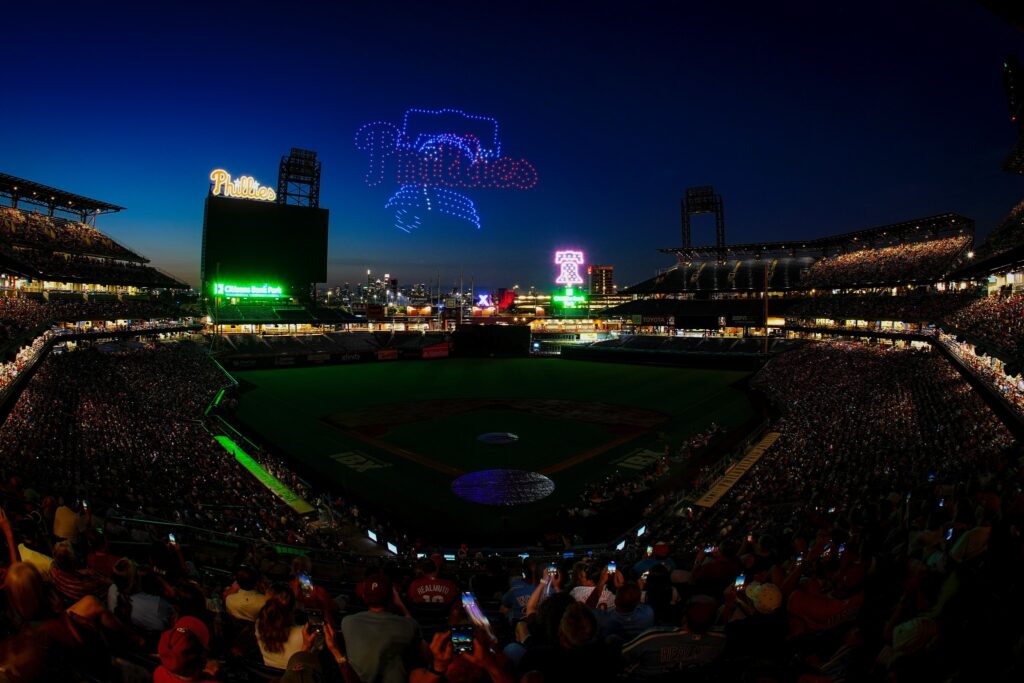
- A national telecom brand — drone entertainment built around a Philadelphia baseball night
- Somerset, Pennsylvania — a 400-drone community show on our Damoda V4 system
- Hoboken Italian Festival, New Jersey — a 300-drone show for one of the region’s best-known street festivals
- Corporate and association events across Pennsylvania
The whole Delaware Valley
Camden and the New Jersey waterfront, Cherry Hill, King of Prussia, the Main Line, Bucks and Montgomery counties, Wilmington and the Jersey shore. Our crews travel with the fleet, so travel is built into the quote rather than added later.
Venues that work
Waterfront sites along the Delaware, Fairmount Park, suburban fairgrounds, stadium precincts and corporate campuses. Open ground for the launch zone and clear sightlines for the crowd matter more than anything else.
Philadelphia airspace
Philadelphia International shapes airspace across the south and west of the city, and events in the South Philadelphia sports complex carry their own restrictions. Send us the venue first and we will confirm what can fly there.
Scale
Large public audiences want 300 drones or more. Our largest Philadelphia brand show flew 1,000. Private and corporate events work well at 100 to 200.
Philadelphia Drone Shows for Game Days and Stadium Activations
The South Philadelphia sports complex puts four franchises inside one footprint, which is unusual and useful. The Eagles play football there, the Phillies run the baseball season, and the Flyers and 76ers share the arena next door. The Union fill out the soccer calendar across the Delaware in Chester. Everything sits within walking distance of the same parking lots, so tailgate activations, pregame plaza programming and postgame crowd holds all fit inside one activation footprint. A flight over that complex reaches tens of thousands of people already standing outside.
Spark free matters in that setting. Lots are packed with vehicles and grills, the stadium surfaces have to be game ready the next morning, and no venue operator wants fallout to clean. The operation runs on Part 107 certified pilots, a ten million dollar aviation liability policy, over a thousand shows of flight history, and fleet counts from seventy aircraft through three hundred plus. Get in touch through the contact form to check availability for the dates you have circled.
Philadelphia Airspace, Measured Site by Site
Philadelphia is one of the easier major American cities to fly a drone show in, and most people assume the opposite because it has a Class B airport. The numbers say otherwise.
The grid
We queried the FAA’s UAS Facility Map feature service directly. Philadelphia’s grid runs 858 cells. Only 83 of them — about 10% — carry a zero-foot LAANC ceiling, and 528 allow the full 400 feet. The remainder are distributed at 50, 100, 150, 200, 250 and 300.
Put that next to the corridor’s other big markets. Nearly a quarter of the mapped grid over New York City is zero-ceiling, and 148 of Newark’s 300 cells — almost half — allow nothing at all. Philadelphia is, on the airspace alone, a materially easier city to put a fleet over than either.
Northeast Philadelphia adds a Class D grid of 566 cells running surface to 2,600 feet MSL, with 127 at zero and 343 at the full 400.
The two sites that make this city work
Penn’s Landing, on the Delaware River waterfront, returns no UAS Facility Map cell at all. We widened the search radius to 20 kilometres to confirm that is a genuine gap rather than a query artifact, then cross-checked the point against the FAA’s Class Airspace service. Philadelphia Class B Area D sits overhead with a floor of 1,500 feet MSL, Class E begins at 700 feet AGL, and everything below that is Class G at the surface.
Which means: no FAA airspace authorization is required for a Part 107 operation at or below 400 feet AGL at Penn’s Landing. No LAANC request, no further coordination, nothing on the critical path but the venue and the crew.
The Benjamin Franklin Parkway and Eakins Oval are the same — Class G at the surface, no authorization needed below 400 feet AGL.
That is a rare combination: the two most prestigious civic event spaces in the city, one with a river backdrop and one with monumental sightlines toward the Art Museum, and neither of them requires an airspace authorization. It is the single most useful fact on this page, and it is why Philadelphia punches above its reputation as a drone show market.
Independence Mall is the exception, and it matters
Independence National Historical Park carries a Department of the Interior national security UAS flight restriction, surface to 400 feet AGL, with a named Acting Chief Ranger as the published coordination point of contact.
It is also National Park Service land. Under NPS Policy Memorandum 14-05, launching, landing and operating an unmanned aircraft on NPS lands and waters is prohibited except as approved in writing by the superintendent — and a superintendent cannot approve a show alone. The Special Use Permit route requires the superintendent to find the activity appropriate and free of unacceptable impacts, then route the request through the regional director to the Associate Director for Visitor and Resource Protection, with FAA authorization already in hand.
The Mall sits roughly two kilometres from the Parkway. That is close enough that the restriction footprint has to be checked against your actual launch point and flight geometry rather than assumed from a street address.
This matters especially now. Philadelphia is the symbolic centre of the America 250 programme, which means Independence Mall is the first place a producer thinks of — and it is the one place in the historic district that is closed to both the technology and the ground. The honest answer is the Parkway or the waterfront, and it is better to hear that at the proposal stage.
The sports complex
Lincoln Financial Field — 67,594 seats, Class B, zero-foot grid ceiling. Citizens Bank Park — Class B, zero-foot ceiling.
A zero-foot ceiling does not mean a show is impossible. It means no automated LAANC authorization is available and the operation requires the FAA’s manual further-coordination process, which runs on roughly a 90-day timeline rather than a near-real-time one. A sports complex show in Philadelphia is a long-lead project, and the lead time is the thing to establish in the first conversation.
Then there are the restriction windows. A standing FAA restriction applies to stadiums seating 30,000 or more during MLB, NFL and NCAA Division I football games. We work from the FAA’s Sporting Event Automated Monitoring System feed — the authoritative machine-readable source — rather than guessing from a published schedule. Observed windows run consistently about five hours: an hour before kickoff to four hours after.
Lincoln Financial Field carries eleven scheduled windows into late December 2026, seven NFL and four NCAA. Franklin Field at the University of Pennsylvania — the first college stadium in the country with a scoreboard, and the second with an upper deck — carries three NCAA windows. Citizens Bank Park repopulates in the spring when the baseball season starts.
Outside those windows, stadium shows are routine, and a post-game show sits just outside the window by design — which is usually what a stadium client wants in any case.
The standing security guidance
Philadelphia carries a dense set of named national security UAS restrictions, each a surface-to-400-foot prohibition: the Philadelphia Naval Shipyard across nine separate polygons, the Naval Support Activity Philadelphia detachment, and a Marine Corps reserve training centre in Delaware County. Separately, standing FAA guidance advises operators to avoid loitering over power plants, dams, refineries, industrial complexes, military installations and correctional facilities. In a city with Philadelphia’s industrial riverfront, that is a planning input rather than boilerplate.
When To Fly in Philadelphia
We computed this rather than looked it up. Twenty years of NOAA Global Historical Climatology Network daily records, 2006 through 2025, at Philadelphia International. The metric is WSF5 — the fastest five-second gust recorded each day — converted to knots.
August is the best month in Philadelphia, and on this data it is the best large-market show window in the Northeast. Mean daily peak gust 20.1 knots, with 47.2% of days reaching 20 knots and only 14.1% reaching 25.
September runs almost level: 20.0 knots mean, 48.6% and 16.4%.
That 14.1% is the lowest strong-gust share of any month at any station we computed across the New York, New Jersey and Pennsylvania corridor, outside Central Park itself.
February through April are the worst. April is 25.0 knots mean with 73.5% of days at 20 knots and 43.7% at 25. March is 24.7 and 71.2%. February is 24.6 and 71.6%. Every month from January through April sits above 63% of days at 20 knots or more.
This maps cleanly onto nor’easter climatology — the National Weather Service notes nor’easters are “most frequent and most violent between September and April,” which is exactly where the gust frequency climbs.
Philadelphia’s inland advantage over the coast
This is the comparison worth having if your event could go either here or to the Shore.
Share of August days with a peak gust at or above 25 knots: Philadelphia 14.1%. LaGuardia 20.6%. Newark 21.7%. JFK 22.6%.
Philadelphia is roughly a third less exposed to strong-gust days in August than the New York coastal stations, and about 35% less than Newark. Sitting back from the ocean is worth real money in the probability of flying on your first scheduled date, and it is a point in favour of a Penn’s Landing or Parkway show over an equivalent boardwalk booking.
What the summer risk actually looks like
August and September are the calmest wind months and they are not the driest. But the risk is a different shape: summer precipitation here is convective, not synoptic — short-fuse afternoon and evening thunderstorm cells rather than all-day gales.
Those are different planning problems. A nor’easter is forecast days out and cancels a date. A July or August thunderstorm cell is a two-hour weather hold and a decision made on site, which is why we build hold windows into the run of show rather than treating them as a failure mode.
One honest caveat about these numbers
WSF5 is a daily peak gust, recorded at any hour. Drone shows fly at dusk, when the boundary layer typically decouples and surface winds slacken.
These figures therefore overstate the wind a show would actually see. They are valid for ranking months and sites against each other — which is what we use them for — and they are not a show-time forecast. An operator presenting a daily-peak gust statistic as a dusk condition is either confused or hoping you are.
Philadelphia Fireworks Law, and Where a Drone Show Sits
Pennsylvania’s fireworks statute is Act 74 of 2022, codified at 3 Pa.C.S. Chapter 11, and reading it closely makes the comparison concrete rather than rhetorical.
A display permit comes from the governing body of the municipality under §1102(b) — in this case the City of Philadelphia. Permits are non-transferable and limited to the stated purpose.
The setbacks are where the real constraint lives, and in a dense city they bind hard. Under §1102(a), display fireworks may not be ignited within 300 feet of a facility meeting the sales-location requirements of §1107. Under §1104(b)(5), consumer fireworks may not be used within 150 feet of a building or vehicle — owned by the user or not. In a city built to the lot line, a 150-foot standoff from every building and parked car is not a trivial condition.
Under §1104(c), no use within 150 feet of an animal housing facility or livestock enclosure, and between 150 and 300 feet the user must give written notice to the owner or manager at least 72 hours in advance. That provision exists because fireworks frighten animals, and it is directly relevant in a city with the Philadelphia Zoo, mounted police units, and a dense population of household pets.
On insurance, §1102(d) requires the municipality to demand not less than $1,000,000 from a display permittee covering damages caused by the permittee, its agents, employees or subcontractors, and §1109(5) sets at least $2,000,000 for licensed sales facilities.
We carry $10 million in drone aviation liability — ten times the display floor Pennsylvania writes into statute. Because it is a statutory number, that is a comparison you can verify rather than a claim.
The protected days, and why your date might move
§1106 lets a municipality impose conditions, prohibitions and limitations on consumer fireworks that do not conflict with the chapter — but it may not restrict use on the days listed in §1106(b), which include 2 through 4 July, 31 December, and Memorial Day and Labor Day weekends.
For a Philadelphia event planner that is a practical scheduling input. On exactly the dates a civic celebration is most likely to fall, the city cannot stop consumer fireworks going up around your venue. If your show is competing for the same sky on 4 July, that is a coordination problem — and it is one of the arguments for the 5 July or Labor Day Sunday slot that a growing number of municipalities in the region now choose.
Where drones sit
Chapter 11 does not mention drones or unmanned aircraft anywhere.
That is structural rather than a loophole. Every element of the statute regulates combustion — ignition, setbacks from buildings and vehicles, livestock proximity, storage, licensed sales locations, discharge points. None of it describes an aircraft, because an aircraft is not what the chapter is about.
A drone show in Philadelphia is not unregulated. It is regulated by the FAA under Part 107, by whatever land manager controls the ground, and by the venue’s own event permitting. It simply does not enter the fire-law chain — which is why a burn ban, a drought restriction, a fire-weather advisory or a venue’s no-open-flame policy closes a fireworks display and leaves a drone show available.
Sea-Level Air, and What It Buys a Philadelphia Show
This section argues against our own geography, which is the main reason to trust it.
We are based in Arvada, Colorado, at about 5,400 feet. We fly a great deal of work at altitude and we have the engineering discipline for it. But the physics is not negotiable, and in a Philadelphia conversation it runs Philadelphia’s way.
Static propeller thrust scales roughly linearly with air density, so density altitude translates directly into available thrust. Computed from the standard density-altitude relation at 29.92 inches of mercury on a representative warm summer evening — the market’s near-worst case:
A show at Penn’s Landing computes to roughly 1,300 feet density altitude — about 96.2% of sea-level standard static thrust.
Our own home field in Arvada computes to 8,073 feet on an 82-degree evening, at about 78%. Phoenix on a 100-degree July evening computes to 3,978 feet and 88.9%.
So Philadelphia holds an 18-percentage-point thrust margin over Denver and about 7 points over Phoenix.
What that margin actually buys
It is margin, not performance, and the distinction matters.
More payload headroom per airframe. Longer hover endurance from the same battery. Higher climb rate. And the one that governs show reliability: a larger reserve for gust rejection, because the same control authority comes out of less motor output. A drone holding station in a 15-knot gust at 78% available thrust has considerably less left over than the same aircraft doing the same job at 96%.
The thin-air derates that constrain fleet sizing, flight duration and wind limits across the Mountain West and Desert Southwest do not bind here at all. Fleet size in Philadelphia is set by what your choreography needs to read at your audience’s viewing distance, and by nothing else.
One detail that cuts the right way: the Northeast’s calmest months are also its warmest, so the figure above sits near the annual worst case. A May or October show on the Delaware waterfront flies several hundred feet lower still.
The Questions Philadelphia Producers Actually Ask
Do we need FAA authorization for a show at Penn’s Landing?
No — and this is the single most useful fact about this city. Penn’s Landing returns no UAS Facility Map cell, and the point is Class G at the surface: Philadelphia Class B Area D sits overhead with a floor of 1,500 feet MSL and Class E does not begin until 700 feet AGL. No FAA airspace authorization is required for a Part 107 operation at or below 400 feet AGL. The Benjamin Franklin Parkway and Eakins Oval are the same.
Can we do an America 250 show on Independence Mall?
Not over the Mall. Independence National Historical Park carries a Department of the Interior national security UAS flight restriction from the surface to 400 feet AGL, with a named Acting Chief Ranger as the coordination contact, and it is National Park Service land where launching, landing and operating require written superintendent approval routed through the regional director to a national Associate Director — with FAA authorization already in hand.
The workable answer in the historic core is the Parkway or Penn’s Landing. Both are Class G at the surface, both carry strong civic sightlines, and both sit outside that footprint — though the Mall is only about two kilometres from the Parkway, so the exact geometry gets checked against your flight plan rather than assumed from an address.
Is Philadelphia’s Class B a problem?
Far less than its reputation suggests. Only about 10% of Philadelphia’s 858 grid cells carry a zero-foot LAANC ceiling, and 528 of them allow the full 400 feet. For comparison, nearly a quarter of the mapped grid over New York City is zero-ceiling and almost half of Newark’s. Philadelphia is one of the more workable major-city airspace environments in the country for this kind of show.
Can we fly at Lincoln Financial Field or Citizens Bank Park?
Yes, with lead time. Both sit on zero-foot grid ceilings, so no automated LAANC authorization is available and the operation needs the FAA’s manual further-coordination process on roughly a 90-day timeline. Lincoln Financial also carries eleven scheduled stadium restriction windows into late December 2026, each running about an hour before kickoff to four hours after. A post-game show sits just outside the window by design. This is a long-lead project, not an impossible one — and the lead time is what we want to establish in the first conversation rather than the eleventh week.
When is the best time of year?
August, then September. Twenty years of gust data at Philadelphia International puts August at a 20.1-knot mean daily peak gust with only 14.1% of days reaching 25 knots — the lowest strong-gust share of any month at any major station in the Northeast corridor outside Central Park. April is the worst month at 43.7% of days reaching 25 knots, with February and March close behind.
Philadelphia or the Jersey Shore?
If the choice is open, Philadelphia is the more reliable date. In August the share of days with a peak gust at or above 25 knots runs 14.1% in Philadelphia against 21.7% at Newark and 22.6% at JFK. Sitting back from the ocean is worth roughly a third fewer strong-gust days, which translates directly into the probability of flying on your first scheduled evening.
Our event is on 4 July. Does that cause a problem?
Not for the show, but it is worth planning around. Act 74 §1106(b) means a Pennsylvania municipality cannot restrict consumer fireworks use on 2 through 4 July, 31 December, or Memorial Day and Labor Day weekends. So on exactly those dates there may be consumer fireworks going up around your venue whatever the city would prefer. That is a sky-coordination question, and it is one reason a growing number of municipalities in the region schedule their civic show on 5 July or Labor Day Sunday instead.
Can you fly if there’s a burn ban or a no-open-flame rule at our venue?
Yes. Burn bans, drought restrictions, fire-weather advisories and venue no-open-flame policies prohibit combustion, and a drone show has nothing to burn. Every element of Act 74 regulates ignition, setbacks from buildings and vehicles, storage, licensed sales locations and discharge points — none of which describes an aircraft. Chapter 11 does not mention drones anywhere.
What about the Zoo, mounted units, or a venue with animals?
It is one of the strongest reasons to choose drones. Act 74 §1104(c) prohibits consumer fireworks within 150 feet of an animal housing facility or livestock enclosure and requires 72 hours’ written notice to the owner between 150 and 300 feet. Pennsylvania wrote that into statute because fireworks frighten animals. A drone show produces no concussive report at all.
How many drones do we need?
It depends on viewing distance and what you want the audience to read in the sky, not on the airspace. More drones means more resolution in the imagery rather than simply more lights — the right number is the one that renders your content legibly at your audience’s distance. A Penn’s Landing show seen from both banks of the Delaware is a different sizing problem from a Parkway show seen along a single axis, and we will size it to the geometry rather than to a package tier.
What insurance do you carry?
$10 million in drone aviation liability — ten times the $1,000,000 floor Act 74 §1102(d) requires Pennsylvania municipalities to demand of a fireworks display permittee. Because that floor is written into statute, it is a comparison you can check rather than a claim you have to accept.
Will altitude affect the show?
No. A summer evening show at Penn’s Landing computes to about 1,300 feet density altitude, roughly 96% of sea-level static thrust. The same show at our own base in Arvada flies at about 8,100 feet and 78%. The thin-air derates that shape fleet sizing and wind limits in the Mountain West simply do not apply on the Delaware.
Why hire a Colorado company for a Philadelphia show?
Because what you are buying is the analysis on this page plus the aircraft and crew to execute it. That Penn’s Landing and the Parkway are Class G at the surface while Lincoln Financial is zero-ceiling; that Independence Mall carries a surface-to-400-foot prohibition two kilometres from the Parkway; that only 10% of the Philadelphia grid is zero-ceiling against almost half of Newark’s; that August beats September on twenty years of gust data and beats the Shore by a third — that is work done because it decides whether a show flies and on which date. We fly nationally, we carry $10 million in coverage, and we would rather tell you a site is wrong in the first conversation than in week eleven.
Philadelphia drone show FAQ
How big a show does a city crowd need?
Large public audiences want 300 drones or more. Our largest Philadelphia show flew 1,000.
Can you fly near the stadiums?
Stadium airspace is restricted around events, so it depends on timing and location. We check before anything is planned.
Do you cover New Jersey and Delaware?
Yes. We fly the whole Delaware Valley, including the Jersey shore and Wilmington.
More Drone Light Shows in Delaware
We fly across Delaware. See all Delaware drone light shows, or a nearby city or venue:
Rehoboth Beach Boardwalk · Rehoboth Beach · Wilmington Riverfront · Bethany Beach · Cape Henlopen State Park · Dover · Lewes
Book a Philadelphia drone show
Tell us your event, venue and audience and we will send a concept and exact pricing within 24 hours.
See also drone show rental · corporate drone shows & events · cost guide
Curious about the drone show company behind these shows? Here is how we work.