
NEW YORK DRONE LIGHT SHOWS
New York represents the pinnacle of American event sophistication, and HireUAVPro is the preferred drone light show partner for the state’s most ambitious celebrations. From Manhattan’s glittering skyline to the majestic Hudson River, from Niagara Falls’ natural grandeur to Long Island’s pristine beaches, New York offers unparalleled venues for transformative drone spectacles. Our FAA night-operations authorization means we can illuminate New York’s iconic skylines and waterfront locations after dark, creating the dramatic contrast that makes drone shows truly magical. With over 1,000 successful productions and specialized expertise in navigating the regulatory complexity of New York airspace, we deliver shows that capture the spirit of New York excellence. Since our founding in 2017, we’ve grown to operate across major metropolitan areas including New York, California, Georgia, Illinois, and Mexico, executing 150-200 shows annually for discerning clients worldwide.
Why New York Is Perfect for Drone Light Shows
New York’s status as the entertainment and media capital of America makes it the ideal market for innovative aerial spectacles. Manhattan’s iconic skyline—the Chrysler Building, Empire State Building, One World Trade Center—provides architectural backdrops that only a handful of cities worldwide can match. These urban canyons, combined with New York’s sophisticated event culture, create demand for entertainment experiences that feel as premium and cutting-edge as the city itself. Drone light shows align perfectly with New York’s identity as a forward-thinking, entertainment-obsessed metropolis that celebrates innovation and spectacle.
Beyond Manhattan, New York’s geography is remarkably diverse for drone shows. The Hudson River creates a natural avenue for waterfront productions visible from Manhattan’s West Side, the New Jersey waterfront, and points beyond. Central Park’s open spaces provide urban oases where tens of thousands gather for public celebrations. Long Island’s South Shore beaches rival California’s coastlines for natural beauty, while the Adirondacks and Finger Lakes regions appeal to corporate retreats and seasonal celebrations. Niagara Falls represents a unique opportunity—the existing spectacle of falling water creates a canvas for light-based art that complements rather than competes with nature’s original wonder.
New York’s event calendar is relentless. New Year’s Eve celebrations across the state draw audiences numbering in the millions. Fourth of July festivities from Coney Island to the Thousand Islands create demand for eye-catching entertainment. Corporate headquarters from financial services to media companies host seasonal celebrations and client entertainment events. Universities hold graduation ceremonies, homecomings, and fundraising galas. Sports events from Yankees games to Bills tailgates to U.S. Open tennis tournaments seek entertainment elements that generate media coverage and enhance attendee experience. Our FAA night-operations waiver ensures we can activate New York’s most dramatic venues after sunset, when drone light shows achieve maximum visual impact.
Cities We Serve in New York
HireUAVPro delivers professional drone light shows across the entire state of New York. In New York City, we serve all five boroughs with shows tailored to the city’s unique airspace requirements and world-class venue infrastructure. Beyond the city, our team operates throughout the state including Buffalo and the Lake Erie waterfront, Rochester along the Genesee River, Syracuse in the heart of Central New York, Albany and the Capital Region, Ithaca in the Finger Lakes, Niagara Falls with its legendary waterfront, and Glens Falls in the Adirondack foothills. We also serve Long Island communities from Jones Beach to the Hamptons, the Hudson Valley, and the Hudson River waterfront in Manhattan. Whether your event is at Central Park, Coney Island, or a private estate upstate, our team has the FAA authorizations and local experience to deliver flawlessly.
Popular New York Drone Show Venues
New York’s iconic venues provide extraordinary stages for drone light shows. Central Park’s Great Lawn in Manhattan has hosted some of the city’s most memorable celebrations and can accommodate massive crowds for outdoor spectacles. The Coney Island Boardwalk combines nostalgic Americana with stunning oceanfront horizons—a classic New York beach destination transformed into a premium event venue. Jones Beach State Park on Long Island offers pristine waterfront with dedicated event infrastructure and capacity for thousands of attendees. Hudson River Park along Manhattan’s west side provides waterfront elegance, visibility from multiple viewing angles, and symbolism connecting New York’s industrial heritage with contemporary innovation. And Niagara Falls State Park represents the natural wonders of upstate New York—combining our drone artistry with one of the world’s most spectacular natural phenomena. Each venue offers distinct advantages for different event types and audience sizes.
Custom Formations Inspired by New York
New York’s iconic culture, architecture, and landmarks inspire some of our most sophisticated custom drone formations. Our choreography team has developed specialized animations that celebrate what makes the Empire State unique and memorable. Here are formation concepts we’ve crafted specifically for New York events:
The Manhattan Skyline Icon Formation: This breathtaking animation recreates Manhattan’s world-famous skyline through layered drone positioning at varying altitudes. Drones form the silhouettes of the Empire State Building, Chrysler Building, and One World Trade Center, then transition into dynamic color patterns representing the city’s electric energy. We sync this with iconic New York music—think jazz standards or classical compositions—to create a tribute to the city’s cultural heritage. This formation is perfect for corporate events, hotel celebrations, and civic occasions in Manhattan.
The Statue of Liberty and Harbor Formation: Drawing inspiration from New York’s most recognizable symbol, this animation uses precise drone positioning to depict the Statue of Liberty’s torch and crown, then transitions into flowing patterns representing New York Harbor’s majesty. The formation often includes color representations of the harbor’s historic shipping lanes and the natural beauty of the East River. This is particularly powerful for waterfront events, Ellis Island celebrations, and New York civic observances.
The Niagara Falls Natural Wonder Formation: For upstate New York events, particularly those near Niagara Falls, we’ve created an animation inspired by the falls themselves. Drones form cascading wave patterns that flow downward like falling water, with color transitions from brilliant white (representing the falls’ mist) to rich blues and greens (representing the surrounding landscape). The formation captures both the power and beauty of one of North America’s most spectacular natural phenomena.
Your Favorite Team’s Logo and Colors Formation: New York sports fans are passionate, and we create custom drone formations celebrating your favorite team’s iconic logo and team colors. Whether it’s a professional sports organization, a college team, or another athletic institution important to your event, our choreography team designs precise drone formations featuring team symbols and colors. We sync these with team anthems, fight songs, and crowd-favorite music to create maximum emotional resonance and fan engagement.
The Hudson River Moonlight Formation: Specifically designed for evening productions along the Hudson River, this animation creates flowing patterns that mirror the river’s movement, with lighting effects that simulate moonlight reflecting on water. Color transitions from deep indigo (evening sky) to silver and white (moonlight) create an ethereal, romantic atmosphere. This formation is ideal for waterfront weddings, anniversary celebrations, and evening gala events.
Our New York Experience
New York represents HireUAVPro’s core market and showcase for our capabilities. The complexity of New York airspace—with LaGuardia, JFK, and Newark airports creating restricted zones, with military operations in the Northeast corridor, and with constant helicopter traffic throughout the metropolitan area—makes New York the ultimate test of pilot expertise and professional operations. We maintain constant relationships with the FAA’s New York regional office, coordinating closely on airspace authorizations and flight operations. Our team understands the nuances of operating in the world’s most congested airspace, and we’ve proven this competence through hundreds of successful New York productions.
Our 1,000+ shows nationwide are significantly concentrated in New York, where event density, event budgets, and client sophistication are unmatched. From intimate 50-drone celebrations for media company galas to massive 500+ drone productions for New Year’s Eve events, we’ve demonstrated versatility across all New York event types and scales. We’ve illuminated Manhattan skylines, activated waterfront parks, created unforgettable moments at elite venues, and managed the regulatory complexity that comes with operating in America’s most restrictive airspace. When New York’s most demanding event organizers book HireUAVPro, they’re choosing the team with the deepest local expertise and the most rigorous safety culture in the industry.
Types of Events We Serve in New York
New York’s diverse event landscape spans virtually every conceivable celebration type. Corporate events and product launches leverage drone shows to create buzz—financial services firms use them for investor presentations, tech companies deploy them for startup celebrations, media companies integrate them into entertainment events. Weddings at premium venues across the Hudson Valley, Finger Lakes, and Long Island benefit from our ability to create intimate 50-drone celebrations or spectacular 500-drone spectacles. Museum galas, theater productions, and cultural celebrations in Manhattan command premium entertainment. Sports halftime shows, pre-game spectacles, and team celebrations integrate drone artistry into the game-day experience. New Year’s Eve is our signature season—communities across New York book us as alternatives to traditional fireworks. Fourth of July celebrations from Coney Island to Niagara Falls leverage our eco-friendly, noise-controlled shows. University graduation ceremonies, alumni celebrations, and fundraising galas increasingly feature drone productions. Corporate retreats in upstate resorts, holiday parties, seasonal celebrations, and promotional events round out a portfolio as diverse as New York itself.
How Our Drone Shows Work
The process of creating a world-class drone light show requires planning, artistry, and technical precision. Here’s how we transform your vision into an unforgettable aerial spectacle:
Step 1: Initial Consultation and Vision Definition
We start by truly listening to your event’s needs, goals, and dreams. In a consultation meeting (in-person, by phone, or video), we explore your event’s theme, target audience, venue location, and timeline. We ask about the atmosphere you want to create, any specific stories or messages you want to convey, and your budget parameters. We discuss your venue’s characteristics, nearby airspace considerations, and viewing angles for maximum audience impact. If there’s a story to tell—celebrating a corporate milestone, honoring a team, or creating a memorable wedding moment—we capture that vision in this initial phase. This conversation is crucial because it sets the creative direction for everything that follows.
Step 2: Custom Design and Choreography
Our talented in-house choreography and animation team creates a show designed specifically for your event and venue. Using proprietary software developed through years of drone show productions, we design precise drone formations, develop custom color palettes and lighting sequences, and choreograph smooth transitions between animations. Every element is synchronized to your selected music or audio track with millisecond-level timing. You’ll receive detailed storyboards, preview materials, and concept videos so you can visualize the show before production begins. We iterate based on your feedback, refining choreography and animations until they perfectly capture your vision. This design phase typically spans 3-4 weeks and is where creativity truly takes flight.
Step 3: FAA Coordination, Permitting, and Site Preparation
While choreography is underway, our regulatory and operations teams handle all complex FAA and permitting requirements. This includes filing detailed airspace authorizations with the FAA, securing any necessary Part 107 waivers, coordinating with local authorities and municipal agencies, and obtaining all permits required by parks departments or venue managers. We conduct comprehensive site surveys, verify GPS coordinates, identify obstacles and airspace hazards, and assess weather patterns and wind behavior specific to your event date. Our Part 107-certified pilots and visual observers develop detailed launch plans, establish communication protocols, and create comprehensive emergency procedures. We verify that our $10 million aviation and umbrella insurance fully covers your event. This phase ensures everything is documented, legally authorized, and operationally sound.
Step 4: Show Night Execution and Beyond
On event day, our professional crew arrives well before showtime to establish command center operations, position launch teams, conduct exhaustive equipment checks, and coordinate with your event’s production team. As the show approaches, our pilots take their positions, visual observers verify all systems are operational, and our command center monitors real-time telemetry data streaming from every single drone. When you give the signal, we initiate the launch sequence. What your audience experiences as breathtaking aerial artistry is actually the result of meticulously choreographed moments, thousands of lines of proprietary code, real-time position adjustments, and the focused attention of experienced professionals. After the show concludes, we retrieve all equipment, conduct comprehensive post-flight analysis, and provide you with professional video footage and photography documenting your spectacular celebration.
What Makes Our Drone Shows Different
HireUAVPro operates with the regulatory rigor that New York demands and respects. Every pilot on our team holds FAA Part 107 certification, and our leadership team has earned specialized 14 CFR waivers for multi-UAS operations and night flight—authorizations that prove our demonstrated safety culture and operational expertise. Our $10 million aviation and umbrella insurance is the gold standard in the industry and protects event organizers from liability. We maintain transparent, ongoing communication with FAA regional offices and work cooperatively within the regulatory framework rather than seeking to circumvent it. New York event planners trust HireUAVPro because we’ve proven ourselves as serious professionals committed to safety above all else.
Our creative and technical capabilities match the sophistication of our clientele. We design every animation in-house using proprietary choreography software that gives us unprecedented control over drone positioning, timing, and lighting effects. Our 2,200+ lumen RGBW LED systems create brilliant colors visible across vast distances—critical when performing above Central Park or the Hudson River where ambient light is intense. We synchronize shows to millisecond precision with FM radio feeds, live music, and broadcast productions. Our fleet features parachute recovery systems, GPS-fenced flight boundaries, real-time telemetry monitoring, and automatic failsafe landing protocols. Unlike traditional pyrotechnics, we deliver shows with zero fire hazard, zero noise ordinance violations, and zero environmental residue—increasingly important considerations for New York’s environmentally conscious communities and premiere venues.
Frequently Asked Questions About New York Drone Light Shows
How long does a drone light show last?
Show duration is entirely customizable to your event’s needs and timeline. Typical productions range from 8 to 16 minutes per launch. For extended celebrations, we can execute multiple launches—for instance, a pre-show sequence around dusk followed by a main show during evening hours, totaling 30+ minutes of drone entertainment. Duration depends on your venue size, audience capacity, creative vision, and budget. We work closely with you to design a show length that perfectly enhances your event’s pacing and maintains audience engagement throughout.
How many drones are used in a show?
Drone count is completely flexible and customizable. Our productions range from intimate 50-drone celebrations (perfect for smaller venues and private events) to spectacular 1,000-drone productions (ideal for major civic celebrations and large waterfront venues). A 200-300 drone show typically provides stunning visual impact for most venues and event types. Larger productions (500-1,000+ drones) are excellent for New Year’s Eve events, major municipal celebrations, and venues with large audience capacities. During your consultation, we’ll recommend appropriate drone counts that maximize visual impact while working within your venue constraints and budget.
Are drone shows safe for spectators?
Drone shows are extremely safe for audiences. Our fleet includes multiple redundant safety systems: parachute recovery for every drone, continuous real-time telemetry monitoring, GPS-fenced flight boundaries that prevent drones from flying outside designated airspace, and automatic failsafe landing protocols triggered if any system fails. Spectators view shows from established safe distances documented in our FAA flight plans. Our $10 million aviation and umbrella insurance protects all attendees. Across over 1,000 productions nationwide, we maintain an impeccable safety record. Drone shows are actually safer than traditional fireworks—there’s no fire hazard, no explosion risk, and no debris. Your guests can enjoy the spectacle with complete confidence.
Can drone shows be customized?
Custom design is core to what we do. Our in-house choreography team creates animations tailored specifically to your event, brand, venue, and celebration theme. Whether you envision formations depicting New York landmarks, your favorite sports team’s logo, your corporate brand colors, specific cultural symbols, or completely original artistic concepts, we bring them to life. We sync shows to your selected music, coordinate animations with your event’s timeline, and design the entire experience around your unique vision. This is why we invest significant time in design and choreography—we’re committed to creating something distinctly yours, not a generic production.
What happens if it rains or is windy?
Weather is a legitimate operational consideration. Our drones can safely operate in sustained winds up to 20+ mph, covering normal weather conditions. However, severe wind, heavy rain, electrical storm activity, or other hazardous conditions require postponement. We monitor weather forecasts closely in days leading to your event and maintain clear communication with you about any adjustments. If rescheduling becomes necessary, we work with you to identify the earliest available opportunity to execute your show. We want to deliver under conditions ensuring both safety and spectacular visuals—not in challenging weather that might compromise either aspect.
Do you handle FAA permits and airspace clearance?
Yes, absolutely. Managing FAA coordination and airspace authorization is a central component of our service. Our regulatory team files all required paperwork, coordinates with FAA regional offices (critical in New York’s restrictive airspace), secures necessary Part 107 waivers, and obtains required permits from municipal authorities, parks departments, and venue managers. We handle all complex regulatory and administrative work—you can focus entirely on your event. This comprehensive permitting and coordination is included in our service and reflects our commitment to operating only in fully authorized, properly documented airspace.
Are drone shows a good fireworks alternative?
Drone light shows are increasingly the preferred choice over traditional fireworks for New York events. They deliver several significant advantages: zero fire hazard, minimal noise pollution, no environmental residue or cleanup requirements, full creative customization, and a genuinely unique experience that fireworks cannot match. Major New Year’s Eve celebrations across New York are increasingly featuring drone shows. Corporate events and upscale weddings prefer drones over pyrotechnics. The technology has become sophisticated enough that drone shows deliver superior results compared to traditional fireworks—while being safer, more environmentally responsible, and more creatively flexible.
Book a Drone Light Show in New York
New York’s premier event organizers are already booking HireUAVPro for their most important celebrations. Whether your vision involves drones dancing across the Manhattan skyline, illuminating the Hudson River, celebrating at a Hamptons venue, or creating an unforgettable moment at any New York destination, we have the expertise, authorizations, and track record to deliver. Contact our team to discuss your event. The first consultation is an opportunity to reimagine what’s possible for your celebration. Let’s create a New York moment that your guests will remember forever.
Flying in New York Airspace
New York is the most constrained drone show market in the United States, and almost nobody describes it accurately. The usual summary — “you can’t fly drones in New York City” — is wrong in a way that costs event producers real opportunities. The actual picture is more specific, more technical, and in several places more permissive than the reputation suggests.
The Class B shelf is not the problem people think it is
New York’s Class B airspace is organised around LaGuardia, and this surprises people: in the FAA’s own UAS Facility Map, all 1,210 grid cells covering New York Class B are attributed to LGA, not to JFK. JFK has no separate grid of its own. Newark carries its own 300-cell grid, and Teterboro another 338.
The grid is where the real constraint lives. Across the five boroughs we count 1,987 mapped grid cells, and the distribution is unforgiving:
491 cells — just under a quarter of the grid over New York City — carry a zero-foot LAANC ceiling. Only 660 cells, about a third, allow the full 400 feet. The rest sit at 50, 100, 200 or 300 feet. Newark’s grid is worse still: 148 of 300 cells, nearly half, are zero-ceiling.
A zero-foot ceiling does not mean a show is impossible there. It means no automated LAANC authorization is available and any flight requires the FAA’s manual further-coordination process, which runs on a 90-day timeline rather than a near-real-time one. The practical effect is that in New York City, which side of a street you launch from can be the difference between an app approval and a three-month FAA submission.
Ceilings at the venues people actually ask about
Queried from the FAA feature service against the current map effective date:
Central Park — both the Sheep Meadow and the Great Lawn sit at a 400-foot ceiling. Central Park is inside Class B to the surface, so authorization is required, but the full show altitude is available through LAANC.
Yankee Stadium — 300 feet. Belmont Park and UBS Arena — 200 feet. Randall’s Island Park and Flushing Meadows Corona Park — 100 feet each, which is a severe choreographic constraint and the single most common unpleasant surprise for producers who assumed a large open park meant a large open sky. Citi Field — zero.
MetLife Stadium is a frequently misstated case. It is not in Newark or LaGuardia Class B. It sits in Teterboro Class D on a 100-foot grid. Anyone quoting you an EWR authorization for MetLife has not looked.
The venues with no grid cell at all — and why that is good news
Several of the best show sites in the metro area return no UAS Facility Map cell. We widened the search radius to 20 kilometres to confirm these are genuine gaps rather than query artifacts, then cross-checked each one against the FAA’s Class Airspace service. Nearly all of them are Class G at the surface, which means no FAA airspace authorization is required for a Part 107 operation at or below 400 feet AGL.
That list includes Prospect Park, Brooklyn Bridge Park, Governors Island, Hudson River Park, Hudson Yards, Coney Island, Jones Beach and Eisenhower Park. In each case New York Class B Area E sits overhead with a floor at 1,500 feet MSL, Class E begins at 700 feet AGL, and everything below that is Class G.
So the honest summary is counterintuitive: a show over the East River from Brooklyn Bridge Park needs no FAA airspace authorization at all, while a show on the lawn at Flushing Meadows is capped at 100 feet.
Two cautions on that list. Liberty State Park in Jersey City is Class G at the surface, but it sits under Class B Area B with a floor of only 500 feet MSL. A 400-foot AGL show at roughly 10 feet ground elevation tops out near 410 feet MSL — about 90 feet below the Class B floor. Legal, and tight enough that it needs deliberate altitude management rather than a default 400-foot ceiling. And Hudson Yards sits roughly 200 metres from a zero-ceiling cell, which makes the site survey the whole job.
The river exclusions, and the traffic they contain
Under 14 CFR Part 93 Subpart W, the Hudson and East Rivers carry carved-out exclusion areas beneath the New York Class B floor. The Hudson Exclusion runs from near Alpine Tower south to the Verrazzano-Narrows Bridge, surface up to but not including the Class B floor. The East River Exclusion covers the airspace below 1,500 feet MSL between the banks, dropping to 1,100 feet MSL north of the LaGuardia six-mile arc.
This is the structural reason those waterfront parks show as Class G, and it is why a harbour-launched show is the technically smart way to put a fleet in front of the Manhattan skyline.
It is also the reason such a show needs real deconfliction work. The exclusions are a manned-aircraft VFR corridor. Aircraft operate there at up to 140 knots indicated, self-announcing on the charted Hudson and East River frequency, carrying the New York Terminal Area or Helicopter Route Chart, southbound on the west shoreline and northbound on the east. That is low-level helicopter and fixed-wing traffic moving directly through the airspace a waterfront drone show would occupy. The absence of a LAANC requirement is not an absence of risk, and we treat those sites as requiring more coordination than the controlled ones, not less.
The standing security restriction over Midtown
FDC 5/2811 is a standing Special Security Instruction under 14 CFR 99.7, issued by New York Center and renewed annually. It establishes a circle of one nautical mile radius, surface to 1,000 feet AGL, centred near 40 45 46 N / 073 58 30 W. The airspace inside is classified National Defense Airspace under 49 USC 40103(b)(3), and all flight operations are prohibited except aircraft on an active IFR plan in two-way contact with ATC. The NOTAM warns explicitly that federal agencies may take security action resulting in “the interference, disruption, seizure, damaging, or destruction of unmanned” aircraft. Coordination runs through the FAA System Operations Support Center.
We computed what falls inside it. The bounding area runs roughly 40th to 79th Street, Second Avenue to the Hudson, which puts Times Square, Rockefeller Center, Bryant Park, Grand Central, the Empire State Building, Columbus Circle, Wollman Rink, the United Nations headquarters and the southern half of Central Park including the Sheep Meadow inside a surface-to-1,000-foot prohibition.
The Great Lawn is outside it, by roughly two tenths of a nautical mile. So is the Intrepid at Pier 86, and so is Hudson Yards.
That single fact reshapes most Manhattan show proposals, and it is not something you will find on a competitor’s location page.
September in Manhattan
The UN General Assembly generates temporary flight restrictions over the New York and New Jersey metropolitan area every September. They are issued ad hoc rather than standing, typically covering a centre and two rings for roughly nine days, and the TFR airspace is designated a No Drone Zone outright. In 2025 the FAA pushed notices to more than 89,000 drone operators within 1,000 miles of the city and officials stated that every violation triggers a federal investigation.
The planning consequence is blunt: mid-to-late September in Manhattan is effectively unbookable. That matters more than it sounds, because September is also one of the two calmest months of the year here.
National security restrictions over named sites
Several locations in and around the city carry their own surface-to-400-foot UAS flight restrictions, independent of airspace class. The commercially significant one is the Statue of Liberty, which sits under a surface-to-400-foot prohibition with a named United States Park Police coordination point of contact. It is the most requested backdrop in the market and it is closed to overflight.
Others in New York include the Marine Corps reserve training centre in Brooklyn and the federal detention facilities in Brooklyn and Manhattan. Separately, standing FAA guidance advises operators to avoid loitering over power plants, dams, refineries, industrial complexes, military installations and correctional facilities.
Stadium restrictions
A standing FAA restriction applies to stadiums seating 30,000 or more during MLB, NFL and NCAA Division I football games, and during NASCAR Cup, IndyCar and Champ Series races. We work from the FAA’s Sporting Event Automated Monitoring System feed, which is the authoritative machine-readable source for active and scheduled windows rather than a guess from a schedule. Observed window length runs consistently five hours — about an hour before kickoff to four hours after.
For New York that covers MetLife Stadium, which carries eleven NFL and one NCAA window scheduled into January 2027, and Highmark Stadium in Orchard Park with four. Yankee Stadium and Citi Field carry no current entries because the baseball season has ended; they repopulate in spring. The JMA Wireless Dome at Syracuse carries four NCAA windows into late November.
Outside those windows, stadium shows are routine. A post-game show sits just outside the restriction window by design.
The New York City Drone Permit, In Operational Detail
Here is the correction that matters most on this page.
New York City has not banned drone takeoff and landing. It did, in substance, before 21 July 2023 — NYPD’s own rulemaking states that prior to that date Administrative Code 10-126(c) “prohibited most take-off and landings” of unmanned aircraft within the city. But on that date 38 RCNY Chapter 24 took effect, creating an NYPD-administered permit route. New York City is permit-gated, not closed. Operators and producers still working from the pre-2023 understanding are turning down work that is legally available.
What follows is what the rule actually requires. We have read it, and we would rather you know the mechanics before you plan an event than discover them thirty days out.
What the permit covers, and the exemptions
A permit is required to take off or land any unmanned aircraft within New York City, with four exceptions: in an area designated by the Department of Parks and Recreation under Administrative Code 18-146(c); for public aircraft operated by a city or government agency under an FAA Certificate of Authorization; in an emergency; or as otherwise authorized under 10-126.
The Parks exemption is real and worth knowing: there are five designated model aircraft fields where no Chapter 24 permit is required — Calvert Vaux Park and Marine Park in Brooklyn, Flushing Meadows Corona Park and Forest Park in Queens, and LaTourette Park in the Staten Island Greenbelt. None of them is in Manhattan or the Bronx. They are also model aircraft fields rather than event venues, and a Parks special-use permit will still be needed to hold an event at one.
Launch sites are nominated, not chosen from a list
A permit “will include a site temporarily designated as a take-off or landing site” by the New York City Department of Transportation, reviewed by NYPD and DOT together before designation.
There is no published list of standing DOT-designated sites. We checked the permit portal, the applicant guide, the FAQ and the infographic; none names one. The mechanism in practice is that you nominate your launch site in the application and NYPD and DOT designate it temporarily for your event. The city’s own FAQ describes the rule as allowing the public “to submit applications requesting additional locations within the City be temporarily designated.”
That is a materially better story than a fixed pad list, and it means site selection is an argument you make rather than a menu you pick from — which is exactly the kind of argument airspace analysis wins.
Timing, and the trap inside it
Applications are accepted no earlier than 180 days and no later than 30 days before the earliest proposed takeoff. A 14-day expedited review is available where every proposed operator, including alternates, appeared on a permit issued within the prior 180 days that was not revoked. Applications are reviewed in the order received, and only complete ones are reviewed at all.
One application may cover multiple aircraft, dates, times and sites, capped at five combinations of date, time and site — a cap the city imposed to keep popular locations from being monopolised.
Now the part that catches people. The city’s FAQ states that all dates submitted “must also include potential dates requested for scheduling purposes as a result of cancellations for inclement weather, unforeseen circumstances, etc.” and then: “Requests for date changes after submission will not be permitted.”
Your rain dates have to be in the original application, inside the five-combination cap. You cannot add one later. In a market where December carries gusts above 20 knots on well over half of all days, that single sentence is the most consequential operational fact in the entire rule — and it is the reason we plan New York dates with the contingency structure built in from the first conversation rather than bolted on at the end.
What the application actually asks for
Applicant and operator identity with government photo ID. Every proposed operator, alternate operator and visual observer. A description of intended use including whether the aircraft will capture or transmit stills, video or audio. Proposed dates and times. The proposed site. A description or map of the geographic area of flight with anticipated altitude and duration. Make, model, year and weight of each aircraft. FAA Part 107 authorization documentation with certifications and waivers, or a Part 11 exemption. FAA registration certificates. Proof of insurance. The applicant’s data privacy policy. The applicant’s cybersecurity policy. A proposed community notice where applicable. And an affirmation.
The fee is $150, non-refundable except where a permit is revoked for reasons that are not the applicant’s fault.
The privacy and cybersecurity policy requirements are the ones that stop operators who have never been asked for them. They are documents, not checkboxes.
Insurance — and the number that separates operators
Chapter 24 section 24-06 is unusually specific. A permittee must maintain, continuously and at its own expense, both Commercial General Liability and Drone Aviation Liability coverage. Each policy must cover all owned and non-owned aircraft operated under the permit — pre-takeoff, during takeoff, in flight, during landing and post-landing — including Bodily Injury, Property Damage, Personal Injury, Invasion of Privacy and Trespass. The carrier must be rated at least A.M. Best A-/VII or the equivalent from S&P, Moody’s or Fitch. The CGL must be at least as broad as ISO Form CG 00 01; the aviation policy at least as broad as ISO Form CG 24 50, scheduling each permitted aircraft specifically with no exclusion under any circumstance.
The limits must apply exclusively to permit operations: $2,000,000 per occurrence and $4,000,000 aggregate.
The City of New York, with its officials and employees, must be named as Additional Insured on a primary and non-contributory basis, with ongoing- and completed-operations coverage at least as broad as ISO Forms CG 20 26 and CG 20 37, at 1 Police Plaza. Workers’ Compensation, Disability and Paid Family Leave proof is required on top, along with a certificate showing the endorsement language and either a signed broker certification or certified copies of every policy.
We carry $10 million in drone aviation liability — five times the per-occurrence minimum and two and a half times the aggregate. We state that as a fact against a published floor rather than as a claim, because the floor is published and anyone can check it.
The recording notice nobody budgets for
If the aircraft will capture or transmit stills, video or audio — which any show you want documented will — then no later than 48 hours before the earliest takeoff, the permittee must notify each community board for every community district where recording is anticipated, giving the designated site, dates and times, expected duration and a named contact with phone number. And it must post notices within 100 feet of the takeoff and landing site carrying the same information.
Notices may go on poles, trees and similar city-owned structures. On trees, elastic bands or string only — tape is prohibited. Everything must come down on completion.
That is a real, scheduled task with a hard deadline and a specified physical method, and it is the kind of thing that gets discovered at hour 40 of a 48-hour window.
What the permit does not give you
The FAQ is explicit: a takeoff and landing permit “alone does not constitute a reservation or grant exclusive use of the location listed on the permit.” Site control is separate. So, generally, is a Parks event permit, and the city notes you may also need the Mayor’s Office of Media and Entertainment.
Compliance obligations during the operation
The operator must physically carry, available for inspection by any federal, state or local law enforcement officer: the permit, FAA authorization documentation and waivers, a copy of the insurance policy, and government photo ID.
A crash or accident requires notifying NYPD and cooperating with any investigation, and 911 for injury or property damage. A cybersecurity incident requires notifying NYC Cyber Command within 24 hours.
Civil penalties run $250 for a first violation, $500 for a second within a year and $1,000 for a third. Separately, 38 RCNY 24-07(b) provides that causing an unmanned aircraft to take off or land in violation of 10-126 may be charged as a misdemeanor, and the city’s FAQ warns that operators using aircraft in a dangerous manner are subject to arrest for reckless endangerment.
One honest gap
The mayoral announcement of the programme framed it around building inspections, infrastructure inspections and capital project planning. Neither it, nor the rule, nor the FAQ mentions drone light shows or entertainment at all.
Entertainment is simply not a contemplated use case in the city’s own materials. We would rather name that than pretend the path is well-trodden. What it means practically is that a New York City show application is an exercise in presenting an unusual use clearly and completely to reviewers who have not seen many of them — which argues for more lead time than the 30-day minimum, not less.
How New York shows have actually been flown
They have been flown. On 4 July 2023, Macy’s flew 500 drones over the East River ahead of the fireworks, presented in partnership with the City of New York. On 9 September 2026, a 9/11 commemoration put 2,977 drones — one per victim — over New York Harbour and the 9/11 Memorial, visible from Liberty State Park.
Both were water-centred. That is consistent with launching into the Class G surface airspace beneath the river exclusions rather than fighting a zero-ceiling grid cell on land, and it is the single most useful pattern to understand about this market.
Fireworks Law Across New York, and Where Drones Sit
New York’s fireworks regime matters to this conversation for a reason that is specific rather than rhetorical: across the entire core of the downstate market, consumer fireworks are illegal and professional display fireworks are heavily permitted, while a drone show triggers neither chain.
Consumer fireworks and the county opt-outs
Under Penal Law 270.00, “sparkling devices” — ground-based or hand-held devices producing a shower of sparks, which neither rise into the air nor explode — are excluded from the state’s fireworks definitions, but “except in cities with a population of one million or more.” New York City is carved out by the statute itself.
Beyond that, sparkling devices are legal statewide by default and counties opt out. The state Office of Fire Prevention and Control publishes the list of counties that have prohibited their sale and use: Albany, Bronx, Columbia, Kings, Nassau, New York, Queens, Richmond, Schenectady, Suffolk, Warren and Westchester, plus the cities of Middletown and Newburgh in Orange County.
Read that list again by geography. It covers all five boroughs, both Long Island counties, Westchester and the Capital Region — the entire downstate core plus Long Island plus Albany. And the state is unambiguous that in New York City, “all consumer fireworks, including Sparkling Devices, remain fully prohibited.”
Where sparkling devices are legal, retail sale is confined to 1 June through 5 July and 26 December through 2 January for permanent and specialty retailers, with certified temporary stands limited to 20 June through 5 July and the same winter window.
Professional displays — Penal Law 405.00
A professional display needs a permit, and the permitting authority depends on where you are: the Office of Fire Prevention and Control on state property, the county park commission in county parks, a city’s licensing agency or designated officer, or an officer designated by a village board of trustees or town board.
The application must name the sponsor and the people in charge of firing, who must hold a valid pyrotechnician certificate, with a verified statement of authorised firers and certificate numbers; the date and time; the exact location; the number and kind of fireworks; storage method and location; and a diagram of the grounds showing the discharge point, buildings, highways, audience lines and nearby trees or overhead lines. It must be filed at least five days before the display.
Permits are not transferable. Firers must be over 18, competent and physically fit. At least two operators must be on duty during discharge, with at least two approved fire extinguishers as widely separated as possible within the display area. Private applicants must post a bond of at least one million dollars, or an accepted indemnity policy in its place; government entities are exempt. And no permit issues where the property line sits less than 500 yards from property operated by a breeder under the state’s racing and breeding law.
Neither 405.00 nor 270.00 mentions drones or unmanned aircraft anywhere.
New York City — the FDNY chain a drone show does not enter
In the city, pyrotechnics run through FDNY. A Pyrotechnic Material Permit requires Building Department-approved plans and Certificates of Fitness E-18 for pyrotechnic special effects and E-19 for the use and discharge of Class B fireworks, under Fire Code Table 105.6(3) and Chapter 41, with related certificates E-20 and the explosives and special-effects provisions of Fire Code Chapter 33.
No FDNY fireworks code provision mentions drones. A drone light show is not a pyrotechnic activity and does not trigger the FDNY pyro permitting chain at all. The gate is NYPD and DOT under 38 RCNY Chapter 24 instead.
That is the clean, accurate comparison to draw, and it is worth being precise about what it does and does not mean. A drone show in New York City is not unregulated — Chapter 24 is a more demanding document than most fireworks permits, with privacy policies, cybersecurity policies, dual insurance towers and a community notice obligation. What it is, is differently regulated: no pyrotechnician certificate, no magazine storage, no fallout zone, no fire extinguisher staging, no discharge diagram, and nothing to burn.
Which is also why a drone show remains available in conditions that close a fireworks display. A burn ban, a drought restriction, a wildland fire advisory or a venue’s own no-open-flame policy prohibits combustion. None of those things prohibit aircraft.
When To Fly in New York
We computed this rather than looked it up. The figures below come from NOAA’s Global Historical Climatology Network daily records, twenty years of data from 2006 through 2025, for Central Park, LaGuardia, Newark Liberty and JFK. The metric is WSF5 — the fastest five-second wind gust recorded each day — converted to knots, with the share of days whose peak gust reached 20 and 25 knots.
The month ranking
August and September are the two best months at every station. At Central Park, August averages a 16.6-knot peak gust with only 4.0% of days reaching a 25-knot gust. September is close behind at 17.0 knots and 5.9%, and carries the lowest precipitation frequency of the warm season at 18.8% of days with measurable rain.
January through April are the worst. March is the windiest month at Central Park — 22.7 knots mean peak gust, with 65.4% of days reaching 20 knots and 32.8% reaching 25. At LaGuardia, April is worse still by frequency: 80.6% of days see a peak gust of 20 knots or more.
December is a precipitation trap. It is the wettest month by frequency at Central Park, LaGuardia and JFK alike — 25.0% of days with measurable precipitation — on top of 58 to 75% of days with 20-knot gusts. A New Year’s Eve show in this market carries real weather risk, and that risk compounds with the city’s rule that rain dates cannot be added after the application is submitted.
This maps onto nor’easter climatology exactly. The National Weather Service notes that nor’easters are “most frequent and most violent between September and April” — precisely the window where 25-knot gust frequency climbs from around 5% of days to between 30 and 58%.
The coastal penalty is large, and it is quantifiable
This is the finding that should drive site selection, and it is bigger than we expected.
August mean peak gust: Central Park 16.6 knots. JFK 21.1. LaGuardia 21.7. And the share of August days with a peak gust at or above 25 knots: Central Park 4.0%. Philadelphia 14.1%. LaGuardia 20.6%. Newark 21.7%. JFK 22.6%.
An inland or sheltered site is roughly five times less likely to see a 25-knot gust day in August than a shoreline site in the same metro area. That is a real argument, backed by twenty years of data, for how we pick between a beach venue and a park venue on Long Island or the Jersey Shore — and for why a client who wants an oceanfront show should be told plainly that the setting costs them margin.
The September conflict
September is climatologically the best or second-best month in the market. Mid-to-late September in Manhattan is blocked by General Assembly flight restrictions. The overlap removes a meaningful share of the single best weather window in the city.
Early September and all of August are the sweet spot for New York City. That is an unusual answer — most markets point at the autumn shoulder — and it falls straight out of the data.
What the summer risk actually is
Precipitation frequency at Central Park is highest in the warm season — 23.9% of July days, 23.5% of August days — even though those are the calmest wind months. The summer risk here is convective, not synoptic: short-fuse afternoon and evening thunderstorms rather than all-day gales. That is a different planning problem. A nor’easter is forecast days out and cancels a date. A July thunderstorm cell is a two-hour hold and a decision made at the venue.
One honest caveat about these numbers
WSF5 is a daily peak gust, recorded at any hour of the day. Drone shows fly at dusk, when the boundary layer typically decouples and surface winds slacken.
These figures therefore overstate the wind a show would actually see. They are valid for ranking months and sites against each other — which is what we use them for — and they are not a forecast of show-time wind. Anyone quoting you a daily-peak gust statistic as though it were a dusk condition is either confused or hoping you are.
Why New York Shows Fly With More Margin Than Ours Do At Home
This section argues against our own geography, which is the main reason to trust it.
We are based in Arvada, Colorado, at about 5,400 feet. We fly a great deal of our work at altitude, and we have built the engineering discipline to do it. But the physics is not negotiable, and in a New York conversation it runs in New York’s favour.
Density altitude is the altitude at which the air has the density you are actually flying in. Static propeller thrust scales roughly linearly with air density, so density altitude translates directly into available thrust. We computed the following from the standard density-altitude relation at 29.92 inches of mercury, using a representative warm summer evening temperature at each site — in other words, each market’s near-worst case.
A summer evening show in New York City flies at roughly 1,200 feet density altitude. Jones Beach and the Long Island shore come in lower still at around 950 feet, Liberty State Park near 1,060, Albany near 1,390, Buffalo near 1,560.
The same show in Denver flies at roughly 8,100 feet density altitude. Our own home field in Arvada computes to 8,073 feet on an 82 degree evening.
In available static thrust against sea-level standard conditions, that works out to about 96.5% in New York City versus about 78% in Denver — an 18-percentage-point margin. Against Phoenix on a 100 degree July evening, which computes to 3,978 feet density altitude and 88.9% thrust, New York still holds about 7.6 points. Even the Northeast’s worst case — Lake Placid at 1,800 feet elevation on a cool evening, 2,570 feet density altitude, 92.7% thrust — beats Phoenix’s best summer-evening case.
What that margin actually buys
It is important to describe this as margin rather than as a performance claim, because that is what it is.
More payload headroom per airframe. Longer hover endurance from the same battery. Higher climb rate. And the one that actually matters for show reliability: a larger reserve for gust rejection, because the same control authority is available from less motor output. A drone holding position in a 15-knot gust at 78% available thrust has considerably less left over than the same drone doing the same job at 96.5%.
The thin-air derates that constrain fleet sizing, flight duration and wind limits across the Mountain West and the Desert Southwest simply do not bind here. Fleet sizing in New York is driven by what the choreography needs to read at the audience’s viewing distance, not by what the air will support.
One more detail worth naming, because it cuts the right way. The Northeast’s calmest months, August and September, are also its warmest — so the density-altitude figures above sit near the annual worst case for this market. An October or May show in New York flies several hundred feet lower still.
Venues Across New York, With the Airspace Attached
Every venue below carries its verified airspace position, because in this state that is the first question rather than a footnote.
Manhattan
Central Park — 843 acres, Class B to the surface, 400-foot LAANC ceiling. The critical distinction is internal: the Sheep Meadow is inside the standing Midtown security restriction and the Great Lawn is outside it by roughly two tenths of a nautical mile. A proposal that says “Central Park” without saying which lawn has not been checked.
Hudson River Park — 550 acres including 400 acres of river designated as an estuarine sanctuary, the second-largest park in Manhattan. Class G at the surface, so no FAA authorization is required at or below 400 feet AGL. It also runs its own America 250 programming.
Hudson Yards — Class G at the surface, and roughly 200 metres from a zero-ceiling grid cell. A viable site where the survey is done properly and a trap where it is not.
Brooklyn
Prospect Park — 526 acres with a 90-acre Long Meadow and the Prospect Park Bandshell. Class G at the surface. On the airspace alone, this is the most straightforward large-audience park site in New York City, and that is not the reputation it has.
Brooklyn Bridge Park — 85 acres on the East River. Class G at the surface, inside the East River Exclusion, with the Manhattan skyline as the backdrop. The deconfliction work against low-level river traffic is the real job here, not the authorization.
Coney Island boardwalk — oceanfront, Class G at the surface. Note the coastal wind penalty from the climatology above.
Queens, the Bronx and Staten Island
Flushing Meadows Corona Park — site of Citi Field, the USTA complex and the Unisphere. Class B to the surface with a 100-foot ceiling, which is the constraint that governs everything there. It also holds one of the five designated model aircraft fields.
Randall’s Island Park — a large playing-field complex on the East River, Class B to the surface, 100-foot ceiling.
Yankee Stadium — Class B, 300-foot ceiling, with stadium restrictions in force during the MLB season. Citi Field — Class B, zero-foot ceiling, which rules out LAANC entirely.
Governors Island — a 172-acre island in New York Harbour, roughly 150 acres operated as public park by the Trust for Governors Island, with 52 historic buildings. Class G at the surface, inside the East River Exclusion boundary. For a Lower Manhattan skyline or harbour show this is one of the strongest sites in the city.
Long Island and Westchester
Jones Beach State Park, including the Northwell at Jones Beach Theater built out over Zachs Bay — Class G at the surface, with no facility map cell within five kilometres. The land, however, is a New York State Park, which is its own permitting question covered below.
Eisenhower Park, East Meadow — 930 acres, Class G at the surface. One of the better large-capacity sites in Nassau County on both airspace and wind.
UBS Arena and Belmont Park, Elmont — 17,250 for hockey and up to 19,000 for concerts, adjacent to the Belmont thoroughbred track just east of the city line. Class B, 200-foot ceiling.
Montauk Point — Class G at the surface, no controlled airspace at all.
Upstate
Buffalo Canalside — the downtown waterfront, Class G at the surface, since the Buffalo Class C floor sits at 2,200 feet MSL. Sahlen Field, the 16,600-seat home of the Buffalo Bisons, is the highest-capacity Triple-A ballpark in the country and already a drone show buyer — it flew 200 drones above the ballpark after a Saturday game in July 2026. Highmark Stadium in Orchard Park seats 60,108, around 63,000 with standing room and up to 66,000 for some events, with a partial roof over roughly 65% of seats.
Syracuse — the Great New York State Fair runs 13 days from late August into Labor Day at the State Fairgrounds, which is Class G at the surface. It is also an established buyer: the 2026 fair ran a 300-plus drone show on its first two nights at around 9:15 p.m., following the evening performances at Suburban Park. NBT Bank Stadium seats 10,815. The JMA Wireless Dome at Syracuse University is indoor, listed at 35,642, and carries NCAA restriction windows through late November.
Rochester — a useful object lesson. Highland Park carries a 200-foot ceiling under Rochester Class C; Genesee Valley Park, a few kilometres away, carries zero. ESL Ballpark downtown seats 10,840.
Albany — Empire State Plaza is Class G at the surface, the Albany Class C floor sitting at 2,000 feet MSL. MVP Arena configures from 6,000 to 17,500 and is indoor.
Saratoga Performing Arts Center, in Saratoga Spa State Park — Class G at the surface, and a state park. Note that a nearby Navy support facility carries a surface-to-400-foot national security restriction, so proximity needs checking against the specific launch point.
Bethel Woods Center for the Arts in the Catskills, on the site of the 1969 Woodstock festival — capacity 15,000, Class G at the surface. On airspace and wind together, one of the cleanest large-audience outdoor venues in the state.
Watkins Glen International in the Finger Lakes — a road course, with NASCAR events triggering stadium-type restriction windows.
Lake Placid Olympic Center — no facility map cell. At roughly 1,800 feet elevation it is the one New York venue where density altitude enters the engineering conversation at all, and even there it computes more favourably than Phoenix in July.
Bear Mountain State Park and the Walkway Over the Hudson at Poughkeepsie — no facility map cells.
Niagara Falls State Park is a genuine special case and we will not give you a blanket answer on it. The point returns Canadian Class B airspace from the Toronto flight information region as well as US Class E at 700 feet AGL, and Niagara Falls International Class D — surface to 3,100 feet MSL — is close by. It sits on an international boundary. It requires individual coordination, and any operator who tells you otherwise has not queried it.
Who Controls the Ground
In New York, clearing the airspace is often the easier half. The land underneath is governed by three separate regimes, and each one can close a site that the FAA would happily authorise.
New York State Parks
The default position of the Office of Parks, Recreation and Historic Preservation is prohibition. Launch, landing and operation of unmanned aircraft are permitted in state parks and historic sites only with prior written approval by the agency, under 9 NYCRR 372.7 — or 409.1 in the Palisades Region — with commercial use additionally governed by PRHPL 3.09(2).
A special permit specifies designated areas, operating times, manner of use and safe-operation conditions. Regions must consult the New York State Park Police before issuing one, and the decision sits with the Regional Director, who retains final discretion to approve or deny. Proof of insurance is required — including from recreational operators. Individual parks publish their own application forms, which confirms the per-park model rather than a statewide authorisation.
This governs Jones Beach, Niagara Falls State Park, Saratoga Spa State Park and Bear Mountain. The airspace at several of those is Class G and needs no FAA paperwork at all. The land needs a Regional Director’s written special permit with Park Police consultation. Those are completely different timelines, and conflating them is how a show gets promised and then cancelled.
National Park Service land is effectively closed
Under NPS Policy Memorandum 14-05, superintendents insert compendium language prohibiting “launching, landing, or operating an unmanned aircraft from or on lands and waters administered by the National Park Service” except as approved in writing by the superintendent, under the authority of 36 CFR 1.5.
And a superintendent cannot approve a show alone. Under the Special Use Permit exception the superintendent must first find the activity appropriate and free of unacceptable impacts, then route the request through the regional director to the Associate Director for Visitor and Resource Protection with a briefing statement and the proposed permit. FAA authorization must already be in hand first.
Gateway National Recreation Area — Sandy Hook, Jamaica Bay, Breezy Point, Fort Tilden, Riis Park and Great Kills — states it plainly: launching, landing or operating a drone from or on the lands and waters of Gateway is not permitted. The same compendium notes fireworks are not allowed within the boundaries either.
There is one genuinely important planning lever in the policy: the NPS closure does not reach launches from non-federal land within park boundaries.
Which, combined with everything above, produces the clearest recommendation on this page. A Statue of Liberty or Lower Manhattan skyline show is best staged from non-NPS, non-Class-B-surface ground with water sightlines — Liberty State Park, Governors Island, or a barge in the harbour. The Statue itself is closed to overflight by a surface-to-400-foot national security restriction regardless. And that is precisely the pattern the 2026 harbour commemoration appears to have followed.
Nesting shorebirds, and a commitment we make without being required to
There is no Long Island or Jersey Shore ordinance analogous to Florida’s sea-turtle lighting rules. Nothing in New York names drones or regulates aerial light displays for wildlife. We would rather say that than imply a legal duty that does not exist.
What does exist is the piping plover, listed as Endangered in New York State — “in imminent danger of extirpation” — and threatened on the Atlantic coast federally, with additional protection under the Migratory Bird Treaty Act. It nests on open, sparsely vegetated beach between the primary dune and the high tide line. On Long Island the key sites are Breezy Point, Jones Beach and Fire Island.
Three things line up, and we treat them as our own diligence rather than as a regulation:
The New York Natural Heritage Program recommends restricting off-road vehicles, fireworks and off-leash pets from nesting beaches from 1 April to 31 August — which is almost exactly the calmest and most bookable window on the coast. That tension is real and we name it rather than hide it.
Fireworks are expressly named in those recommended restrictions. A drone show is a credible, specific substitute on a nesting beach, and that is a far stronger environmental argument than the generic claim that drones are greener than pyrotechnics, because it points at a named species with a named state endangered listing.
Kite flying is specifically identified as a disturbance threat, with a recommended prohibition within 200 metres of fenced nesting areas, because nesting adults are highly disturbed by a tethered object in the air. The guide does not mention drones. The honest inference is that a drone fleet deserves at least the same buffer, so we hold a self-imposed 200-metre standoff from fenced nesting areas and will put that in writing for a venue or a conservation body that asks.
Worth noting that the most sensitive plover beaches in the metro area — Breezy Point, Sandy Hook, Fort Tilden, Riis Park, Great Kills — sit inside Gateway, where both drones and fireworks are already prohibited outright.
The Questions New York Producers Actually Ask
Is it true you can’t fly a drone in New York City?
No, and this is the most common and most expensive misconception in the market. Before 21 July 2023 it was substantially true — NYPD’s own rulemaking says the prior law “prohibited most take-off and landings” in the city. Since that date, 38 RCNY Chapter 24 has provided a permit route administered by NYPD with launch sites temporarily designated by the Department of Transportation. New York City is permit-gated, not closed. It is a demanding permit, and it is a real one.
How much lead time do you need for a New York City show?
The rule accepts applications no earlier than 180 days and no later than 30 days before the first proposed takeoff. We do not recommend working to the 30-day minimum. The city’s own materials frame the programme around inspections and capital projects and never mention entertainment at all, which means a show application is an unusual submission being read by reviewers who see few of them. We want 90 to 180 days. A 14-day expedited path exists, but only where every listed operator appeared on a permit issued within the previous 180 days that was not revoked.
Can I add a rain date later if the weather turns?
No, and this is the single most important operational fact about this market. The city states that all potential dates — including weather contingencies — must be in the original application, and that “requests for date changes after submission will not be permitted.” One application can carry up to five combinations of date, time and site. Your rain dates have to live inside that cap, chosen before you submit. We plan New York dates with that structure from the first conversation.
Do you need FAA authorization for a show over the East River?
Often not. Several New York City waterfront sites — Brooklyn Bridge Park, Governors Island, Hudson River Park, Prospect Park, Coney Island — are Class G at the surface, because the Class B floor over them sits at 1,500 feet MSL and Class E does not begin until 700 feet AGL. No FAA airspace authorization is required at or below 400 feet AGL. What those sites do need is more traffic deconfliction, not less: the river exclusions are an active low-level corridor where manned aircraft operate at up to 140 knots.
Why is a huge open park capped at 100 feet when a city street is not?
Because the facility map grid follows airport approach geometry, not parkland. Flushing Meadows and Randall’s Island are both inside Class B to the surface on 100-foot grid cells. Prospect Park is Class G at the surface with no cap. Nearly a quarter of the mapped grid over New York City carries a zero-foot LAANC ceiling and only about a third allows the full 400 feet. Site selection in this city is an airspace exercise before it is an aesthetic one.
Can you fly over the Statue of Liberty?
No. It carries an FAA national security flight restriction from the surface to 400 feet AGL, with a named United States Park Police coordination point of contact, and it is National Park Service land where launching, landing and operating are prohibited except by written superintendent approval routed up through the regional director. A show that features the Statue as a backdrop is a different question, and the answer is to stage from Liberty State Park, Governors Island or a harbour barge with the sightline across the water.
What about Central Park?
Possible, with the right lawn. Central Park sits in Class B to the surface with a 400-foot LAANC ceiling available. But the southern half of the park is inside a standing surface-to-1,000-foot security restriction that also covers Times Square, Rockefeller Center, Bryant Park and the Empire State Building. The Sheep Meadow is inside it. The Great Lawn is outside it, by about two tenths of a nautical mile. Separately, a Parks special-use permit is required to hold the event at all.
When is the best time of year?
August and early September. Twenty years of NOAA gust data puts those two months at the lowest mean peak gusts and the lowest share of 25-knot days at every station in the metro area, with September also carrying the lowest warm-season rain frequency at Central Park. Mid-to-late September in Manhattan is blocked by General Assembly flight restrictions, which is why we say early September specifically. January through April are the worst months, and December combines the year’s highest precipitation frequency with gusts above 20 knots on well over half of all days.
Should I put the show on the beach?
You can, and you should know what it costs. In August, the share of days with a peak gust at or above 25 knots runs 4.0% at Central Park and 22.6% at JFK — a shoreline site is roughly five times more exposed than a sheltered inland one in the same month and metro area. If the oceanfront is the point of the event, that is a fair trade made knowingly. If it is just a venue choice, an inland site buys you a materially better chance of flying on the first date.
Can you fly if there’s a burn ban or a no-open-flame rule?
Yes. Burn bans, drought restrictions and venue no-open-flame policies prohibit combustion. A drone show has nothing to burn. In New York City specifically, a drone show does not enter the FDNY pyrotechnic chain at all — no Certificate of Fitness E-18 or E-19, no pyrotechnician certificate, no magazine storage, no fallout zone, no discharge diagram. The gate is NYPD and DOT instead.
Are consumer fireworks even legal where my event is?
In New York City, no — all consumer fireworks including sparkling devices are fully prohibited, and the state statute carves out cities over a million people by name. Elsewhere in the state, sparkling devices are legal by default and counties opt out. The counties that have prohibited them include Albany, Columbia, Nassau, Schenectady, Suffolk, Warren and Westchester plus all five boroughs — which is the entire downstate core, both Long Island counties and the Capital Region.
What insurance do you carry?
$10 million in drone aviation liability. New York City’s permit rule requires $2,000,000 per occurrence and $4,000,000 aggregate, applying exclusively to permit operations, across both a Commercial General Liability policy and a Drone Aviation Liability policy, from a carrier rated at least A.M. Best A-/VII, with the City of New York named as Additional Insured on a primary and non-contributory basis at 1 Police Plaza. Our coverage is five times the per-occurrence minimum and two and a half times the aggregate. The city publishes its floor, so that is a comparison anyone can verify rather than a claim you have to take on faith.
Does the permit mean we have the venue?
No. The city is explicit that a takeoff and landing permit “alone does not constitute a reservation or grant exclusive use of the location.” Site control is separate, a Parks event permit is usually separate again, and the Mayor’s Office of Media and Entertainment may also be involved. We will tell you which of those apply to your site before you commit to a date.
Do New York shows actually happen, or is this theoretical?
They happen. Macy’s flew 500 drones over the East River on 4 July 2023 in partnership with the City of New York. A 9/11 commemoration flew 2,977 drones — one for each victim — over New York Harbour in September 2026. Upstate, the Great New York State Fair ran a 300-plus drone show on its opening two nights in 2026, and the Buffalo Bisons flew 200 drones over Sahlen Field in July. The market is real and the buyers already exist.
Will altitude affect my show here the way it does out west?
Not meaningfully, and it is worth hearing this from a Colorado operator. A summer evening show in New York City flies at about 1,200 feet density altitude; the same show at our own base in Arvada flies at about 8,100 feet. That is roughly 96.5% of sea-level static thrust versus about 78%. The thin-air derates that shape fleet sizing and wind limits in the Mountain West do not bind in New York. Fleet size here is driven by what your choreography needs to read at your audience’s viewing distance.
Why hire a Colorado company for a New York show?
Because what you are buying is the analysis on this page plus the aircraft and crew to execute it. Everything above — the grid ceilings at named venues, which half of Central Park is inside a security restriction, the fact that Teterboro and not Newark governs MetLife, the five-combination date cap and the no-rain-dates-later trap, the 200-metre plover standoff, the twenty-year gust climatology by station — is work we did because New York rewards it more than any other market in the country. We fly nationally, we carry $10 million in coverage, and we would rather tell you a site is wrong in the first conversation than discover it in week eleven.
Drone Shows We Have Flown in New York
From Brooklyn to the Hudson Valley and the St Lawrence, we fly shows across New York State.
1,000+
Shows flown
$10M
Insured
50–5,000
Drones per show
- Greenpoint, Brooklyn — a 500-drone show over the East River waterfront
- Millerton, Dutchess County — 235 drones for the village’s 175th anniversary
- Alexandria Bay — a 200-drone show in the Thousand Islands
- Brooklyn — a 125-drone show for a youth drone program
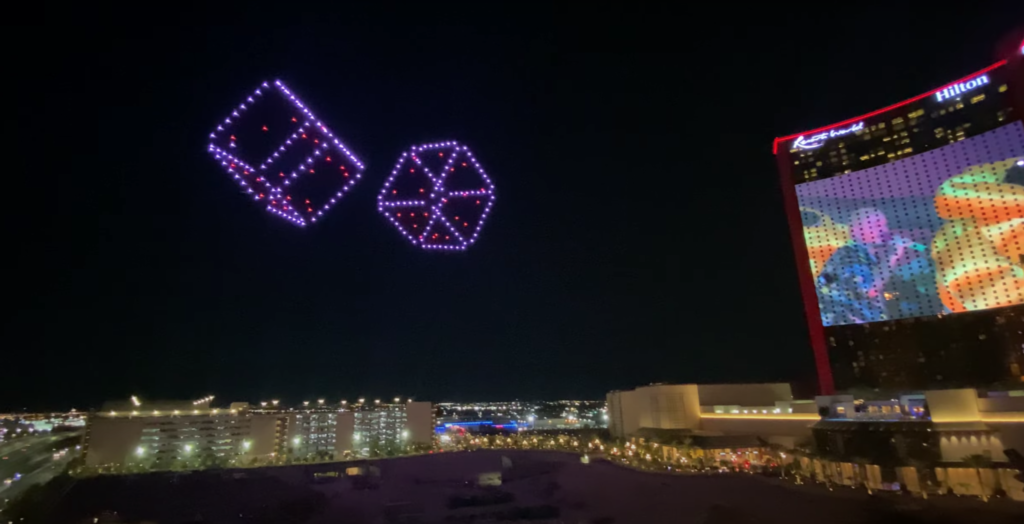
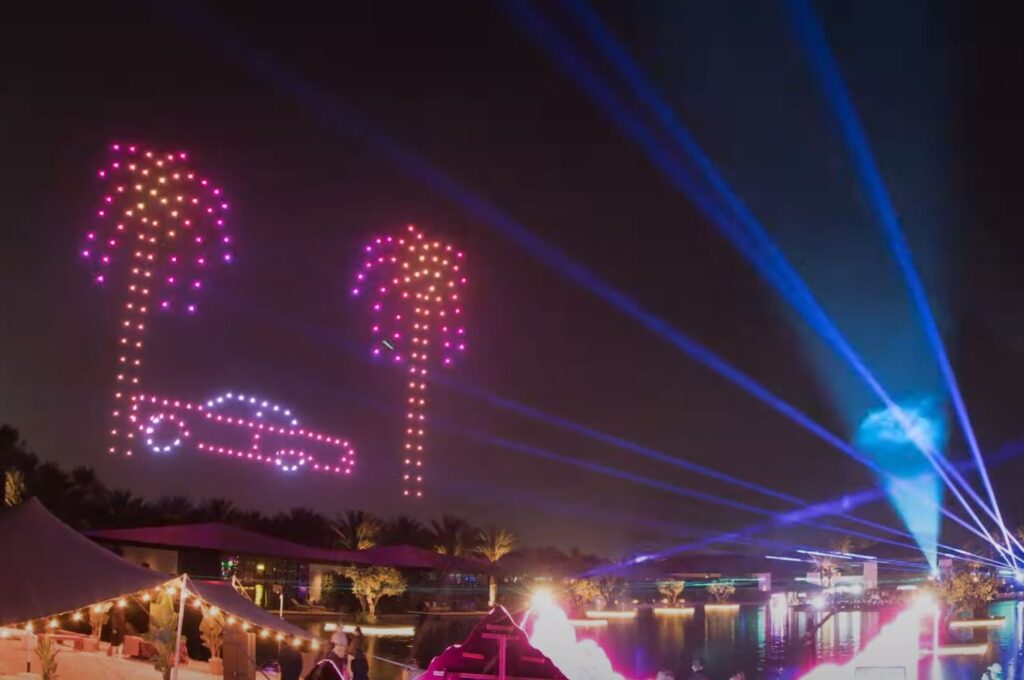
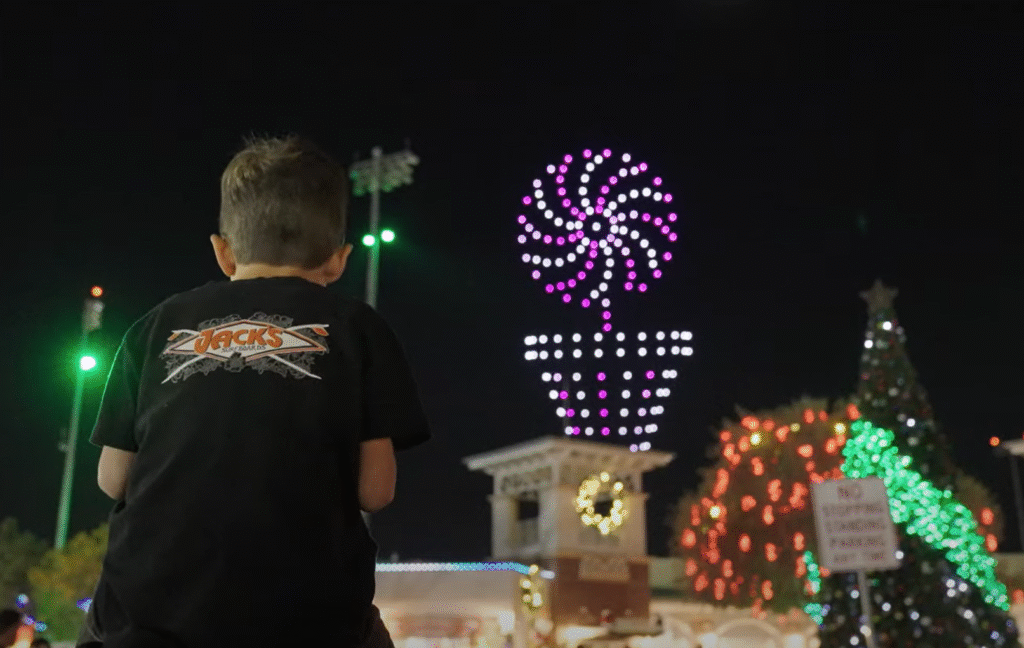
New York City airspace
The five boroughs are among the most restricted airspace in the country, between JFK, LaGuardia, Newark and heliport traffic. Shows are possible — we have flown Brooklyn — but they need lead time and the right site.
Upstate and the Hudson Valley
Village anniversaries, county fairs, waterfront festivals and resort events from Dutchess County to the Adirondacks and the Thousand Islands, where airspace is far more open.
Anniversaries and milestones
A drone show can write a town’s name, its founding year or its milestone in the sky, which is why New York communities book them for centennials and anniversaries.
Season
Late spring through autumn is peak, with village celebrations concentrated around July 4th and town anniversaries.
Drone Shows for New York Area Sports and Arena Events
No market in the country carries a heavier roster. Football splits between the Giants and the Jets across the river in New Jersey, basketball between the Knicks at Madison Square Garden and the Nets in Brooklyn, baseball between the Yankees and the Mets. Three hockey clubs operate within an hour of each other in the Rangers, the Islanders and the Devils. Soccer adds New York City FC and the Red Bulls, and the Liberty keep summer booked. Producers working this calendar use the sky for ring nights, draft parties, anniversary games and brand takeovers outside the gates.
Airspace here is tight and rooftops sit close, which is exactly why a pyrotechnic free program travels better: nothing burns, nothing drifts, nothing drops into a rail yard or onto a neighboring building. Crews are Part 107 certified under FAA rules, insured at the ten million dollar level for aviation liability, with a thousand plus shows behind them and fleet sizes running from seventy up past three hundred. Send details through our contact form and we will map the window around your schedule.
New York drone show FAQ
Can you fly in New York City?
In the right locations and with the right authorizations, yes. Send us the venue first and we will confirm.
Do you cover upstate?
Yes — the Hudson Valley, the Adirondacks, the Finger Lakes and western New York.
Can you spell out our anniversary in the sky?
Yes. Numbers, town names and logos are all straightforward at 200 drones or more.
Case study from this market
- Millerton, Dutchess County — 235 drones for the village’s 175th anniversary, flown alongside fireworks during a nine-day celebration
Book a New York drone show
Tell us your date, venue and audience and we will send a custom concept and exact pricing within 24 hours.
See also drone show rental · corporate drone shows & events · cost guide
Drone Light Shows Across New York
We fly drone light shows throughout New York. Explore the cities and venues we serve: