
Last Fourth of July, a midsized Colorado city cancelled its annual fireworks show for the third year running. Drought conditions, wildfire risk, and a growing list of noise complaints from residents and veterans groups made the decision unavoidable. But this time, instead of cancelling the celebration altogether, the city booked a 300-drone light show — and the response was overwhelming. Families packed the park. Local news ran it as the lead story. Social media lit up with footage of the town’s logo floating above the treeline while a synchronized soundtrack played across the field. No smoke. No debris. No fire trucks on standby. And the city council started getting calls the next morning asking when they could do it again.
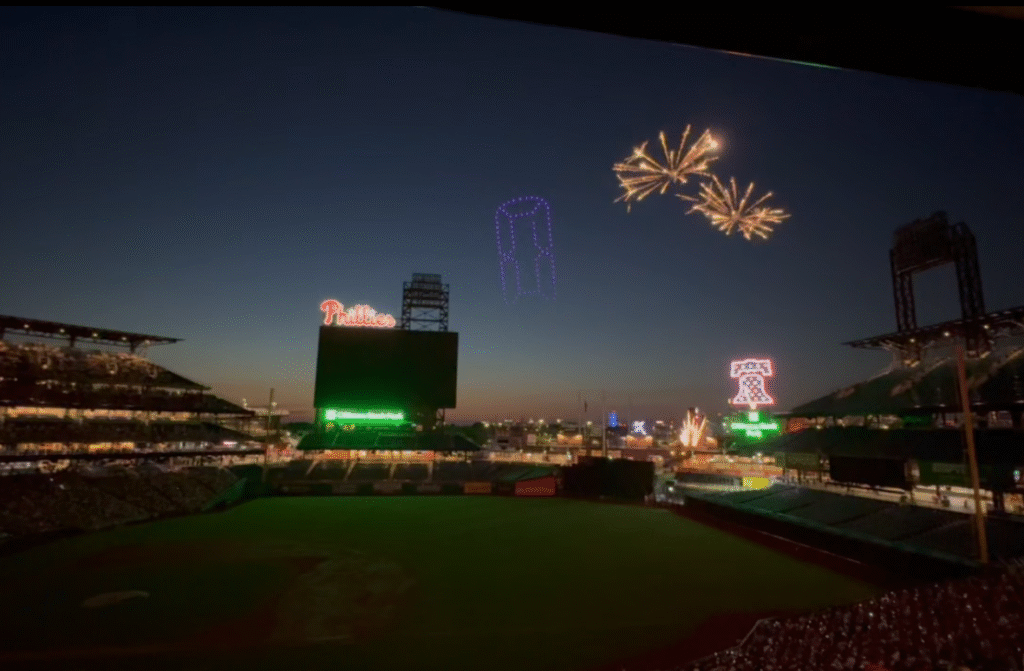
Why Cities Are Having This Conversation Right Now
The shift from fireworks to drones isn’t hypothetical — it’s happening across the country. According to the American Pyrotechnics Association, fireworks-related fires cause an estimated $105 million in property damage annually. Dozens of states now restrict or ban consumer fireworks, and municipalities in wildfire-prone regions face increasing pressure to find alternatives for public celebrations.
At the same time, the drone light show industry is growing at over 16% annually. What was once a novelty reserved for Olympic ceremonies and Super Bowl halftime shows is now accessible to cities and counties of all sizes. The technology has matured, costs have come down, and the creative possibilities have exploded — which is why parks departments, event commissions, and city councils are evaluating drone shows as a permanent replacement, not just a one-year experiment.
Cost: How the Numbers Actually Compare
This is where most decision-makers start, and the honest answer is that the two are closer than most people think.
A professional fireworks display for a municipal event typically runs $10,000 to $50,000 depending on duration, shell size, and choreography. A comparable drone light show — meaning one that delivers the same audience impact and duration — falls in a similar range:
- 50–100 drones: $10,000 – $20,000. Clean formations, custom text, and branded imagery. Ideal for smaller community events or as a complement to an existing celebration.
- 100–300 drones: $12,500 – $50,000. This is where most city celebrations land. Detailed logos, multi-scene storytelling, and the kind of visually rich performance that generates local news coverage and packed social media feeds.
- 300–700 drones: $45,000 – $125,000. Major municipal celebrations, county fairs, and marquee events. Enough resolution for photorealistic imagery and complex animated sequences that rival any fireworks grand finale — and last significantly longer.
- 700–2,000 drones: $125,000 – $250,000. Landmark celebrations like centennials, semi-quincentennials, and state-level events. These are headline-making spectacles designed for maximum media reach.
- 2,000–5,000 drones: Custom quote. World-class productions for the biggest stages. Very few companies in the U.S. have the fleet capacity to operate at this scale.
The key difference isn’t just the sticker price — it’s the value per dollar. A fireworks show gives you bursts and colors. A drone show gives you your city seal, a countdown to midnight, a veteran salute animation, a tribute to a local landmark, sponsor logos, and a standing ovation — all in one performance. For events with sponsors, the ability to display branded content often offsets a significant portion of the cost through sponsorship revenue that fireworks simply can’t generate.
Safety and Environmental Impact
This is where the comparison gets decisive — and it’s the primary reason municipalities are making the switch.
Fire risk. Fireworks are, by definition, controlled explosions that send burning debris across a wide area. In drought conditions, a single errant shell can start a wildfire. Drones produce zero sparks, zero debris, and zero fire risk. Period. For any city in a fire-prone region, this alone changes the calculus.
Chemical fallout. Fireworks deposit heavy metals — barium, strontium, copper compounds — and perchlorate (a thyroid-disrupting chemical) across the launch area and surrounding environment. Studies have shown measurable spikes in air and water pollution after fireworks events. Drones are electric, battery-powered, and produce no emissions or chemical residue.
Noise. A professional fireworks display generates sound levels between 150 and 175 decibels at the launch site — louder than a jet engine. This causes documented distress to veterans with PTSD, pets (animal shelters report their highest intake volumes the week after the Fourth of July), wildlife, and residents with sensory sensitivities. Drone shows are effectively silent. The only sound the audience hears is the music you choose to play.
Physical safety. Our Damoda V4 drones weigh just 2 pounds each and are equipped with parachute recovery systems, GPS-fenced flight boundaries, automatic return-to-home, and fail-safe landing. We carry $5 million in aviation and umbrella insurance. Compare that to the U.S. Consumer Product Safety Commission’s data showing approximately 10,000 fireworks-related injuries treated in emergency rooms every year.
Creative Flexibility: What Drones Can Do That Fireworks Can’t
Fireworks offer color, pattern, and spectacle — and they do it well. But they can’t tell a story. Drones can.
Every drone show is 100% custom-designed. A municipal Fourth of July show might feature the American flag waving in three dimensions, transition to the city seal, spell out “Happy 4th” across the sky, render a tribute to local first responders, and finish with a patriotic eagle that dissolves into a cascade of red, white, and blue. All synchronized to a live soundtrack broadcast over FM radio so every person in the park hears the same music matched to every movement overhead.
For cities, this creative control opens doors that fireworks never could:
- Community storytelling: Celebrate your city’s history, honor local heroes, showcase landmarks, or commemorate milestones with visuals that actually depict what you’re celebrating — not just generic bursts of color.
- Sponsor integration: Display sponsor logos and messages as part of the show. This creates real sponsorship value that helps offset event costs — something you can’t sell with fireworks.
- Reusability and rescheduling: Fireworks are single-use. If weather cancels your show, that inventory is gone. Drones fly hundreds of shows. A weather delay means you reschedule at minimal additional cost.
- Venue flexibility: Drones can fly over water, parks, stadiums, and downtown areas where fireworks would be prohibited. The safety perimeter is significantly smaller, meaning you can use venues that were never viable for pyrotechnics.
What Municipal Buyers Need to Know About Logistics
If you’re evaluating a drone show for your city or county event, here are the practical details that matter for procurement and planning.
FAA permitting. Every drone show in the U.S. requires an FAA waiver under Part 107. A reputable company handles this entirely — airspace analysis, safety documentation, waiver applications, and NOTAM filings. The process takes 90+ days, which is why booking early is critical. If your event is in the summer, start the conversation in the winter.
Site requirements. You need a launch area roughly the size of a basketball court to a football field depending on drone count, with a safety perimeter around it. The audience viewing area should be 200+ feet from the launch grid. Our team conducts site surveys and coordinates with local authorities, fire departments, and airport control towers as needed.
Insurance and compliance. Ask any vendor about their insurance coverage. We carry $5 million in aviation and umbrella coverage. All of our pilots hold FAA Part 107 Remote Pilot Certificates, and we operate under multi-UAS waivers (14 CFR 107.35) and night operations waivers (14 CFR 107.29). We’ve completed over 900 shows without a safety incident.
Timeline. For a smooth process, plan on 4-6 months lead time. That gives adequate runway for creative development, FAA authorization, sponsor coordination, and venue planning. Rush bookings under 90 days are sometimes possible but carry premium pricing and reduced flexibility.
The Verdict: Which One Should You Choose?
Fireworks still have a place. They’re familiar, they’re visceral, and for some communities, the tradition itself carries cultural value. We respect that.
But if your city is dealing with wildfire restrictions, noise complaints, environmental concerns, ADA accessibility considerations, or simply wants to offer something new that generates excitement and community pride — a drone light show isn’t just an alternative. It’s an upgrade.
The cities that have made the switch aren’t going back. They’re booking annual packages, integrating drones into multiple events throughout the year, and discovering that the format attracts larger crowds, more sponsors, and more positive coverage than fireworks ever did.
See What’s Possible for Your Community
We work with cities and counties across the country to design shows that fit their budget, their venue, and their story. Whether it’s a 100-drone Fourth of July celebration or a 1,000-drone centennial spectacular, our team handles every detail — creative design, FAA permitting, music synchronization, crew, and execution.
Request a free municipal consultation: hireuavpro.com/contact | graham@hireuavpro.com | (630) 800-0400