
Detroit Drone Light Shows
Detroit’s riverfront stretches along the Detroit River like a blank canvas at night. The city’s industrial history created open spaces, cleared sightlines, and an architectural vocabulary of bridges, tall structures, and distinct neighborhoods that feel distinct from one another. When dusk falls over downtown Detroit or Corktown, when the Ambassador Bridge lights up and Windsor’s towers glow across the water, that’s the moment a drone light show claims the sky. Detroit’s automotive and manufacturing heritage means the city understands scale, precision, and coordinated production. That same sensibility applies to large-scale drone operations.
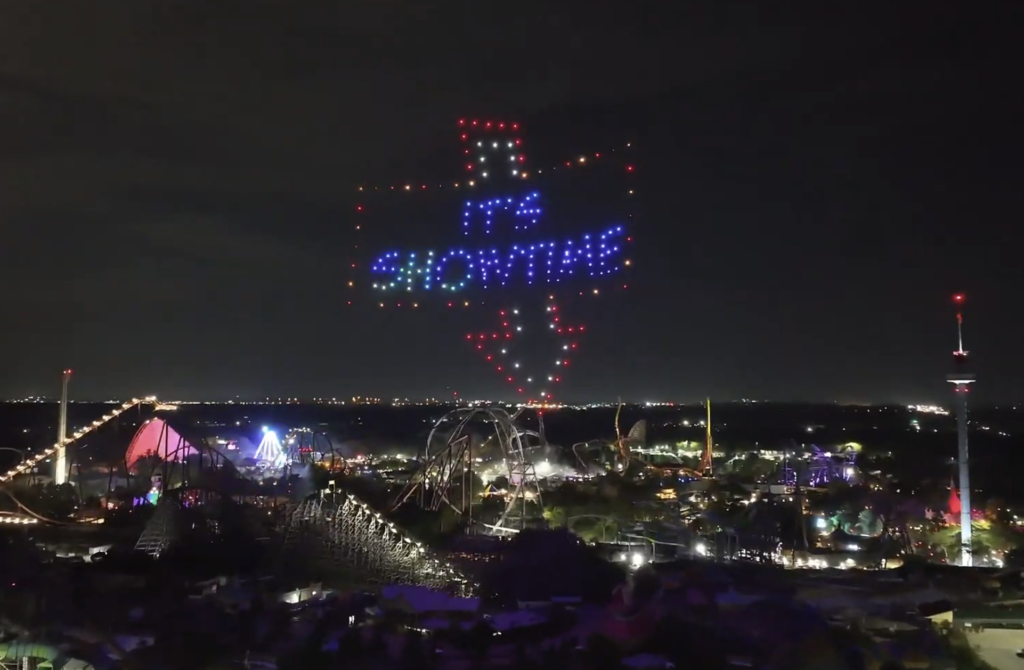
Detroit Drone Shows for Game Day and Stadium Programming
Detroit put its franchises inside a single walkable district, which few cities managed. The Lions play football downtown, the Tigers run baseball across the street, and the Pistons and the Red Wings share the arena a block north. That arrangement lets one aerial program serve a venue, a plaza and the surrounding bar and restaurant corridor at once. Marketing groups here build around home openers, rivalry weekends, playoff runs and the outdoor activations that fill Woodward Avenue before a gate opens on a cold evening.
A show with no pyrotechnics suits the setting. Crowds gather in narrow streets between tall buildings, the riverfront sits close, and nobody wants embers or debris landing on either. Pilot in command duties fall to Part 107 holders under FAA rules, the policy behind us runs to ten million dollars of aviation liability, our log clears one thousand completed performances, and a fleet can be built at seventy drones or stretched past three hundred. Contact us through the form on this site to begin planning your date.
More Drone Light Shows in Michigan
We fly across Michigan. See all Michigan drone light shows, or a nearby city or venue:
Grand Rapids · Holland · Lansing · Mackinac Island · Marquette · Michigan State · Milwaukee · Silver Beach · Sleeping Bear Dunes · Traverse City · University Of Michigan · Ann Arbor
Detroit Airspace, Measured Site by Site
Detroit is a better drone show city than its aviation density suggests, and there is one complication nobody else writes about.
We queried the FAA’s UAS Facility Map feature service directly at the coordinates of every venue below, against the current map effective date.
The downtown venues are uncontrolled surface airspace
Hart Plaza. Comerica Park. Ford Field. Belle Isle.
All four return no UAS Facility Map grid cell at all.
We widened the query envelope to confirm that is a genuine gap rather than missing data. Detroit City Airport does carry a Class D grid — 68 cells in the band we sampled, with ceilings at 400, 300, 100 and zero feet — but those cells begin just north of the central business district, with the nearest samples sitting well above the riverfront. The core downtown event sites fall outside them entirely.
The practical result: for a 400-foot show at Hart Plaza, Comerica Park, Ford Field or Belle Isle, there is no LAANC request on the critical path. No authorization step, no app, no federal coordination window. Federal airspace is not what gates a downtown Detroit show.
That is worth putting in context. Nearly a quarter of the mapped grid over New York City carries a zero-foot ceiling. Almost half of Newark’s does. Cleveland’s own lakefront sits at zero because Burke Lakefront Airport is right there on the water. Detroit has none of those problems at its marquee venues.
Belle Isle deserves specific mention. It is a 982-acre island park in the Detroit River with no grid cell, water on every side, and skyline sightlines back toward downtown. On airspace and geometry together it is one of the strongest large-audience show sites in the state.
The complication: Hart Plaza sits on an international border
This is the Detroit-specific fact most likely to be missed, and it is not on the chart you would naturally check.
Hart Plaza is on the international boundary with Windsor, Ontario. Canadian airspace and Transport Canada’s rules begin mid-river.
The FAA’s UAS Facility Map maps United States airspace. A clean “no grid cell” result at Hart Plaza is therefore an accurate statement about the American side of the river and says nothing whatsoever about the Canadian side. An operator who reads “no grid” and quotes you a show with a 1,500-foot lateral spread over open water has quoted you something that may cross a national border.
A Hart Plaza show is entirely workable. It is a show with a hard lateral limit mid-channel, and the flight geometry, the geofence and the return-to-home logic all have to be built around a boundary that does not appear on the facility map. That is a design constraint rather than a prohibition — and it is exactly the kind of thing we want settled in the first conversation rather than during setup on the day.
The same consideration applies to any show staged on the riverfront between the Ambassador Bridge and Belle Isle. The further upriver or inland you move, the more lateral room you have to work with.
Stadium restrictions
A standing FAA restriction applies to stadiums seating 30,000 or more during MLB, NFL and NCAA Division I football, from an hour before the event. In the Detroit area that covers Ford Field and Comerica Park in their seasons, and Michigan Stadium in Ann Arbor — which sits at a 400-foot LAANC ceiling under Ann Arbor Municipal Class D and holds over 107,000 seats.
We check your date against the FAA’s Sporting Event Automated Monitoring System feed — the authoritative machine-readable source for active and scheduled windows — rather than reading a schedule and hoping. Outside those windows, stadium shows are routine, and a post-game show sits just outside the window by design, which is usually what a stadium client is actually asking for.
Standing security guidance
Standing FAA guidance advises operators to avoid loitering over power plants, dams, refineries, industrial complexes, military installations and correctional facilities. Along the Detroit and Rouge river industrial corridors that is a genuine planning input against specific sites rather than boilerplate, and we check the flight geometry against it rather than the venue’s street address.
Detroit Cannot Write Its Own Drone Ordinance
This is a real advantage of producing in Michigan, and it is the opposite of the situation at the other end of the Great Lakes.
MCL 259.305, from Michigan’s 2016 Unmanned Aircraft Systems Act, provides that a political subdivision “shall not enact or enforce an ordinance or resolution that regulates the ownership or operation of unmanned aircraft” unless a statute specifically allows it.
The critical detail is what is missing: there is no large-city carve-out. Detroit is bound by that preemption exactly as a township of four thousand people is.
Compare the neighbours. Illinois preempts local drone rules everywhere except Chicago, which runs its own municipal code provision. Ohio’s 2025 drone law grants localities additional authority over recreational drone use in parks and on local public property. New York City operates a full municipal takeoff-and-landing permit regime under its own Administrative Code, with a fee, an application window, dual insurance towers naming the City as additional insured, a data privacy policy, a cybersecurity policy, community board notification and physically posted notices.
Detroit has none of that.
Alongside the preemption, MCL 259.311 provides that persons FAA-authorized to operate commercially may do so in Michigan consistent with federal law, and MCL 259.320(2) provides that flying through navigable airspace in line with federal law does not by itself create state criminal liability.
The exceptions, stated honestly
They are narrow. A locality that already bans non-emergency motor vehicles may restrict flights that knowingly disrupt horses used in commercial activities — carriage rides and riding businesses — which is worth checking if your venue has carriage operations. Localities may set rules for drones they themselves operate. State natural resources law controls where it conflicts. And MCL 259.321 prohibits knowingly interfering with police, fire, EMS, search and rescue or corrections officers, which is simply good practice written as law.
What this means for your timeline
In Detroit, the questions that decide whether your show flies are federal airspace, the land manager’s permission, and the international border if you are on the river. Nothing else.
No municipal drone permit application. No researching whether city council passed something in 2023. No discovering in week nine that there is a local ordinance layer you did not budget for. That is a materially shorter and more predictable path than the same show would face in Chicago or New York, and it is one of the better-kept secrets about producing events in this city.
Fireworks, Drones and the Detroit Calendar
We are going to be straight about something that cuts against the usual drone show pitch in this city.
Michigan is the least restrictive of the Great Lakes states on consumer fireworks, and the fire-risk argument that lands in Colorado or California does not carry the same weight here. Saying otherwise would be selling you something untrue.
What the statute protects
Under MCL 28.457, localities generally may not regulate the sale, display, storage, transportation or distribution of regulated fireworks beyond what the Act allows. A local ordinance may regulate ignition, discharge and use of consumer fireworks — but it may not restrict them after 11 a.m. on a statutory list of protected days:
31 December until 1 a.m. on 1 January. The Saturday and Sunday before Memorial Day until 11:45 p.m. 29 June through 4 July until 11:45 p.m. each day. 5 July when it falls on a Friday or Saturday until 11:45 p.m. And the Saturday and Sunday before Labor Day until 11:45 p.m.
An ordinance under that provision must impose a civil fine of $1,000 per violation and no other sanction, with $500 of each fine going to the enforcing local law enforcement agency.
So Detroit cannot clear the sky for you between 29 June and 4 July. Six consecutive protected evenings, plus both long weekends and New Year’s Eve, and no city ordinance reaches them.
Why that is a scheduling input, not a problem
If your civic or corporate show falls in that window, there will be consumer fireworks going up around your venue until 11:45 p.m. whatever the city would prefer. For a drone show — which depends on a dark, uncluttered sky to read properly — that is a genuine coordination issue.
It is also why a number of Michigan communities have moved their civic event to 5 July or the Labor Day weekend. Not to dodge a rule, but to own the sky for the evening. If your date is flexible, that is the single most valuable scheduling conversation we can have with you.
The argument that actually holds in Detroit
Not fire. The arguments that hold here are noise, pets and service animals, veterans with blast sensitivity, air and water quality on the river and the lakes, debris on a shoreline or in a park, and the fact that a drone fleet is a programmable sponsorship asset rather than a fixed sequence of shells — it can render a logo, a product, a vehicle silhouette, an anniversary number or a message that reads clearly from a quarter mile away.
In a city whose signature industry is design and manufacturing, that last point is not a small one.
There is one fire-adjacent case that still holds, and it is venue-level: a no-open-flame policy, a drought restriction, a dry-grass advisory on a golf course or a venue’s own insurance condition prohibits combustion. A drone show has nothing to burn and remains available when a display does not.
Insurance
We carry $10 million in drone aviation liability. For regional scale: Ohio requires at least $1,000,000 in bond or insurance before issuing a fireworks exhibition permit, and Pennsylvania requires municipalities to demand the same from a display permittee. Our coverage is ten times those published floors, and because they are written into statute it is a comparison you can verify rather than a claim you have to take on trust.
The Detroit Market That Already Exists
Ford Fireworks is the region’s flagship — flown over the Detroit River at Hart Plaza in late June, now past its 65th annual edition, with the City publishing full street closure, parking and transportation plans around it.
It remains a pyrotechnic show. It is also, straightforwardly, the largest drone show opportunity in Michigan.
An event with 65 years of audience expectation behind it does not switch technologies in one season, and it should not be asked to. The realistic route for something of that age and scale is the additive model: drones as a distinct earlier moment with its own identity, fireworks keeping their slot. That is exactly how Ohio’s flagship did it — Red, White & BOOM! in Columbus added 216 drones at 10 p.m. as an opening act in front of a 400,000-plus crowd and kept the pyrotechnics, funded by a presenting sponsor. Two or three years of that is usually what makes a full conversion a conversation the audience is asking for rather than one the committee has to defend.
Michigan has already converted an event, and it was in winter
Silver Bells in the City in Lansing replaced its fireworks with a 100-drone show at the downtown holiday celebration.
That precedent is useful for two reasons most people miss. It was a winter show, which is a season a lot of operators quietly avoid. And it was a full replacement rather than an addition, at a mid-size civic event, on a mid-size fleet.
If you are a Michigan committee wondering whether a hundred drones can carry an evening, Lansing is the answer. You do not need four figures of aircraft to hold a downtown crowd.
An honest word on the competition
The Lansing show was flown by Firefly Drone Shows, which is based in the Detroit area. There is a capable Michigan-based operator in this market, and we would rather tell you that up front than let you discover it in a procurement meeting.
What we would ask you to compare is not the drone count, and not whose truck is closer. It is whether the proposal in front of you tells you the grid ceiling at your actual coordinates, the stadium restriction windows against your actual date, the authorization timeline that follows from both, the international boundary if you are on the river, and the liability limit standing behind the whole thing.
Everything on this page is the output of that work. If a competing proposal shows the same analysis, you have two good options and you should pick on price and chemistry. If it does not, that gap is the question to ask.
The Questions Detroit Producers Actually Ask
Do we need FAA authorization for a show on the riverfront?
At the main venues, no. Hart Plaza, Comerica Park, Ford Field and Belle Isle all return no UAS Facility Map grid cell — Detroit City Airport’s Class D cells begin north of the central business district and these sites fall outside them. For a 400-foot show there is no LAANC request on the critical path.
So what is the catch at Hart Plaza?
The border. Hart Plaza sits on the international boundary with Windsor, and Canadian airspace and Transport Canada’s rules begin mid-river. The FAA’s facility map covers United States airspace only, so a clean “no grid” result there describes the American side and says nothing about the Canadian side.
A Hart Plaza show has a hard lateral limit mid-channel. The flight geometry, the geofence and the return-to-home logic all have to be built around a boundary that is not drawn on the map most people check. It is a design constraint rather than a prohibition, and it is the first thing we would want to settle with you.
Does the City of Detroit require a drone permit?
No. Michigan law bars political subdivisions from enacting or enforcing ordinances that regulate the ownership or operation of unmanned aircraft, and there is no large-city exception — Detroit is bound by that preemption like anywhere else in the state. What you do need is FAA authorization where the airspace requires it, the landowner’s permission, and whatever event permit the venue itself runs. For contrast, Chicago is carved out of Illinois’s preemption and runs its own municipal rule, and New York City operates a full permit regime with its own fee, insurance and public notice requirements.
Which Detroit venue would you actually recommend?
For a large audience, Belle Isle — a 982-acre island park with no grid cell, water on every side, and skyline sightlines back toward downtown. It gives you lateral room that the Hart Plaza border constraint does not, and the geometry is genuinely better for a fleet. Hart Plaza remains the right answer when the riverfront and the Windsor skyline are the point of the show, and we will design to the mid-channel limit.
When should we schedule?
Late summer and early autumn are the most reliable evenings in the Great Lakes region, and the spring shoulder — March and April — is consistently the windiest part of the year and the one to price defensively or avoid.
But in Detroit the bigger scheduling input is the fireworks calendar, not the weather. If your event falls 29 June through 4 July, consumer fireworks will be going up around your venue until 11:45 p.m. and no city ordinance can stop them. A drone show needs a dark, uncluttered sky to read properly. If your date has any flexibility, 5 July or the Labor Day weekend is worth real consideration.
Can you fly in winter?
Yes, and Michigan has already proved the market: Lansing’s Silver Bells replaced its fireworks with a 100-drone show at a downtown holiday celebration. Cold shortens battery endurance and we plan fleet sizing and segment length around it. The larger winter variable on the lakes is wind, not temperature.
Will heat or altitude affect the show?
No — Detroit is one of the best markets in the country for multirotor performance. Static propeller thrust scales roughly with air density, so what matters is density altitude. Detroit sits at about 630 feet field elevation and a July evening show here operates at roughly 1,670 feet density altitude — the lowest of the major Midwest metros.
The same show at our own base in Arvada, Colorado flies at about 7,500 feet on a July evening; Phoenix at about 3,700. Part of the reason Detroit does so well is the diurnal swing: July overnight minima here run in the mid-sixties, so the evening cooling actually arrives. In Phoenix, July minima sit in the mid-eighties and that relief never comes.
Practically: your fleet size in Detroit is set by what the choreography needs to read at your audience’s viewing distance, and by nothing else.
Can we fly over Ford Field or Comerica Park?
Not during a covered game. A standing FAA restriction closes the airspace around stadiums seating 30,000 or more during NFL, MLB and NCAA Division I football, from an hour before the event. We check your date against the FAA’s own Sporting Event Automated Monitoring System feed rather than a published schedule. Outside the windows a stadium show is routine, and a post-game show sits just outside the window by design — which is usually what a stadium client wants.
How many drones do we need?
It depends on viewing distance and what you want the audience to read, not on a package tier. For regional reference: Lansing carried a full civic holiday evening on 100 drones, and Ohio’s flagship Independence Day event flew 216 in front of 400,000-plus people. A Belle Isle show seen from multiple shorelines is a larger number than a plaza show seen along one axis. More drones means more resolution in the imagery rather than simply more lights, and we size to the geometry.
Should we replace our fireworks or add to them?
Both are legitimate and we will build either. For a long-established event with decades of audience expectation — Ford Fireworks being the obvious case — the additive model is the lower-risk route, and it is the one Ohio’s flagship used successfully at scale. For a mid-size civic celebration, full replacement already has a Michigan precedent in Lansing. The question is really about your audience’s expectations and your sponsor structure, and a drone fleet is a far better sponsorship asset than a shell burst because it can actually render a brand.
Why hire a Colorado company for a Detroit show?
Because what you are buying is the analysis on this page plus the aircraft and crew to execute it. That the downtown venues have no grid cell while the Class D cells begin just to the north; that Hart Plaza has an international boundary mid-river that the FAA’s map does not show; that Belle Isle gives you lateral room Hart Plaza does not; that Michigan’s drone preemption has no big-city exception while Illinois’s does; that your late-June sky is statutorily protected for everyone else’s fireworks — that is work we do because it decides whether a show flies and on which date. We fly nationally, we carry $10 million in drone aviation liability, and we would rather tell you a venue or a date is wrong in the first conversation than in week eleven.
Detroit’s Geographic and Industrial Context
Detroit is geographically unique among major US cities. The river runs north-south through it—a geographic dividing line that creates natural audience zones and viewing corridors. A show launched from the downtown riverfront, Hart Plaza, or the Dequindre Cut has the water as both a staging element and a reflective surface. Wind patterns off the Great Lakes system are consistent and measurable; we can account for them precisely.
The city’s manufacturing and automotive legacy is relevant. Detroit understands production logistics, coordinated operations, and quality-control at scale. When we present a multi-drone operation, we’re not selling a novelty—we’re offering a technology that Detroit’s audience already grasps conceptually. Precision, synchronization, safety systems—these are ideas the city’s business community thinks about daily.
Detroit’s comeback narrative attracts national attention. Restaurants, galleries, tech startups, and real estate developments in Corktown, Midtown, and downtown are remaking the city’s image. Events that support this narrative—that signal investment, creativity, and forward momentum—resonate. A drone show becomes part of that story: Detroit hosting something sophisticated, technically impressive, and culturally significant.
For a full breakdown of everything drone light shows, visit our comprehensive drone light show guide page
Types of Detroit Events Ideal for Drone Shows
Auto industry and corporate showcases: Detroit remains an automotive and manufacturing hub. OEMs, suppliers, and tech companies use events to showcase innovation. A 600-drone show choreographed around vehicle launches, autonomous systems concepts, or industrial themes speaks to Detroit’s core identity. We can integrate brand colors, motion patterns, and thematic elements that align with your corporate narrative.
Riverfront celebrations and civic events: Hart Plaza, the Dequindre Cut, and Rivard Plaza host major annual events: Nuit Blanche, Detroit Electronic Music Festival, holiday celebrations, and civic commemorations. A drone show over the riverfront during one of these events becomes a signature moment. The river itself frames the show, creating reflected imagery that amplifies visual impact.
Downtown revitalization and real estate launches: New residential developments, hotel openings, and renovated historic buildings use signature events to generate buzz and media coverage. A drone show announcing the opening of a landmark building or major public space becomes the story that drives traffic and attention.
Music and cultural events: Detroit’s music history—techno, Motown, contemporary acts—provides a thematic foundation. Festival organizers and music promoters can integrate a drone show as a climactic moment, synchronized to a final performer or a cultural narrative the event celebrates.
Detroit Drone Show Pricing
We offer shows ranging from 100 to 5,000 drones, with pricing starting as low as $8,500. The final cost depends on drone count, animation complexity, location, and timing. Our team will put together a transparent, all-inclusive quote based on your event’s specific needs.
Pricing includes creative design consultation, drone customization, crew deployment, all safety and insurance protocols, FAA airspace coordination, and complete site logistics. Detroit’s established event infrastructure and riverfront venues can streamline certain permitting steps compared to less experienced jurisdictions.
Executing a Show in Detroit
Detroit’s airspace requires coordination with Coleman A. Young International Airport (formerly Detroit City Airport). We handle that conversation and all necessary FAA authorizations. Our Part 107 certifications, multi-UAS waivers, and night operations authorizations cover the full scope of what you need to execute.
Site selection is critical in Detroit. A show above Hart Plaza benefits from the surrounding pedestrian infrastructure and established crowd management. A show over Rivard Plaza uses the riverfront as a visual anchor. A downtown or Corktown rooftop launch offers different advantages and constraints. We visit the proposed location, assess wind behavior specific to nearby tall structures, evaluate sight lines from intended audience zones, and build the operational plan around those variables.
Weather is a consideration in Michigan. Rain, wind, and cloud cover can constrain show windows. We monitor conditions in real-time and maintain flexibility around launch timing. Our Damoda V4 drones are rated for up to 20 mph sustained wind; the show window might be 30–45 minutes within a broader evening, but we’ve executed this trade-off hundreds of times.
Our fleet carries 2,200+ lumens RGBW LEDs per unit with individual color addressability. That precision allows choreography at scale—hundreds of drones moving in synchronized patterns, colors shifting in response to music or narrative, formations that build and dissolve across the sky. Every drone maintains GPS-fenced boundaries, real-time telemetry, and autonomous fail-safe systems.
Our Fleet: Two Systems Built for Every Event
We operate two professional drone platforms, giving you the flexibility to match your event’s scale and budget.
The Kaiken is our lightweight, durable, and cost-effective system — built for events that want professional quality at an accessible price point. It’s reliable, proven, and delivers clean formations and vivid color across the night sky.
The Damoda V4 is our premium platform — powerful, bright at 2,200+ lumens RGBW, and equipped with cutting-edge safety features including parachute recovery, GPS-fenced flight boundaries, automatic return-to-home, and fail-safe landing. The Damoda V4 also comes with a free second launch the same night, giving your audience up to 20 minutes of aerial entertainment across two performances.
Both systems are operated by FAA Part 107 certified pilots under multi-UAS and night operations waivers, backed by $10 million in aviation and umbrella insurance.
Transform Your Detroit Moment
Detroit’s identity is rooted in precision, scale, and the ability to execute complex operations. A drone light show carries that same DNA: technical excellence, coordinated timing, safety-first design, and a scale that commands attention. Whether your event is a corporate milestone, a civic celebration, or a cultural moment, a drone show in Detroit becomes part of the city’s larger comeback narrative.
Start with a conversation about your event, your venue, and your creative vision. We’ll assess the specific location, understand the audience and the moment, and design something that only makes sense in Detroit—precise, impressive, and unforgettable.
Ready to get started? Book a drone show and our team will put together a custom proposal within 48 hours.
Hire UAV Pro is a drone light show company flying shows across Detroit and the rest of the United States.